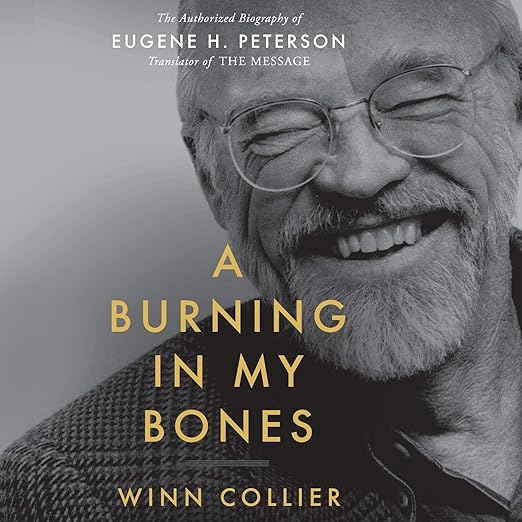
I came to A Burning in My Bones knowing Eugene Peterson's name primarily through The Message, his translation of the Bible into contemporary American idiom that proved as controversial among traditionalists as it was beloved by new readers. I had not thought much about the person behind that project. Winn Collier's authorized biography corrected that oversight with more force than I expected. I finished it on a weekday evening feeling, as one reviewer describes it, a wish that I had paid closer attention to Peterson while he was still alive.
Collier was given exclusive access to Peterson and his materials, and his friendship with both Eugene and his wife Jan gives the biography an intimacy that distinguishes it from more distant authorized works. The life it portrays is, on the surface, quiet. Peterson served as a pastor in a suburb north of Baltimore for most of his career, resisted the celebrity Christian circuit that would have amplified his influence, and spent decades translating scripture in a way his local congregation could actually understand. The biography makes the case that these apparently small choices were deeply countercultural acts.
What We Made of It
The title comes from Collier's description of Peterson's spiritual disposition: a constant, ferocious hunger for God that expressed itself not in spectacular ministry but in sustained, unglamorous faithfulness. That quality is what the biography captures most successfully. Collier does not smooth over Peterson's struggles as a pastor, husband, and father, and the result is a portrait that holds together integrity and struggle without collapsing into either hagiography or exposé. The sections on The Message are particularly illuminating. Peterson's original motivation was specifically local: he wanted to make scripture accessible to his congregation using the language of their actual daily lives, not the language of formal religious English. What became an international publishing phenomenon began as a pastoral act of service to a specific community in a suburb north of Baltimore that no one outside that suburb had heard of. That origin story is more interesting than the celebrity translation narrative that surrounds The Message in popular consciousness.
Why Listen to A Burning in My Bones
Richard Poe's narration is the right fit for this material. He reads with a measured pace that suits the biographical subject and does not hurry through sections that require contemplative space. At just under ten hours, the audiobook is appropriately sized for the scope of the life it covers. One reviewer notes that the book stirred the fires of the heart after retirement from ministry, which speaks to how specifically it will resonate with listeners who have experience in pastoral or church community contexts. But the biography is accessible to secular listeners as well. Peterson's preoccupations with language, vocation, and the discipline of sustained attention to a single place and community are concerns that extend beyond specifically religious experience and into broader questions about how to build a meaningful life against institutional pressure.
What Might Not Land
The biography's treatment of Peterson's later years and his complicated relationship with the church's drift toward celebrity culture is among its most charged sections. A reviewer who had retired from ministry describes the western church as rife with hateful reaction to quiet faithfulness, which gives some sense of the emotional register this material can provoke in readers who have lived similar tensions. Listeners who are primarily interested in the mechanics of Bible translation, the specific choices Peterson made in rendering the Greek and Hebrew texts, will find that material present but not dominant. The biography is fundamentally about the person and the vocation rather than the textual scholarship. Collier writes with evident affection for his subject but does not suppress the complexity, including Peterson's own admission that the higher one rises in public attention, the more one becomes a target.
Should You Listen to A Burning in My Bones?
Readers who have encountered The Message and wondered about the theology and biography behind it will find this essential. Listeners interested in vocational biography generally, in how a person sustains a singular commitment over a lifetime, will find the material compelling regardless of their religious background. Those who have read Peterson's own works, including A Long Obedience in the Same Direction, will come to the biography with the right foundation. Listeners looking for a fast-paced biography or one with dramatic external events should note that Peterson's life was deliberately uneventful in the conventional sense, and the book's power lies precisely in making that choice feel significant.
- Voice: Richard Poe brings contemplative gravity to Winn Collier's biography, sustaining the meditative pace that Eugene Peterson's life story demands.
- Big ideas: Vocation as lifelong practice, the counter-cultural act of slow faithfulness, language as spiritual discipline
- Atmosphere: Quiet and reverent, occasionally elegiac, with an undertow of genuine grit
- Worth it?: The authorized biography Peterson deserved, written with access and intimacy, and a corrective to the celebrity Christianity that Peterson himself resisted.