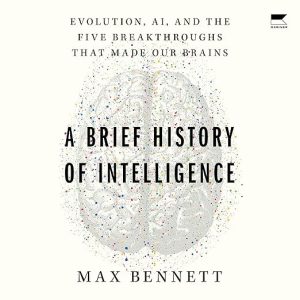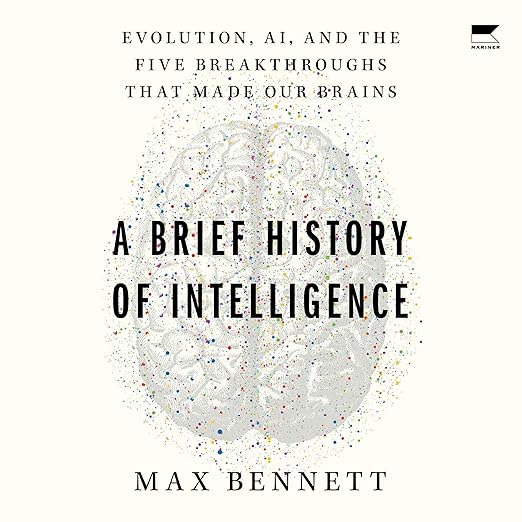
An AI can beat a grandmaster at chess and still cannot load a dishwasher. Max Bennett puts that gap at the center of a twelve-hour audiobook, and his answer is not a software problem but a billion-year one: the brain arrived where it is through five distinct evolutionary breakthroughs, and machine intelligence has skipped most of them. George Newbern narrates. The publisher's shelf comparisons, Sapiens and Behave and Superintelligence, are ambitious to the point of recklessness, and the surprising thing is how nearly the book earns them. A supplemental PDF ships alongside the audio, and it turns out to matter.
Bennett's Five Breakthroughs Make Neuroscience a Listen
The five-breakthrough scheme is what makes this work as a listen rather than a slog. Each leap gets its own stretch of the book, and each carries a specific cognitive capacity, so the reader is never asked to hold an undifferentiated mass of neuroscience in mind. One reviewer, R. Michaels, described it as a "Well researched and well written explanation of the 600 million year evolution of brains" whose chapters are organized around those five stages, and added that most of the five stages had been new information. That reaction looks typical of the pool. The framework is the book's contribution as much as any individual finding inside it.
Bennett's credibility comes from an unusual pairing, and it is worth understanding before you commit twelve hours. He works in applied artificial intelligence rather than in a neuroscience department, and the book was built, per the publisher, with support from researchers in the field. Steven Miller, who reviewed it from Singapore, thought that combination was the point, writing that Bennett "has very seriously educated himself about neuroscience" and that his background gives him "a very insightful way to make linkages between the development of machine intelligence (AI) and animal/human intelligence". An outsider who did the reading is often better at synthesis than an insider defending a subfield.
What I found most impressive is the discipline of the synthesis. A. Menon called the book "an aggregation of results from neuroscience and computer science in a synthesis attempting to frame how brain functioning has evolved", which is precise, and placed it in the must read category for anyone curious about either field. Don was blunter about the achievement that matters most in a book this technical, noting that "this deeply science-grounded book is also thoroughly readable". Both are right. Bennett resists the two failure modes of the genre, neither dumbing the science into metaphor nor showing his working at the expense of the argument.
Chapter Summaries Work as a Listening Handrail
An enumerated framework is the friendliest possible structure for audio, and this one is built on scaffolding a listener can actually hold. What it asks of a reader is signposting rather than expression: five numbered stages, dozens of species, a long chain of neural mechanisms, and a listener who needs to know at every moment which breakthrough they are inside. R. Michaels noted that "Each chapter had a very useful summary", plus a recap of the whole argument at the end, and those summaries are the handrail. Anyone who has abandoned a long science title halfway will recognize how much difference that makes.
Do not treat the PDF as optional. Steven Miller's review praises the illustrations alongside the writing, which tells you the diagrams in the print edition carry real explanatory weight, and the publisher supplies a supplemental enhancement file with the audio for exactly that reason. Evolutionary trees, brain-region maps and comparative diagrams are hard to hold in the ear. Open the file on a phone or tablet at the start of each breakthrough and the listening experience changes. Skip it and you will follow the argument, but you will be reconstructing pictures somebody has already drawn for you. Twelve hours is long enough that the file pays for the interruption: pausing once per breakthrough to look at a diagram costs a minute and saves a chapter of quiet confusion.
AI Chapters Age Faster Than the Neuroscience
The AI half is aging faster than the biology half, and the reviews already show it. R. Michaels, writing in early 2026, named as "The only annoying part" the section where Bennett discusses the limitations of ChatGPT-3, and the sentence breaks off on the listing before the thought is finished. The point stands regardless. A book published in October 2023 anchors its machine-learning examples to a moment that has since moved considerably, while its account of six hundred million years of brain evolution has not moved at all. I would read the neuroscience as durable and the model comparisons as a snapshot of late 2023.
Density is the other consideration. The reviewer dubuqueguy offered the sharpest practical advice in the pool: "It would be best not to read this book alone. This book needs the context of a book club's discussion." That is a compliment about substance and a warning about solitary listening, and at twelve hours and seventeen minutes it deserves attention. One oddity on the listing to note: the rating counter shows a single rating behind a 4.7 average, while five substantial written responses sit beside it. The written responses, several of them long and analytical, are a far better guide here than the number.
Five Stages Build Toward a Contestable Thesis
People working in or near machine learning who want a serious argument about what current systems lack should start here, because the book supplies a specific, testable account rather than the usual gestures at consciousness. Readers arriving from popular evolutionary science will find familiar terrain treated with more rigor than the genre average, and the neuroscience is properly sourced rather than decorative. It also suits the listener who likes an argument with a shape: five stages, each with a claim, building toward a conclusion about what artificial systems still have to cross.
A settled scientific consensus is not on offer, and anyone wanting one should look for a textbook instead. This is a synthesis with a thesis, and the thesis is contestable by design. Listeners who want AI commentary current to this year will find the machine-learning references anchored several years back, and anyone hoping for a light popular-science listen should know that the middle chapters ask for real attention. For everyone else, twelve hours here buys a genuine mental model rather than a collection of facts, and the numbered structure makes it far easier to carry away than the length suggests.
- Narrator: Five numbered breakthroughs across twelve hours need constant signposting, and George Newbern is credited with holding that scaffolding steady.
- Subjects: Brain evolution as five distinct leaps, what AI has skipped, neuroscience read against machine learning
- Tone: Dense but propulsive, argument-driven
- Bottom line: The most useful bridge between neuroscience and AI on the shelf right now, provided you accept that its AI half dates faster than its biology.