At a Glance
- Voice: Aure Nash holds the entire reading credit on a book written in an emphatically first-person voice, so one performer carries somebody else's I across all twelve essays.
- Big ideas: Black girlhood and womanhood, first-generation Jamaican American life in Queens, humor as survival equipment, repair after fraught family love.
- Atmosphere: Candid and quick-moving, funny right up until it stops being funny.
- Worth it?: Ideal company if you want prose that keeps a friend's distance, and the wrong purchase if you need one sustained argument.
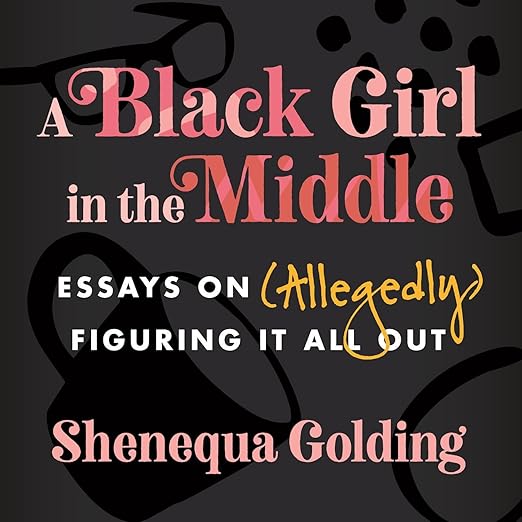
How much of a personal essay survives when the I belongs to somebody else? Shenequa Golding writes in a register so particular that the question stops being academic, and this audiobook hands twelve of her essays to Aure Nash, the only reading credit Beacon Press Audio prints anywhere on the page. Golding's subject is the middle, and she means it literally: not the fly kid, not the overachiever, a Queens childhood spent somewhere between the two as a first-generation Jamaican American. Five hours and fifty-four minutes is a compact frame for twelve pieces, which tells you their approximate length before a single one of them has played.
Reviews Praise a Voice None of Them Heard
Five written responses sit beneath this listing, and one of them names its format outright: a sample read first, then an immediate purchase of the Kindle edition, then four days of reading. Nothing in that account, or in the four beside it, describes a recording. That gap matters more here than it would on a novel, because what those responses keep praising is voice. The word most of them reach for is conversation, and conversation is precisely the quality that changes hands when a book moves to audio. A buyer coming to this edition is reading enthusiasm about a text and paying for a performance of it, and the page offers no bridge between the two.
Golding's best structural joke here is a taxonomy. She breaks down what the copy calls the ten levels of Black Girl Math, which is an essayist's way of arguing that a nonverbal vocabulary is precise enough to be numbered. Cataloguing has been the essay's favorite move since Montaigne, and it does specific work by ear: a graded list survives being spoken aloud far better than an argument that doubles back on itself, and the comedy sits in the intervals between the ranks rather than in any single punchline you might miss while merging into traffic.
In the Middle Names an Actual Place to Live
One response lands on an unusual pair of cultural markers, naming both the pandemic and the classic run of Gargoyles on the Disney afternoon block among the things this collection touches. That pairing is a fair description of Golding's range. She moves from a shared recent catastrophe to an animated series without treating either as the small one, and the essays around them take in maturation, familial and romantic love, and the work of embracing who you are. A collection that can hold both registers without whiplash is doing something considerably harder than it looks, and the same response calls the result honest, poignant and super witty, which is one quality more than most debut collections manage.
Her title repays a second look, too. Not between, which would imply two fixed poles and a person suspended unhappily between them, but in the middle, which names an actual place a person can live. The copy quotes Golding's own hedged version of it, kind of in the middle, and the hedge is doing as much work as the noun. That is also why the epigraph the description opens with matters: at thirty-seven, she writes, she can say her own name is a big name. A collection that opens by claiming a name has already told you what the arc is.
Essay collections suit this medium unusually well, and this one is built for it. Every piece carries a natural stopping point, and no plot thread waits to be dropped between sessions. Golding's subjects are self-contained by design: a devastating verdict on her body absorbed and eventually answered with squats, a chapter that begins in a hotel room and ends on celibacy, the slow repair of a relationship with her father, the decision to embrace hurt and anger rather than fear them. You can leave any one of these and return without needing a recap.
A Fixed Pace That Cuts Both Ways in Audio
Another response finished the book before a plane landed. That is a real measurement of the material's pull and also a warning about what changes in audio, because the reading speed that carries somebody through a flight belongs to them, and here it does not. Five hours and change is a fixed quantity you cannot accelerate through the sections you have already taken the point of. For a collection built on wins and losses in roughly equal measure, and on humor that works by arriving fast, that inflexibility cuts in both directions: the jokes land at the pace they were performed at, and so does everything else.
Before you buy, note two things about the page itself. This listing carries no content advisory of any kind, while the copy openly flags a hotel room encounter it calls harrowing, along with damage done inside a family and inside several relationships, so the harder essays arrive unannounced within a book that has spent the previous hour making you laugh. And the genre fields file the collection under literature and fiction alongside biography and memoir, which is simply wrong. Nothing here is invented, and a listener who finds it on a fiction shelf will spend the first essay recalibrating.
Nash Sounds Like Talking to a Best Friend
Somebody here describes the experience as talking to a best friend, and as reading about things they already knew firsthand. That identifies the audience precisely. If you want essays that operate at conversational distance, that thread comedic relief through material with no comedy in it, and that decline the responsibility of speaking for anyone else, the collection is built for you. Golding says as much in the copy's second paragraph, refusing to represent all Black women on the grounds that they are too vast, too vibrant and too complicated to be represented by one person. Listeners who came up first-generation in an American city, or who spent a childhood being neither the striking one nor the accomplished one, will recognize the terrain fastest.
Skip it if what you want is a chronological memoir with a shape. A debut essay collection spanning a life in Queens is not the same product as a life story, and the arrangement here is thematic rather than sequential. Anyone hoping for a single sustained argument about Black womanhood will find twelve angles instead of one thesis, which is the design and not a defect in it. The collection settles nothing, and it never proposed to.
Good to Know
How long is each essay in the A Black Girl in the Middle audiobook?
The copy counts twelve essays and the recording runs five hours and fifty-four minutes, which puts the average piece a little under half an hour. Lengths certainly vary, but that arithmetic is a fair guide: these are single-sitting essays with built-in stopping points, not chapters of a continuous narrative.
Is this audiobook a memoir or an essay collection?
An essay collection, firmly. Golding arranges twelve thematic pieces spanning her life in Queens rather than telling that life in order. The genre fields on this listing also file it under literature and fiction, which is a mislabel worth ignoring, since none of the material here is invented.
What does Black Girl Math actually refer to?
It is Golding's own graded scale, described in the copy as ten levels. At the low end sits a hard glare; at the high end sit the responses reserved for unfaithful boyfriends. Treating an unspoken vocabulary as something that can be ranked is both the funniest stretch of the collection and the one she works hardest at.
How heavy does the material get, and does the page warn you?
It gets heavy. The description itself names a harrowing encounter in a hotel room that leads into a chapter on celibacy, plus fraught relationships with her father, her friends and romantic partners. No content advisory appears anywhere on the listing, so those essays arrive without warning.