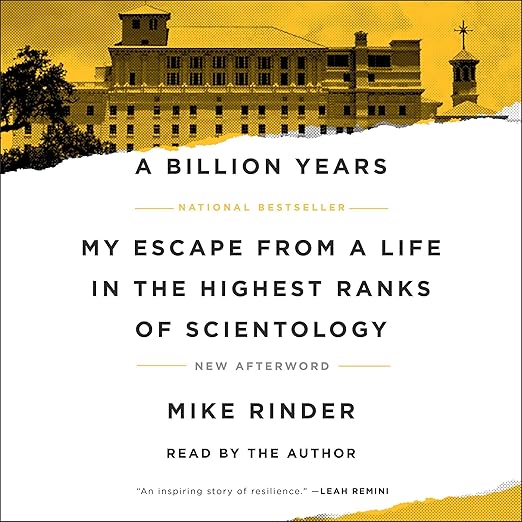
Somewhere in the tagging of this audiobook, a memoir about a life spent inside Scientology acquired a sports and outdoors classification and a subject tag reading Adventurers, Explorers and Survival. The religion tag beside it is at least defensible. That one is not, and an error of this kind decides who ever finds a book. Mike Rinder's account of signing a billion-year contract, rising to run an organization's external affairs, and getting out at fifty-two belongs in several categories. Hiking is not among them. Before anything else, know that the metadata on this page has no idea what it is holding, which is worth remembering when you reach the numbers further down.
Rinder reads it himself, and that decision carries more weight here than in most memoirs. For a stretch of the 1980s he was Scientology's international spokesperson and the head of its Office of Special Affairs, which is to say his professional voice was the organization's public voice. The same voice now delivers the account of the yacht, the deck-swabbing, the tax exemption negotiated with the IRS, the celebrity membership, and the makeshift prison the book calls the Hole. Hearing a former spokesman describe the machinery he operated is a different experience from reading it on a page, and no hired reader could have supplied that. If you are weighing formats, this is the argument for the recording.
A billion years is not a metaphor in the title. The description says he signed a billion-year contract after high school, was admitted to the Sea Organization, was brought to L. Ron Hubbard's yacht and promised training in the most advanced techniques, then put to work swabbing the decks. That sequence, in three sentences, is the entire book in miniature: enormous promises, menial reality, and a doctrine that explains away the distance between them. The five-star response from jane identifies the same mechanism from outside, praising the way the book shows step by step how one gets trapped. The body cuts off before the sentence finishes, which is a loss, because it was the most analytical thing anyone here wrote.
What Mike Rinder Gets Right
Scientology and the Aftermath brought at least two of these readers to the book, and that shapes the column. Fluffyluggage says the television show is where the interest began, and describes recognizing stories from it here in far greater detail. Shirley Hubbert opens by mentioning having watched the program several years ago and calls the book shocking, informative, eye opening, compelling. Neither reader arrived cold, which is worth knowing if you are considering this as a first encounter with the subject. The description does supply the necessary background, including the succession to David Miscavige and the surveillance that followed the escape, but the enthusiasm below it comes from an audience that had already picked a side.
Leah Remini's blurb sits inside the description, calling the book not only a cautionary tale but also an inspiring story of resilience, with a starred line from Kirkus Reviews behind it. That is publisher copy doing publisher work, and you should discount it accordingly. The response that actually earns attention sits at the bottom of the column, and it is in Italian. A reader in Italy writes of having, like Mike, a son in the Sea Org unseen for twelve years, calls the cruelty a sign of madness, and names David Miscavige as very, very cruel. That is not a book review. It is testimony from inside the situation the book describes, and most buyers will scroll straight past it because of the language.
Where Mike Rinder Loses Some Ground
The one qualification in the column comes from G Raines, who gives four stars and says the story did drag a little in the middle. Everything else in that review is unreserved: heartbreaking, pathological cruelties, children taken away from parents, people who disappear without a trace, the young bullied and humiliated with impunity. A middle-drag complaint matters more in audio than in print, because fourteen hours and twenty-two minutes does not let you skim. If the book slows where that reader says it slows, you will feel every minute of it. Weigh that against what the same reader calls an important read, one that illuminates the tactics clearly.
Fourteen hours is a long stretch in a room with this material, and prospective listeners should be honest with themselves about it. The book covers children separated from parents, people vanishing, humiliation applied as policy, and a period the author spent confined in the Hole. On a page you set that down. Delivered in the author's own voice, at his own pace, it accumulates. Shirley Hubbert's phrase for what he came through is Scientology Hell, with the added observation that he was lucky to live through it. That is the register the whole book operates in. Nobody in this column calls the account sensationalized and nobody calls it easy, so plan the listen in sections rather than in one run.
Who Should Pick Up A Billion Years
Whether you come for the institution or for the person decides how this lands, and jane's opening sentence divides the audience better than I could: readers interested in the inner workings of Scientology, readers interested in the general dynamics of cult control, and readers who just want a fascinating real life adventure story. All three are served. The first group gets the tax exemption, the Office of Special Affairs, and the names the description drops, Tom Cruise, Lisa Marie Presley, John Travolta. The second gets the mechanism, which travels intact to any high-control group. The third gets the 2007 escape and the surveillance that followed it, which reads like a thriller and happens to be the author's life.
Curiosity alone may not be enough. Anyone wanting a balanced account of a religion will not find one here, and the book makes no pretense otherwise: this is one former executive's version, told by the executive. Anyone looking for the sports and outdoors material those tags promise should close the page now. And anyone who needs a light listen should read the runtime beside the subject matter and come back another month. What remains is a strong recommendation for one specific reader, someone willing to spend fourteen hours inside a system as described by the man who ran its public face. The memoir survives its own mislabeled listing, but only just, and only because the voice reading it is the one that lived the story.
- Narration: Mike Rinder reads his own account, so the organization's former spokesman is the voice describing what it did.
- Themes: Cult control, institutional abuse, escape and surveillance, family separation.
- Mood: Steady, documentary, heavy for long stretches.
- Verdict: Essential for readers of high-control-group accounts, provided you can sit with fourteen hours of it.
Does Mike Rinder narrate the A Billion Years audiobook himself?
Yes. The credit names him as both author and reader across all fourteen hours and twenty-two minutes. That matters more than it usually would, because he served as the organization's international spokesperson during the 1980s. The voice that once represented Scientology in public is the one delivering the account of what happened inside it.
Is this audiobook a good starting point for someone new to the subject?
The description supplies the necessary background by itself, including the founder, the successor, and the escape. A pair of the people writing here arrived by way of a television series rather than cold, though, so the enthusiasm in the column comes from an audience already invested. A newcomer gets a complete account and a partisan one.