Quick Take
- Narration: Rebecca Lowman's reading is warm and unhurried, a good match for Colwin's conversational, interior-focused prose style that rewards patience.
- Themes: Marriage as ongoing negotiation, the texture of New York intellectual life, the ambivalence of wanting and receiving what you wanted
- Mood: Gently comic, melancholic at its edges, and deeply affectionate toward its characters and their ordinary difficulties
- Verdict: A novel less about what happens than how it feels to have things happen, readers who need plot will struggle, but Colwin's admirers will find this final book as warm and precise as everything that preceded it.
I encountered Laurie Colwin for the first time in a used bookshop in Philadelphia, which is probably the appropriate origin story for a Colwin reader. Someone had shelved Happy All the Time in the wrong section and I picked it up because the title seemed either deeply naïve or deeply ironic. Forty pages in I understood it was neither, Colwin was doing something more specific and stranger, which was writing about ordinary happiness without condescension and without sentimentality. A Big Storm Knocked It Over is her fifth and final novel, published posthumously in 1994 after her sudden death at forty-eight, and it carries throughout the bittersweet quality of something that was not meant to be a final statement but functions as one.
The novel follows Jane Louise Parker through her late thirties, she has just married a man described, with characteristic Colwin understatement, as having a "native decency" that leaves her almost breathless at her good fortune. She works at a small, financially precarious publishing house. Her best friend Edie is a constant presence. She and her husband wait to become pregnant, she wonders what she actually wants, she thinks about whether happiness is something you find or something you decide on. Eventually a child arrives and transforms things in ways the novel describes as "unexpected" and "rapturous", though Colwin, being Colwin, is too honest about the complexity of that rapture to leave it at the simple noun.
A Closer Look at A Big Storm Knocked It Over
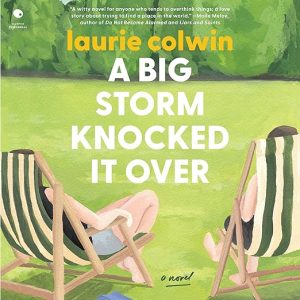
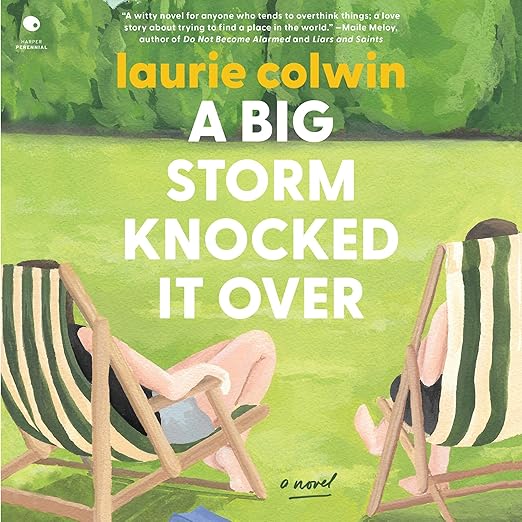
The description of A Big Storm Knocked It Over as "a meditation rather than a novel", offered by a reviewer who nonetheless found it enjoyable, captures something real about how this book operates. Colwin is not interested in plot as a delivery mechanism. She is interested in the texture of consciousness as it moves through ordinary days, the half-formed anxieties of early marriage, the specific quality of friendship between women who have known each other long enough to stop explaining themselves, the small recognitions that constitute intimacy between people who love each other but cannot entirely say so. Maile Meloy's blurb describes the book as "a love story for anyone who tends to overthink things," which is another way of saying this is a novel written in the register of internal life rather than external event.
What Makes A Big Storm Knocked It Over Worth Hearing
The detail I find most underrated in discussions of this novel is its portrait of the small literary press where Jane Louise works, financially imperiled, staffed by people who love books more than business, surrounded by the specific anxieties of an industry that has always been slightly too small for its own ambitions. Colwin worked as a food and fiction writer for most of her adult life and understood that milieu from the inside. The publishing house scenes have the quality of observation that comes from proximity rather than research, and they provide the novel's best comedy, the kind that is funny specifically because it is accurate, recognizable to anyone who has worked inside small cultural institutions that survive on conviction rather than revenue.
Things to Know Before Starting A Big Storm Knocked It Over
Rebecca Lowman's narration is a thoughtful production choice. Colwin's prose has a rhythm that is easy to mistake for simplicity, it moves quickly, it is witty, it does not announce its depths, and a narrator who leaned into the comedy at the expense of the underlying melancholy would misread it entirely. Lowman finds a middle register that keeps the wit audible while leaving room for what one reviewer called the "complicated happiness" at the book's center. The seven-hour runtime passes without fatigue, which is the basic standard for literary fiction narration and one Lowman consistently meets. She does not intrude, which is its own form of excellence.
Who Laurie Colwin Is Writing For
There is a question that faces any reader approaching Colwin's final novel: is this the right place to start? Probably not. Happy All the Time, her 1978 debut, is more immediately charming and more confident in its comedy. Family Happiness, from 1982, is arguably her most sustained achievement in characterization. A Big Storm Knocked It Over, posthumous, elegiac in a way that may be accidental but feels entirely intentional, is most fully appreciated by someone who already knows what Colwin can do and wants to see where she was heading. For that reader, the 2024 audiobook is exactly the right format: warm, unhurried, and completely suited to the domestic intimacy that is Colwin's subject and her greatest gift.
Who should listen: Colwin devotees who have read her earlier novels and want to complete the set; listeners who love fiction in the tradition of early Anne Tyler or early Nora Ephron; readers who find the interior lives of ordinary people in prosperous circumstances as interesting as dramatic crisis. Who should skip: Anyone who came for plot or pacing, this novel has neither in any conventional sense. Listeners unfamiliar with Colwin would be better served starting with Happy All the Time before working toward this more elegiac final work.
Common Questions
Is A Big Storm Knocked It Over related to Laurie Colwin's other novels, or is it standalone?
It is standalone. Some of Colwin's novels share overlapping New York social worlds and sensibilities, but A Big Storm Knocked It Over does not continue characters or plot threads from her earlier work. New readers can start here, though Happy All the Time is often recommended as a more immediately accessible entry point.
Does the posthumous publication affect the novel's completeness?
Colwin died in 1992 and the novel was published in 1994. Most assessments suggest it was complete at the time of her death, not unfinished. It reads as a fully realized novel, not a work-in-progress, though its elegiac quality takes on additional resonance knowing it was her last.
Why is this partly categorized under humor and satire? Is it actually funny?
Yes, in Colwin's characteristic mode, dry, observational, and affectionate rather than satirical. The comedy comes from the precision of her social observation, particularly the publishing house scenes and the portrait of early marriage among a certain kind of thoughtful, anxious Manhattanite. It is not broadly comic but it is frequently and genuinely amusing.
Is this a good audiobook for listeners who do not normally read literary fiction?
Probably not as an entry point. The novel's pleasures are specifically literary, they come from the quality of the prose and the acuity of observation rather than from incident or suspense. Listeners who generally prefer genre fiction or narrative nonfiction may find the pace and register frustrating.