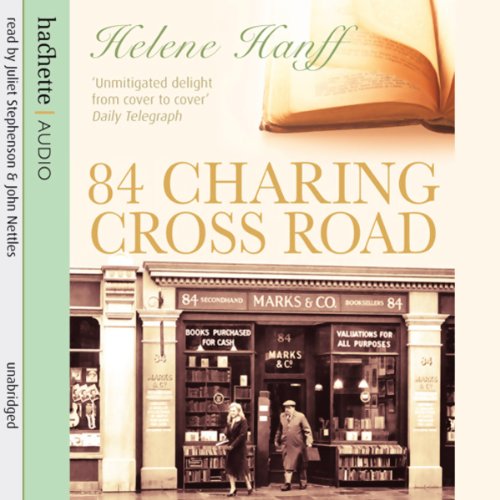
At a Glance
- Performance: Juliet Stevenson voices both correspondents across two hours and eleven minutes, with no narrator anywhere in the text to introduce either of them.
- What it covers: A friendship built entirely by post, transatlantic manners, secondhand bookshops, the years accumulating between letters.
- Feel: Warm, undramatic and quietly devastating by the end.
- Our call: You get two hours of somebody else's mail, which is the whole appeal and also the whole limitation.
Juliet Stevenson has two hours and eleven minutes here, and two people to be. The book is a correspondence, which means every page belongs either to a writer in New York or to a bookseller in London, and the audiobook has a single voice for both of them. Little, Brown Audio put the recording out on February 13, 2007. The description sitting above it is one sentence long, and that sentence names nobody at all: a true story of letters between a New York writer and a London bookseller, which has touched the hearts of thousands.
The names all arrive from the review column instead. Stan Vernooy, writing in September 2002, sets out what the publisher declines to: the writer is American and is the author of the book; the letters pass between Hanff and the Marks and Co. booksellers at 84 Charing Cross Road; and her primary pen pal is a man named Frank Doel, with whom she shares a love of old books. That entry also stresses that the letters are unedited and un-commented-on, which is the single most useful fact anyone offers about the form. Everything else here is administrative: a publisher, a runtime, a date in February 2007, and blanks where an ISBN and a page count would go.
A rating counter reading one sits above five written responses, which is the first thing here that does not add up. The badge says 4.7, and one vote on a whole-star scale cannot produce 4.7 under any rounding rule you care to apply, so the figure and the counter are already describing different things before the reviews enter the argument. Five people have both written and scored: four 5s and a 4. Whatever the badge is counting, it is not them.
What makes two hours and eleven minutes the right length is that the book carries no narration inside it. No scene setting, no description of a room, nobody explaining who anyone is. Letters do all of the work and the gaps between them do the rest. The December 2025 entry calls the book simplistic but so wonderful, and a beautiful glimpse into life, which sounds like faint praise and is not: the simplicity is the technique, and the reason the ending lands. The listing files the book in two places at once, under biographies and memoirs and under literature and fiction, with a Diaries and Correspondence tag sitting on top. For something the description calls a true story, that fiction label is a small oddity worth noticing.
Stevenson Must Make Two People Distinguishable
Two correspondents, one reader, and no narrator standing between them. That is the whole performance problem, and it is more interesting than it sounds. Stevenson has to make a New York writer and an English bookseller distinguishable from the first line of every letter, without a single attribution anywhere in the text to help. The letters themselves are the only cue. Get the switch wrong and the book collapses into a monologue; get it right and two hours is enough to build a friendship you believe in.
Five entries sit under this recording, and one of them has collected the book in four separate forms. The Kindle Customer writing in June 2009 owns a couple of paperbacks, a copy of the play script, an audio book and the film, and cannot recall when the volume first turned up in a life it went on to affect profoundly. That reader loves the era and the book love, meaning not just reading but being around books, the library, the haunting of old book shops. This is not a plot people return to. It is a temperature.
My own reaction, reading the description against the column, is that a recording may be the ideal form for this. A friendship conducted entirely in writing across an ocean gets spoken aloud by somebody who was never part of it, which is precisely what happens in your head when you read letters that were never meant for you. Two hours and eleven minutes is also short enough to take in one sitting, and PenMonster did exactly that with a print copy: sat down and read it straight through. It explains, too, why that entry gets as far as delightful little book and then moves on to the seller, since summarizing letters means discarding the very thing that makes them letters.
A Rebuttal to an Argument That Vanished
One thing this column is mostly not about is the listening. Two of the five entries grade the delivery rather than the book. PenMonster reports that the seller, a Goodwill in Michigan, was maybe a week early, and that the used copy arrived in very good condition. Tom Wescott, giving four stars, bought it as a gift, notes that the item arrived quickly and in excellent condition, and would recommend this seller. Both are describing a parcel, on a page selling an audio file.
That leaves Stan Vernooy's entry, which is the fullest account of the book this listing carries and also the strangest artifact on it. Dated September 2002, it predates by more than four years the February 2007 recording it now sits beneath, so whatever it is reviewing, it is not this. It stops mid-word, halfway through announcing total disagreement, without reservation, with previous reviewers whose position you cannot read and whose entries are nowhere in this column. A rebuttal to an argument that has vanished.
PenMonster Calls It Good Night-Time Reading
Everything about this suits a particular evening more than a particular reader. It is two hours and eleven minutes long, it is warm, it concerns two people who never meet, and it works best when nothing else is running. PenMonster calls it good night-time reading, which is the most practical recommendation in the column. Anyone drawn to secondhand bookshops, transatlantic manners, or the specific pleasure of reading somebody else's mail will be at home inside ten minutes.
Where it will disappoint is wherever a listener wants incident. Nothing happens in the ordinary sense: books are requested, books are sent, years pass, and the affection accumulates in the margins. The entry that comes closest to describing the emotional destination puts heart-rending and tragic in its headline and then gives nothing further away. Finding out what that means costs two hours and eleven minutes, and the letters do the rest of the work themselves.