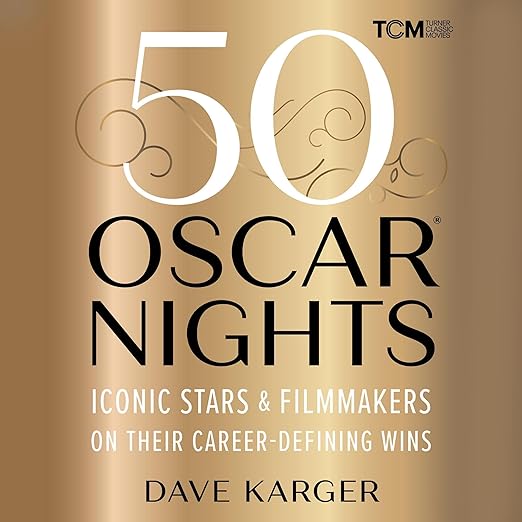
Dave Karger spent decades covering the Academy Awards as a journalist and Turner Classic Movies host before assembling 50 Oscar Nights, and that accumulated access is the book's entire foundation. The audiobook, narrated by Karger himself across 5 hours and 20 minutes, collects original interviews with fifty Oscar winners spanning sixty years of the ceremony, asking them to revisit not the glamour of winning in the abstract but the texture of the specific night: what they wore, how they felt when they heard their name, what happened in the hours that followed, and what the experience looks like from a distance of years or decades. The approach sounds simple and turns out to be revelatory. When you ask talented people to recall the sensory and emotional details of a single evening rather than to assess their career arc, you get material that institutional profiles almost never surface.
He Was in the Room, So Karger Narrates
The interviewee list runs from Nicole Kidman to Martin Scorsese, from Rita Moreno to Aaron Sorkin, from Meryl Streep to Joel Grey. Karger has interviews with fifty individuals across categories including actors, directors, composers, costume designers, and documentary filmmakers. That breadth is intentional: the book is partly an argument that the Oscars matter not just as a starmaking apparatus but as a recognition mechanism across every craft involved in making films. Kevin O'Connell, who received his Oscar for sound mixing after an industry-record 20 nominations without a win, gets the same reflective space as Julia Roberts or Steven Spielberg. That democratic range is one of the book's most valuable structural choices.
Karger's self-narration is the natural fit for this material. He conducted these interviews; he was in the room. Reading them back, he brings a quality of firsthand recognition rather than simply performing text he's been handed. The Hilary Swank anecdote, celebrating her Best Actress win at an Astro Burger in West Hollywood rather than at an industry party, lands with the right combination of humor and warmth. Elton John explaining his conviction that he'd won for the wrong song is delivered with the precise comedic timing such a story requires. Karger doesn't oversell these moments; he doesn't need to. The material generates its own energy when read by someone who gathered it personally.
The format rewards the audio treatment specifically because these are conversations rather than essays. Reading interview transcripts from the page has a flatness that disappears when a journalist narrates his own work. Karger's voice carries the context of decades of relationship-building with the Hollywood community, and you hear that context in the way he shapes transitions between subjects and frames the more complicated reflections without editorializing past what the interviewees themselves offer.
The Moonlight Win Still Carries the Announcement Error
The interviews that deal in complexity rather than celebration are the ones that make the audiobook worth the full listen. Marlee Matlin, Barry Jenkins, and Mira Sorvino each describe Oscar nights colored by circumstances that complicate the simple triumph narrative the ceremony usually projects. Jenkins' win for Moonlight is inseparable from the La La Land announcement error that preceded it, a moment that transformed what should have been straightforward recognition into something considerably more complicated. Sorvino's Oscar came years before circumstances would recontextualize what she had experienced in the industry. Karger includes these testimonies without editorializing past what the subjects themselves offer, which is the right journalistic instinct for material this charged.
At 5 hours and 20 minutes, the runtime suits the structure. Each interview is self-contained enough to make the audiobook episodic in the best sense: it can be listened to straight through or revisited in sections around particular subjects. The full fifty interviews are all present, and listeners who come primarily for specific names in the interviewee list will find the material is worth navigating the complete collection rather than hunting for individual chapters.
More Than 150 Photographs Live in Print Only
The print version includes more than 150 photographs, a detail that translates entirely to the audio experience's advantage and disadvantage simultaneously. The descriptions of red-carpet moments, emotional acceptances, and after-party images are vivid enough in conversation that the absence of visuals doesn't feel like deprivation during the listening experience. But listeners who want the full package, both the oral history and the photographic record, will find the print or digital version a companion worth seeking out alongside the audio.
The scope of fifty interviews across sixty years necessarily means some feel more fully developed than others. Shorter, more recent interviews share space with longer retrospective conversations that benefit from greater temporal distance. Karger's framing between interviews provides bridging context, but listeners expecting equal depth from every subject should calibrate for a collection of varying lengths rather than a uniformly deep exploration of each winner's experience.
What the Night Actually Felt Like, From Inside
Film history enthusiasts who want access to candid reflection from Oscar winners across generations will find this exactly the right territory. The oral history format in Karger's hands is better suited to audio than to the printed page, since the conversational quality of the interviews is preserved and heightened when you hear his narration rather than reading his transcription. Skip it if you want in-depth biographical or critical analysis rather than personal recollection from a specific ceremony night, or if your interest is limited to a single era or category of filmmaking. For anyone who watches the Academy Awards as a genuine annual event rather than background noise, 50 Oscar Nights offers something the broadcast itself rarely provides: what the night actually felt like from inside it, across fifty different windows into the same ceremony over six decades.
Does the 50 Oscar Nights audiobook include all the interviews from the print book?
The audiobook is based on the same interviews Karger conducted for the print edition. The primary difference is that the print version includes more than 150 photographs, which are not part of the audio experience. The conversations themselves are fully represented across the 5-hour runtime.
Is this audiobook accessible to casual movie fans or is it aimed at dedicated film history enthusiasts?
Both audiences will find value in it, though in different proportions. Casual fans who recognize the bigger names, Spielberg, Roberts, Streep, Kidman, will enjoy the personal anecdotes and unexpected behind-the-scenes details. Film history readers will get additional depth from the interviews with craftspeople and less-publicized winners whose stories are not widely known outside industry circles.
How does Dave Karger perform as the audiobook's narrator given that he is a journalist rather than a professional voice actor?
His performance is one of the audiobook's genuine strengths. Karger's familiarity with the material, having conducted the interviews himself, gives the narration an authority and warmth that conventional professional casting rarely achieves. He knows when a story is funny and when it requires space, and that knowledge is audible throughout.
Does the audiobook cover recent Oscar years or focus primarily on classic Hollywood?
The collection spans sixty years of the ceremony, covering both classic and contemporary winners. The interviewee list includes figures whose wins range from the 1960s through recent years, giving the audiobook genuine historical range rather than concentrating on any single era or generation.