- Narrator: Tom Davis reads his own memoir with the timing of a seasoned comedy writer - unhurried, anecdote-first, and genuinely amused by his own material, though the delivery occasionally wanders where a tighter read might have served.
- Subjects: Saturday Night Live's early era, counterculture and the 1960s, the unglamorous side of comedy careers
- Tone: Loose, digressive, and warmly nostalgic with a streak of honest self-deprecation
- Bottom line: A memoir that finds its footing in the margins of SNL history rather than at its center - better as a character study than as a backstage chronicle.
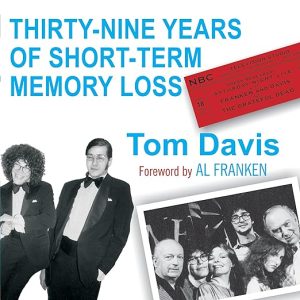
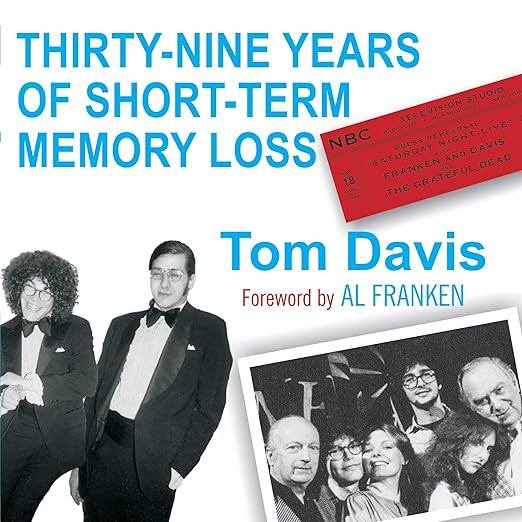
Saturday Night Live's original writing room is the kind of setting that invites mythologizing, and Tom Davis's memoir of his years as a staff writer and comedy partner to Al Franken is at its sharpest precisely when it resists that pull. Davis narrates his own audiobook - a nine-plus-hour recording of 39 Years of Short-Term Memory Loss - and the self-performed quality is both the book's greatest asset and its most honest liability. His timing is real. His affection for the material is real. And the gaps in the story are real too.
Peripheral Vantage Point That Works Best
What reviewers who approach this expecting a comprehensive SNL history will find is something smaller and more personal. As reviewer Breanna Klewitz noted, if you want the full picture of the show, Live from New York is the more thorough account. Davis's memoir is about Davis - about growing up in conservative suburban Minneapolis, finding his footing in the San Francisco counterculture, and navigating a career built in the long shadow of more famous friends. Lorne Michaels, John Belushi, Dan Aykroyd, Bill Murray, Michael O'Donoghue, Chris Farley - they move through the book as Davis encountered them, obliquely, in the corners of scenes rather than at their centers.
That peripheral vantage point is actually where the book works best. Davis is good at the small detail - the texture of a rehearsal night, the particular energy of a table read, the way success around you registers differently when your own name is not the one getting bigger. There is genuine candor here about the asymmetry between his career arc and Franken's, and about the drug culture that ran through that era of the show with a frankness that feels earned rather than sensational.
The one review that questioned whether Davis was as funny on the page as his professional resume suggested is worth engaging. The answer is: sometimes. The encyclopedia joke - a casual aside explaining to younger readers that an encyclopedia is a hard-copy search engine, followed by a suggestion to Google it - lands cleanly because it trusts the reader to find the joke without the author underlining it. Those moments of light comic restraint are the memoir's best. The passages where Davis seems to be working harder are the ones that read most like notes toward a funnier telling rather than the polished version itself.
Davis as Narrator Sets a Dinner-Table Rhythm
Davis as narrator is the right choice for this material, and the audiobook captures something a different reader could not: the rhythm of a man telling you his stories over a long dinner, circling back, adding detail, occasionally losing the thread and finding it again. Reviewer Tracy, who came to the book feeling nostalgic after SNL's 40th reunion special, noted that it is as much about the Grateful Dead as it is about Saturday Night Live - and that is accurate. The book's interests are genuinely broad, and Davis's voice accommodates that breadth without forcing it into a tidier shape.
The nine hours and sixteen minutes run time does require some patience. The structure is associative rather than chronological, and there are stretches where the memoir's charm depends entirely on your tolerance for digression. But for listeners willing to follow Davis at his own pace, the payoff is a portrait of someone who lived at the center of a particular creative moment without quite belonging to it - which is, it turns out, a more interesting position than center stage. Davis's account of escaping his conservative Minneapolis roots has the texture of real memory rather than curated narrative, and that authenticity is what self-narration serves best.
Three Stars or Five, Depending on Expectations
The ratings on this audiobook are polarized in a way that tracks the book's nature. Listeners who wanted SNL history gave it three stars. Listeners who settled into Davis's particular wavelength gave it five. Your experience will depend almost entirely on how willing you are to follow someone down a path that does not always circle back to where you expected to end up. Davis does not write to a thesis; he writes by accretion, and the shape of the memoir only becomes visible in retrospect.
There is also something instructive in the contrast between Davis's career and the meteoric trajectories of the people around him. He frames his own relative obscurity with enough humor and self-awareness to make the disparity feel like material rather than wound, but a careful listener will catch the places where the lightness costs him something to maintain. That is not a criticism of the memoir - it is its most honest quality. The book's 3.8 average rating reflects the split between listeners who came for one thing and got another, not a failure of execution on Davis's part.
Margins View for Readers of Canonical Histories
This audiobook is well-suited to listeners who have already read the canonical SNL histories and want something from the margins - a writer's-room perspective rather than a star's account. It also works for anyone with genuine affection for early-to-mid 1980s counterculture and the particular subculture of comedy writing before it became a formalized career path. Skip it if you want tightly structured memoir with a clear narrative throughline, or if you come expecting a comedy highlight reel from the people who made SNL famous. That is not what Davis wrote, and the audiobook is honest about that from the first hour.
Does Tom Davis narrating his own audiobook work well for this memoir?
Yes, with caveats. Davis has the timing of a comedy writer and his self-narration gives the book an intimate, unfiltered quality. The delivery can wander, but that looseness is part of the memoir's character rather than a production flaw.
How long is the audiobook, and does the runtime justify the content?
The audiobook runs nine hours and sixteen minutes. Whether that justifies the content depends on your tolerance for digressive memoir. The structure is associative rather than linear, and some stretches require patience, but Davis rewards listeners who follow him on his own terms.
Are the mixed reviews of this audiobook fair?
Partially. The criticisms that the book is not consistently funny and that it does not deliver a complete SNL history are accurate. But they reflect mismatched expectations more than genuine failures. As a character-driven memoir about a supporting figure in a famous room, it delivers what it sets out to do.