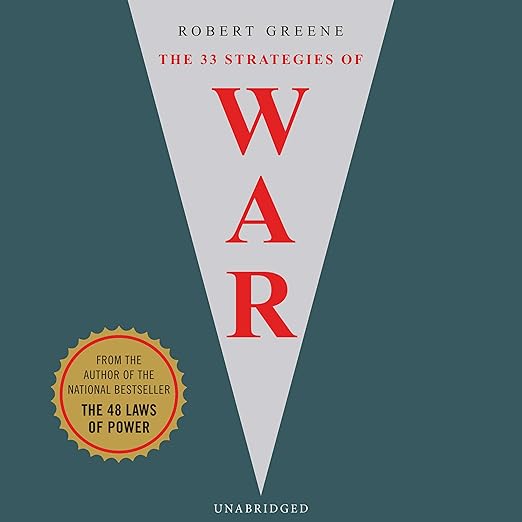
Military history repurposed as career advice sounds like a bad idea until you hear what Robert Greene actually does with it. This audiobook runs twenty-seven hours and thirty minutes, released by the HighBridge imprint of Recorded Books in July 2015 with Donald Coren credited as reader. The copy bills it as the I-Ching of conflict and a contemporary companion to Sun Tzu's The Art of War, then promises examples running from Napoleon to Margaret Thatcher and Hannibal to Ulysses S. Grant.
Seeing a Situation Without Your Feelings on It
Strategy in Greene's sense is not planning. It is the discipline of seeing a situation without your own feelings arranged on top of it, and that is the argument the thirty-three chapters keep restating from different angles. The military framing earns its place rather than decorating the book. The October 2024 note carries five stars and describes the method accurately, calling it historical military tactics applied to everyday life and personal challenges, large and small alike.
Twenty-Seven Hours Is a Term's Worth of Listening
Five ratings sit above this listing at a 4.8 average, and five written responses sit below it, every one of them graded at five stars. Those two facts cannot both describe the same votes. Five whole-star votes can only average 4.8 if one of the five is a four, and no four appears anywhere on the page. Either the counter is missing votes or the average is not counting the ones you can see.
Twenty-seven and a half hours is the real commitment, and it runs longer than most people expect from a title sold on career shelves. That length is not padding. Every strategy carries several historical cases plus a counter-case, so the structure multiplies where a normal chapter would simply add. What it means in practice is a term's worth of listening rather than a weekend's, and treating it as background audio wastes most of it.
History, Philosophy, and War as a Usable Manual
Application is the promise, and one response is unusually specific about it landing. One note from September 2025 came to Greene through this book and then went straight on to three more of his titles, describing the particular gift on display as making history, philosophy, human psychology and war feel like a manual you can actually pick up and use. That is the right description of the project.
Napoleon, Hannibal, Thatcher and Grant sit inside the same argument as movie moguls and samurai swordsmen, according to the copy, and that range is the point rather than a flourish. A principle holding across an ancient campaign and a studio negotiation is either genuinely structural or fraudulently broad. Greene stakes the whole book on the first reading, and the sheer volume of cases is his method of proof.
Emotion is where the material is most useful and least comfortable. The strategies keep returning to one instruction, which is to see a situation as it is rather than as your feelings have already arranged it, and that is easy to nod along to and very hard to manage inside a real conflict. In audio the repetition works in your favor. A principle heard thirty different ways stands a better chance of surviving a bad meeting.
Contents Pages Do Not Exist in Audio
Contents pages do not exist in audio, and here that absence costs something concrete. The May 2023 note describes a Table of Contents carrying each chapter title alongside part of the chapter overview, calls it an excellent refresher and reference, and points readers to the paperback preview online in order to see it. A listener gets none of that: no map on the way in, no route back to a strategy afterward.
Counting on the recording as a reference is the mistake that follows. Thirty-three strategies spread across a run this long form a structure built for return visits, and a linear file is close to the worst container for return visits ever devised. Anybody planning to use the book as something consulted after the fact, rather than absorbed once, should budget for a printed copy alongside the audio.
Careers is where the listing files it, with a Career Success tag attached, and that placement will mislead somebody. This is a book about conflict, drawn from war, treating professional life as one arena among many. Nothing in the copy promises promotions, interviews or salary negotiations as such. A listener arriving for business tactics will get Hannibal instead, which is a better deal, but it is not what the shelf advertised.
Take Your Time, Treat Each Chapter With Intent
Managers and anybody currently facing a rival will take a great deal from it, though the strongest recommendation on this page points somewhere else entirely. A December 13 note suggests the book specifically for young adults, arguing it prepares you for the conflicts still ahead, and attaches a listening instruction worth following: take your time, treat each chapter with intent, and do not gloss over anything.
Younger listeners are an unlikely fit for a book of this weight, but the logic holds up. The strategies are least useful once you have already learned them the expensive way and most useful before your first genuinely hostile negotiation. The historical range does the teaching, so no professional experience is assumed anywhere. What is assumed is patience, and patience is the one thing a young listener has to bring unaided.
Give it a miss if you want tactics for a particular job rather than a general grammar of conflict, because the examples come from battlefields and courts, not from quarterly reviews. Give it a miss as well if you cannot commit real attention, since half-hearing a book this size returns almost nothing at all. Sample the reading, then block out a season instead of a weekend and let the cases accumulate.
Questions Listeners Ask
How does this audiobook position itself against The Art of War?
The description places it alongside The Art of War rather than in competition with it, and the difference is method. This book argues by accumulation: thirty-three strategies, each carried by historical cases rather than by maxims, which is why it runs so much longer than the work it answers.
Does the audiobook require any background in military history?
None whatsoever. Every campaign is introduced before it gets used, and the roster in the copy runs from Hannibal to Margaret Thatcher precisely so that no single specialty is needed. What the book does assume is stamina, since the argument is built by accumulation and skipping cases removes the evidence the strategies rest on.