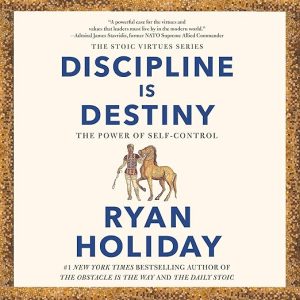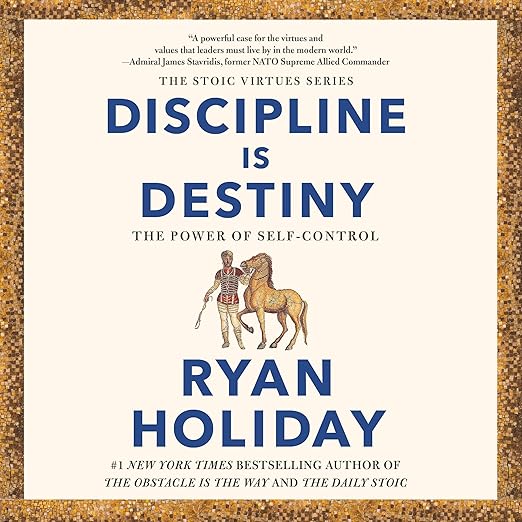
Ryan Holiday has built a substantial audience around one core project: making Stoic philosophy legible and usable for contemporary readers who would never pick up Marcus Aurelius on their own. Discipline Is Destiny, the second book in his Stoic Virtues series following Courage is Calling, narrows the lens to temperance: the virtue Cicero called the polish of life, the one Eisenhower described as the true substance of freedom. The audiobook version of this particular argument benefits enormously from Holiday's decision to narrate it himself, because the material calls for a voice that sounds like someone who has internalized what they are saying rather than performing it for effect.
The central question the book poses, how you can master anything without first mastering yourself, is not a new question. Holiday knows this and does not pretend otherwise. His contribution is the historical scaffolding he builds around the answer. Lou Gehrig showing up to the ballpark when his body was failing. Queen Elizabeth II maintaining composure through decades of public scrutiny. Floyd Patterson losing his heavyweight title and returning with enough self-possession to fight again. Toni Morrison managing a full-time publishing career while writing her most significant novels. Marcus Aurelius governing an empire while writing private meditations nobody was supposed to read. These are not anecdotes deployed as decoration; they are Holiday's primary evidence, and the book is organized around them rather than around abstract principle.
Holiday Circles a Question Instead of an Argument
The structure of Discipline Is Destiny mirrors the Stoic teaching method it describes. Holiday does not lay out a single argument and then defend it over several hundred pages. He circles the central idea from multiple angles, using different historical figures to illuminate different dimensions of temperance: bodily discipline, emotional regulation, the management of success, the management of failure, and the specific challenge of maintaining discipline when everything is going well. The result is a book that reads less like a conventional argument and more like a collection of case studies unified by a governing question that Holiday returns to with each new figure.
One reviewer noted that the book is educational, historical, and entertaining, which is accurate but undersells the craft. Holiday has developed a prose style that is deliberately plain without being thin, direct without being blunt, and the audiobook benefits from his own delivery, which matches that register exactly. He does not inflate the historical material with emotional commentary; he trusts the examples to carry their weight. When he does offer interpretation, it is concise. This is a book that respects your time even as it makes demands on your attention, and the self-narration ensures that the pacing between examples and reflection is the one Holiday intended.
He Is Explaining Rather Than Performing
The audiobook runs seven hours and seventeen minutes, which positions it as a serious listen without being a commitment that requires scheduling in multiple sessions. Holiday's narration is consistent in pacing and tone throughout, and the chapter structure, built around individual figures and individual dimensions of the temperance argument, means the book is naturally divisible if you prefer to engage with it in shorter segments across several days rather than in continuous blocks.
Self-narration here is the right call. Holiday has done this enough times that the delivery feels natural rather than labored, and a specific value comes from hearing the author's own rhythm when the material depends on his interpretation of historical sources. He knows which examples he wants to emphasize and where the pauses belong, and that knowledge shapes the audio experience in ways that a third-party narrator would have to infer from the text alone. The one caveat: if you prefer audio performers with dramatic range and vocal variety, Holiday's measured delivery will feel understated. He is not performing; he is explaining, and the distinction matters for this kind of argument-forward material.
Napoleon and Fitzgerald Fit a Familiar Pattern
The book is the second in a planned series, and while it stands alone, readers who want the fullest context for Holiday's argument about the four Stoic virtues will benefit from having Courage is Calling either read or listened to first. The thematic progression is not strict enough to make this inaccessible as a standalone, but Holiday does occasionally reference the series framework in ways that will have more resonance with prior context already in place.
The cautionary tales Holiday includes, Napoleon, F. Scott Fitzgerald, Babe Ruth, are instructive but they are also familiar. Listeners who have read widely in the motivational nonfiction space will recognize the pattern: exemplary figures are balanced by figures who had the talent but lacked the discipline to sustain it. Holiday executes the pattern well, but it is a pattern, and recognizing it does not diminish but may reduce the initial impact of those sections for experienced readers in the genre.
Should Look Toward Holiday's More Framework-Driven Work
Existing Holiday readers who followed Ego Is the Enemy and The Obstacle Is the Way will find this a natural continuation. The Stoic Virtues series is Holiday's most systematic project, and Discipline Is Destiny delivers what the series promises: a rigorous, historically grounded case for ancient virtue as a modern practice. Readers who responded to those earlier books will find the same authorial voice here applied to a more specific and demanding argument.
New listeners who are curious about Stoicism but intimidated by primary texts will find Holiday's accessible framing a genuine entry point. The book does not require philosophical background; it requires only a willingness to sit with the idea that self-mastery is both harder and more valuable than most productivity literature acknowledges. Listeners who prefer their personal development content more practical and less philosophical may find the historical emphasis too heavy for their purposes, and should look toward Holiday's more framework-driven earlier work instead.
Before You Listen
Do I need to listen to Courage is Calling before this audiobook?
Discipline Is Destiny can be listened to on its own without prior knowledge of the Stoic Virtues series. However, Holiday references the series framework at points, and having read or listened to Courage is Calling will give you more context for how temperance fits into his broader four-virtue argument.
How does Ryan Holiday's self-narration affect the audiobook experience?
Holiday reads with a measured, plain delivery that suits the material. He does not perform the text dramatically; he explains it, which matches the Stoic register of the writing. Listeners who prefer more vocal variety from audiobook narrators may find the delivery understated, but for this kind of argument-forward nonfiction, self-narration works well.
Is this audiobook more practical or more philosophical?
The book leans toward the philosophical and historical end of the nonfiction spectrum. Holiday builds his argument through historical figures rather than frameworks or step-by-step tools. Listeners wanting concrete productivity tactics will find the approach more contemplative than prescriptive.
How does this audiobook compare to Holiday's earlier Stoic titles?
Discipline Is Destiny is the most thematically focused of Holiday's Stoic books, organized entirely around the virtue of temperance. Earlier titles like The Obstacle Is the Way and Ego Is the Enemy cover broader ground. This entry assumes a reader who has some familiarity with the Stoic project, even if not from Holiday's own catalog.