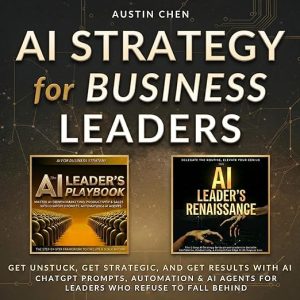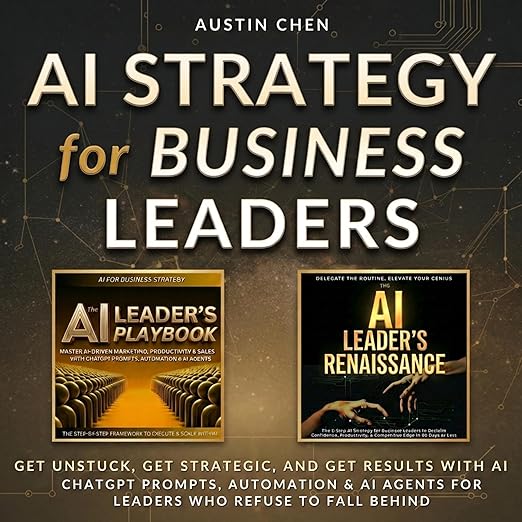
Random experimentation is the one approach Austin Chen calls guaranteed to fail, and this audiobook is built on the claim that most leaders are doing precisely that. Two books are welded into a single purchase: The AI Leader's Playbook, which handles execution, and The AI Leader's Renaissance, which handles strategy. Eleven hours and twenty-three minutes, Ted Kettler reading, published in March 2026 under a series name carrying no number. Whether the apparatus survives contact with a real working week is the question worth asking.
Sales-Page Prose Parked in a Product Description
Execution is the more concrete of the two halves, and its shape is easy to summarize. A thirty-day implementation framework, a set of prompts the copy calls battle-tested, something called the CRAFT method aimed at producing expert output on a first attempt, a STAR automation system, and fifteen business templates said to cover every critical function. That is a great deal of named apparatus for eleven hours, and named apparatus is exactly what this genre sells.
Strategy runs on a different logic in the second half. Its centerpiece is the Professional Renaissance Method, five steps across sixty days, spelled out as Release, Expand, Partner, Protect and Elevate. Three ideas around it do the actual work: a Three-Zone Framework separating what to automate from what to augment and what to keep away from AI entirely; a distinction between automating and amplifying; and the Commoditization Trap, described as the pattern turning most adoption into a race to the bottom.
Register deserves naming before anything else, because the description sells urgency rather than content. The divide is already visible, within two years it will be permanent, every week you delay the gap widens, the window is open and the only variable left is you. That is sales-page prose parked in a product description, and it forecasts the book's likely rhythm accurately: motivational business writing with frameworks inside it, rather than a technical manual with motivation bolted on.
Automate, Augment, Protect Survive a Single Hearing
Books about strategy survive audio better than books about tactics do, and this one is both. The Renaissance half, the part about deciding what to shield from automation, stays conceptual enough that hearing it works fine and arguably works better, since the arguments are short and the examples are workplace-shaped. Anyone who thinks best while moving will get more from that half than from a printed copy sitting unopened on a desk. The execution half is where the format starts costing you something, and it costs you most on the pieces you were meant to reuse.
Of everything named on this page, the Three-Zone Framework is the idea most likely to earn its keep. Automate, augment, protect: a manager can apply that to a real task list in an afternoon without needing any of the surrounding vocabulary. The Automate versus Amplify distinction does similar work, separating leaders who gain leverage from leaders who only gain speed. Both survive a single hearing intact, which is the correct test for material you are listening to rather than annotating.
No technical prerequisites, no coding required, no chasing every new tool. The description repeats that promise three separate ways, and for a management audience it is the right promise to make. The book is not teaching anybody to build anything. It teaches you to decide what to hand over, in what order, and what to keep. A non-technical executive can therefore listen straight through without hitting a wall, which is not true of most titles shelved under computers and technology.
The Least Informative Shape a Record Can Take
Five people have rated this and none of them has written a syllable. That leaves a 5.0 average with no reasoning attached, which is the least informative shape a reception record can take: high enough to look like consensus, thin enough that one unhappy buyer would move it several tenths. For a book published in March 2026 that is unsurprising. It does mean the description, the credits and the runtime are the entire evidence base a buyer has to work from.
Fifteen deployable templates and a library of prompts raise an obvious format question, and the listing never answers it. No companion PDF appears anywhere on the page. A prompt read aloud is a prompt you cannot copy, and a template described in speech is a template you have to rebuild from memory. Anybody buying for the apparatus rather than the argument should hunt for supplementary material first, or budget for a second purchase in text.
Packaging has loose ends worth noticing too. Two separately titled books arrive as one product with no indication of where the first ends and the second begins, so a listener wanting only the strategic layer has nothing to navigate by. The series line names a run called AI for Business, Strategy and Leadership and then leaves the number blank, which means the page cannot say whether this is the beginning of that run, the whole of it, or an entry somewhere in the middle.
Kettler Delivers an Argument for Deciding Quickly
Managers who have been experimenting for a year without a policy are the exact audience, and the aim is honest about it. If your organization has people using these tools in uncoordinated ways and nobody has decided what should be automated against what should stay human, the vocabulary here alone gives you a way to run that conversation. Team leads and function heads will take more from it than individual contributors will, mostly because the decisions it describes are decisions only a manager gets to make.
Practitioners who already have a working process should probably pass. The book assumes you are behind, and a good deal of its length goes on establishing that before it starts helping. Anyone allergic to business-book scaffolding, methods with acronyms, systems in capital letters, frameworks named after their own steps, will find the density of that scaffolding heavy across a full week of listening. And the templates are the part of the package that travels worst in this format.
Austin Chen has assembled a competent, heavily branded synthesis of what a manager might reasonably do about AI right now, and the strategic layer is the layer worth your time. Just be clear about what you are buying: an argument for deciding quickly, rather than a set of tools you can take straight off the recording and put to work the same afternoon.
Quick Take
- Narrator: Ted Kettler holds the reading credit, on material that is framework-dense rather than narrative, so section boundaries do more work here than character or scene.
- Subjects: AI adoption strategy, deciding what to automate against what to protect, professional expertise under commoditization pressure.
- Tone: Urgent, systematized, unapologetically corporate.
- Bottom line: Useful vocabulary for a manager without an AI policy, weakened by templates a recording cannot hand over.
Does the audiobook name specific AI tools or stay at framework level?
It stays at framework level. The description promises no chasing every new tool and names no product anywhere in its contents, building instead on method-shaped apparatus such as CRAFT, STAR and the Three-Zone model. That should age better than a tool guide, at the cost of giving you no setup instructions whatsoever.
What does the page say about Austin Chen's background?
Nothing at all. No credentials, no biography, no client roster and no track record appear anywhere in the description, which rests its entire authority claim on the frameworks themselves. Buyers who weigh author expertise before committing to a long business title will find nothing here at all to weigh it against.
Is the running time long for a book selling speed?
It is, and the mismatch is worth planning around. A thirty-day implementation framework and a sixty-day method delivered across eleven hours means the listening itself is the smaller commitment by a wide margin. Treat the recording as briefing material and reserve real calendar time for the work it prescribes.
Will this audiobook date quickly given how fast the technology moves?
The copy sets its own horizon. It claims the divide between prepared and unprepared leaders becomes permanent within two years, which from a March 2026 release puts that deadline in early 2028. Method-level framing ages more slowly than tool coverage, so the strategic half should outlast the urgency.