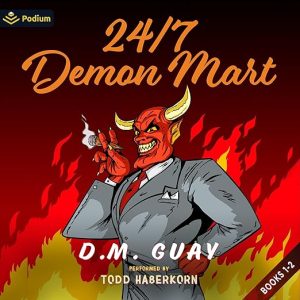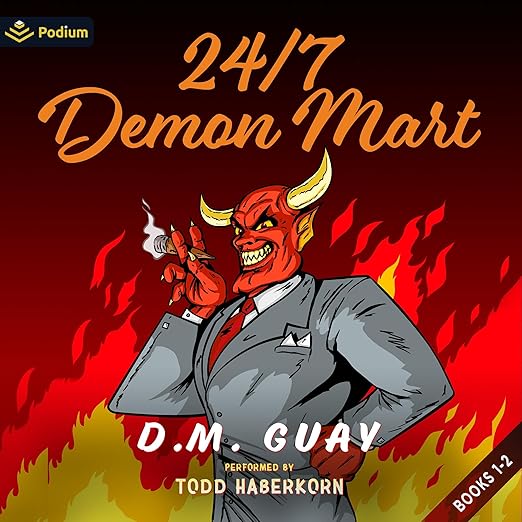
Troma is the reference that unlocks this one, and it arrives from a reviewer rather than the publisher. Pinning the tone, a four-star notice describes "a humorous troma movie mixed with urban fantasy and the sensibilities of a 90s graphic novel." Hold that register in your head and nineteen hours and twenty-three minutes of convenience-store demonology stops reading as an odd runtime for an audiobook and starts reading as a season of television.
Lloyd Wallace works the intersection of hell and earth, and the description calls him the most clueless crossing guard that intersection has ever seen. He has no idea the beer cave at his corner store is the gateway to hell. In the copy’s own words he is "a zero, a loser with a capital L," right up until he accidentally slays a one-eyed tentacle monster and gets hired by the store’s suave, devilish owner.
Haberkorn Holds the Narrator Credit Quietly
Convenience-store horror is a stronger premise than I expected it to be, because the setting generates its own comedy without being asked. Fluorescent lights, a graveyard shift, a slushy machine and a portal to hell all run on compatible logic. Guay staffs the place accordingly: DeeDee, billed as a karate-chopping bombshell, and Kevin, "a talking roach with a really bad attitude." One reviewer who says this genre "isn’t my usual thing" finished up calling it "one of the funniest series i’ve ever read."
Disagreement in this pool is unusually sharp and unusually specific, which makes it far more useful than five agreeable notices would be. Both four-star reviewers dislike the same thing, and it is not the plot. One opens "So, I love the premise and writing," supplies the Troma comparison, then lands the objection: "Thing is I cant stand the main character." The other begins "A talented writer, HOWEVER" before complaining the author "tries too hard to be a Christopher Moore or Jim Butcher" and objecting to "the focus on snarkiness between characters." Both dissenters take care to praise the writing first.
Todd Haberkorn is the reader to whom the narrator credit belongs, and not one notice in this pool discusses the recording. What the five reviewers argue about, at length and with real feeling, is whether Lloyd is tolerable company, and that argument happens to name the production problem exactly. A reviewer who avoids first-person fiction because it "usually feels like reading someone’s diary" reports that this one instead reads "more like your best friend telling what happened to him today." A comic first-person voice that has to sound like a friend rather than a diary, held for nineteen hours, is where a reading of this book either works or falls apart. The text sets that bar and the notices leave it unmeasured.
Monster Burger Becomes the Zombie Book's Villain
Bundling two novels and a Christmas special into one purchase is the format’s strongest practical argument. The Graveyard Shift and Monster Burger arrive together, joined by a bonus called Hell for the Holidays, so anyone who takes to Lloyd has an enormous runway ahead. At this length it is either excellent value or a large commitment to a voice you have not yet sampled.
Kevin the roach and DeeDee carry more weight than a sidekick pair usually does, and the second book leans on them harder still. Once Lloyd grows too frightened to leave his house, the description puts the rescue in three sets of hands rather than one: DeeDee, Lloyd and Kevin have to save the day again. Ensemble comedy wears better than a solo act, which matters a great deal at this length. Guay also lets the supporting cast be competent while the lead is not, which keeps the jokes from curdling into contempt for everyone on the page.
Zombies escalate the premise in book two without abandoning it, and the setting shoulders the work once more. Shoddy construction has compromised the gate, the neighborhood is in flux, and across the street the Monster Burger has acquired a snooty new owner nursing what the copy calls "a personal beef against the Demon Mart staff." A rival fast-food franchise as the antagonist of a zombie apocalypse is exactly the right instinct for this material.
Five Reviews Actually Average Out to 4.6
Numbers on this listing are unusable, and saying so bluntly saves you time. The rating count reads one, the average reads 4.4, and a solitary rating cannot produce 4.4 under any arithmetic. The listing nonetheless displays five full written reviews under that solitary rating. Whatever is being displayed, it is not a summary of what these five readers concluded, and their own average works out at 4.6 if you do the sum yourself.
'Neckbeard Basement Dweller' Is the Real Risk
Protagonist risk is the genuine decision point, and the pool has done you the favor of describing it precisely. If a lazy, oblivious, video-game-playing basement dweller is a comic archetype you enjoy watching stumble into heroism, three readers here promise a good time. If he reads instead as, in one reviewer’s phrase, a "neckbeard basement dweller," you are committing the better part of a day to somebody you dislike. Sampling the opening is not optional on a book this long. Ten minutes will settle it, because the voice announces itself immediately. Comedy is the genre where taste does the most work and consensus does the least.
Sequencing of the reviews adds a final wrinkle. The oldest notice, from December 2019, predates this bundle by roughly eight months, so that reader was responding to the first book alone rather than to the collected pack. The rest run from January 2022 to June 2025. That spread is a strength in one sense, since the comedy kept finding new readers across five and a half years, and a caution in another, because they are not all reviewing the same product.
Moore and Butcher Are the Yardstick Here
Fans of comic urban fantasy are the core audience, particularly anyone raised on Christopher Moore or Jim Butcher, since even the reviewer who disliked the book reached for those two names as the yardstick. Add listeners who want long-form comfort comedy with low stakes and a high body count, and anybody who has worked a night shift in retail and suspected the building was quietly against them.
Leave it if broad humor about a slacker protagonist grates, if you want horror that is actually frightening, or if comic first-person storytelling is a form you already know you dislike. Leave it too if you need a listing’s numbers to mean something, because these plainly do not. What remains is a genuinely funny, genuinely silly stretch of hours in a corner store built over a gateway to hell, and three of these five reviewers enjoyed themselves enormously.
Before You Listen
Is the audiobook scary or mostly comedy?
Comedy, decisively. One reviewer compares the tone to a Troma movie crossed with urban fantasy and a nineties graphic novel, and another calls it one of the funniest series they have read. Tentacle monsters, zombies and a talking cockroach are played for laughs rather than dread throughout.
Why does this audiobook show only one rating?
The listing is inconsistent, and the figures should be ignored. A single rating cannot average 4.4, and five written reviews appear beneath a rating count of one. Calculate the visible notices yourself and you get 4.6, which is a far more honest summary of the pool.