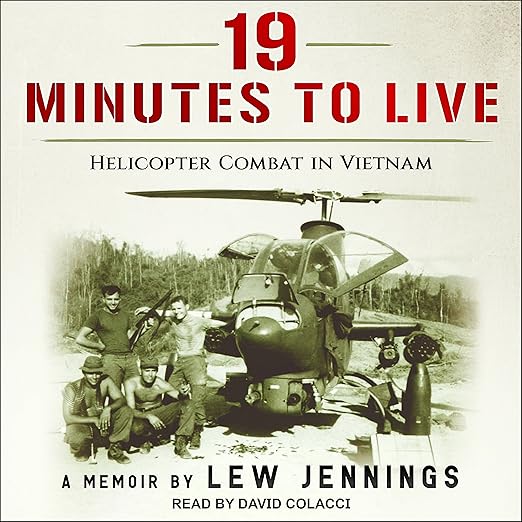
The title comes from a statistic that Lew Jennings offers early in the book: nineteen minutes was roughly the average time a helicopter crew could survive in sustained combat. He flew over seven hundred Air Cavalry Cobra Gunship missions. The math of that should stop you, and it does. I came to this one late on a Friday evening and stayed with it far longer than I planned to, not because it is relentlessly exciting, though it is that, but because Jennings's voice carries the specific gravity of someone who has spent decades deciding what to put on the page and what to leave out.
The Vietnam War produced some extraordinary memoir literature, and most of it focuses on the infantry experience. The helicopter war, which the synopsis correctly notes gave the conflict one of its identifying names, is less thoroughly documented at the first-person level. Jennings flew Cobras in air cavalry operations from the far south to the DMZ, including the Ashau Valley and Hamburger Hill, and he describes those operations with the combination of tactical precision and human detail that distinguishes useful military memoir from operational summary.
The Verdict, Briefly
The book's structure moves through Jennings's tour chronologically but organizes around specific missions and the men who flew them. Some of the most powerful sections involve accounts from other pilots, testimony Jennings gathered and includes in a way that gives the book a collective quality; this is not only his story but the story of the helicopter crews as a group. A Vietnam veteran reviewer who served two tours in 1965, 1967, and 1968 wrote that every word is absolutely on the mark, which is the kind of validation that cannot be manufactured. The photos Jennings includes in the physical edition, images of how young these flyers were, register differently in the audio format, but the text conveys the same reality: most of these pilots were barely out of adolescence.
The Best Parts of 19 Minutes to Live - Helicopter Combat in Vietnam
David Colacci's narration is clean and direct, appropriate for a book that earns its weight through accumulation of specific detail rather than dramatic performance. Jennings writes with a clarity that reflects both his military precision and his awareness that he is doing something the historical record needed done. Multiple reviewers noted that he is highly patriotic but his information was unbiased and factual, which is a meaningful distinction in Vietnam War literature, where bias of various kinds has distorted many accounts. The Distinguished Flying Cross is awarded for valor under fire; Jennings received three. He does not dwell on the decorations, which tells you something about how he frames his own story. A reviewer who met one of the men described in the book and found him completely humble noted that the book captures something true about how that generation of warriors understood themselves.
Points to Consider
The book is genuinely intense in its combat sequences; the title is not exaggerating the stakes, and the descriptions of helicopters being shot down and crews lost are specific and unsparing. Listeners who find detailed combat narrative difficult should calibrate accordingly. The focus is exclusively on the helicopter war; there is limited context provided about the broader political or diplomatic dimensions of Vietnam. This is a combat memoir, not a history of the war, and Jennings does not attempt to adjudicate the conflict's larger meaning. The technical aviation detail is substantial; while Jennings explains the equipment clearly enough for non-pilots to follow, the specificity of the Cobra gunship operations may be more granular than some listeners need.
Who Should Pick Up 19 Minutes to Live - Helicopter Combat in Vietnam
Essential for anyone interested in the Vietnam air war, particularly helicopter operations, and for readers of military memoir more broadly. Alongside books like Chickenhawk by Robert Mason or Low Level Hell by Hugh Mills, this belongs in the shelf of definitive Vietnam helicopter accounts. Vietnam veterans will find the specificity resonant; multiple veteran reviewers confirmed the accuracy of the detail. General readers who enjoyed memoirs like We Were Soldiers Once and Young will find the human dimension of this book equally compelling. Not suited for listeners seeking broader historical or political context about the Vietnam War rather than close-in combat experience.
Before You Listen
How accurate is the military and aviation detail in 19 Minutes to Live?
Very. Multiple Vietnam veterans who reviewed the book, including one who served two tours, confirmed that the detail is accurate and the portrayals are credible. Jennings flew over 700 combat missions himself.
Is this book appropriate for listeners who are not familiar with military aviation?
Yes, with the caveat that the Cobra gunship specifics are detailed. Jennings explains the equipment in context, and a reader without aviation background can follow the narrative, though some of the technical detail will be more meaningful to those with prior knowledge.