Key Details
- Narration: The credited narrator here reads as 'Eve herself' rather than an actual name, an obvious placeholder value; the standard English audiobook edition is typically narrated by Robertson Dean with measured, authoritative pacing suited to long-form history.
- Themes: The Columbian Exchange and its long-term consequences, the first global economy, how 1492 built the modern world
- Mood: Intellectually dense and methodically rewarding, best for attentive listening rather than background absorption
- Verdict: A genuinely ambitious narrative history audiobook that reframes the early modern world through the ecological and economic consequences of contact.
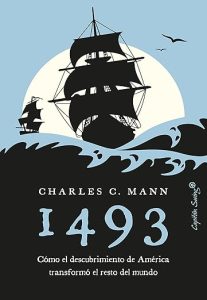
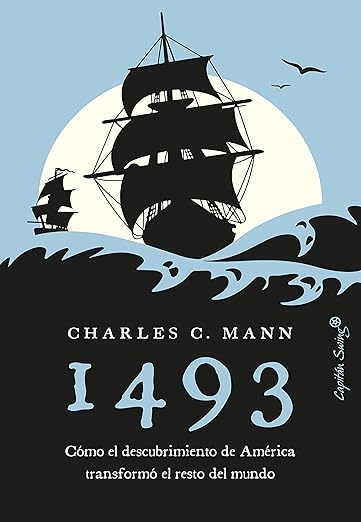
What if Columbus's 1492 voyage mattered less than what came immediately after? That's the animating question of Charles C. Mann's 1493, the follow-up to his celebrated 1491, and the audiobook format makes the argument vivid in ways that pages alone struggle to achieve. One listing quirk to note up front: the synopsis text shown for this title runs in Spanish rather than English, which reflects a listing discrepancy rather than a problem with the content itself. The audiobook is the full English-language edition of Mann's history of the Columbian Exchange, running nearly eighteen hours, and it's among the more intellectually ambitious narrative histories available in audio format.
The book's core claim is that 1492 was the start of a process, not the event itself, and that the real transformation of the world began when species, diseases, crops, and peoples began moving across the oceans at scale. The Manila galleon trade, which carried American silver to China in exchange for silk bound for Europe, created the first genuinely global economy. African slaves, South American potatoes, Indonesian spices, and Chinese porcelain began their world-altering journeys. Mann argues that the political disputes most central to today's world, immigration, trade policy, cultural conflict, have their roots in this post-Columbian reorganization of human life.
Our Take on 1493
Mann is a science journalist rather than an academic historian, and that background shapes the audiobook's texture in ways listeners should understand before committing eighteen hours. This is a book built for general audiences who want to be genuinely informed rather than for specialists who need a precisely argued historiographical intervention. The writing is accessible without being superficial, and Mann's range across ecology, economics, anthropology, and political history is impressive even where specialists might find it simplified.
Whoever is actually credited as narrator here shows up as 'Eve herself,' which reads like a placeholder rather than a real name. The published English audiobook edition of 1493 is typically narrated by Robertson Dean. Dean's narration is well-suited to the material: measured, authoritative, capable of sustaining listener engagement across the extended runtime that Mann's argument requires.
Why Listen to 1493
The Columbian Exchange has been written about extensively, but Mann's contribution is the scale at which he operates and the specificity of his evidence. The potato's journey from Andean highlands to European peasant tables is not, in Mann's telling, a charming food history anecdote: it's an ecological and demographic catastrophe in process, because the Irish dependence on a single Andean genetic strain created the vulnerability that produced the Famine. Understanding the potato requires understanding where it came from, which requires understanding what 1493 set in motion.
The Manila galleon chapters are particularly well-constructed. The image of an early global economy threading silver from Potosi through Manila to Shanghai, with European merchants extracting rents at multiple points along the way, has an explanatory power for modern economic geography that Mann develops carefully and clearly. The audio format sustains this across long stretches without losing the thread.
Readers who engaged with 1491 will find the companion volume equally stimulating. Where 1491 reconstructed a pre-contact Americas that European historical narrative had systematically underestimated, 1493 traces the consequences of that contact with similar revisionary force. Together they constitute a genuinely different frame for understanding the early modern world.
What to Watch For in 1493
At nearly eighteen hours, this audiobook demands sustained commitment. Mann's argument advances through accumulated examples rather than linear narrative, which means the listening experience rewards patience and discourages passive background listening. This is a book you need to actually follow, and it's dense enough that even attentive listeners may find themselves replaying passages.
Mann's reliance on a handful of key narratives, the Manila trade, the potato's European spread, the silver economy of the Americas, means that some episodes in global history receive attention at the expense of others. Specialists in African history, South Asian history, or Middle Eastern history will notice what's absent as much as what's present.
Mann's background as a science journalist rather than a credentialed academic historian deserves attention here because it shapes both the book's strengths and its limitations. The strength is accessibility: Mann writes with the narrative instinct of someone who has spent his career explaining complex ideas to general audiences, and across eighteen hours he never loses the ability to make his evidence feel like a story rather than a lecture. The limitation is that specialists in early modern global history will find certain arguments simplified and certain debates elided. For the audiobook's likely audience, which is curious generalists rather than academic historians, that tradeoff is the right call. The goal is genuine understanding of how the modern world was assembled, and Mann consistently delivers that over the full runtime.
The ecological chapters, particularly those dealing with the spread of the earthworm across North America, are among the most unexpected and genuinely surprising in the audiobook. Mann's argument that European earthworms, arriving as stowaways in plant soil, fundamentally altered North American forest ecology is the kind of claim that sounds eccentric until the evidence accumulates. It's also an example of the Columbian Exchange at its most counterintuitive: we tend to think in terms of crops, diseases, and people, and forget that the very soil was being reorganized. These surprising microhistories within the larger argument are where Mann's science journalism background serves the audiobook most distinctively, and the eighteen-hour runtime allows him to develop them with full attention rather than passing mention.
Recommended For
This audiobook rewards curious generalists who want to understand how the modern world's economic and cultural geography was assembled in the century after Columbus, and who are willing to invest eighteen hours in a careful, wide-ranging argument. Listeners who enjoyed Mann's 1491 should proceed directly to this one.
Skip it if you need narrative momentum or a clearly defined protagonist. This is an ideas-driven history organized around patterns and processes rather than individual stories. The argument builds across the full runtime, and listeners who tune in selectively will lose the architecture that makes Mann's conclusions feel earned.
Good to Know
Do I need to listen to Mann's 1491 before this audiobook?
Not strictly required, but strongly recommended. 1491 establishes the pre-contact Americas that 1493 is reacting against, and the two books develop a cumulative argument. Starting with 1493 is possible; starting with 1491 is better.
Why does this audiobook listing have a Spanish-language synopsis?
This looks like a straightforward listing error, not a genuinely bilingual edition, and it's worth flagging before you assume the actual audio switches languages too. The audiobook itself is the full English-language version of Charles C. Mann's 1493.