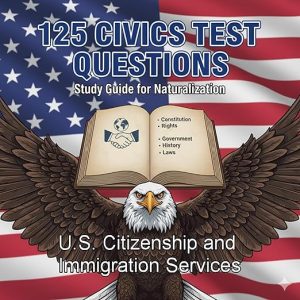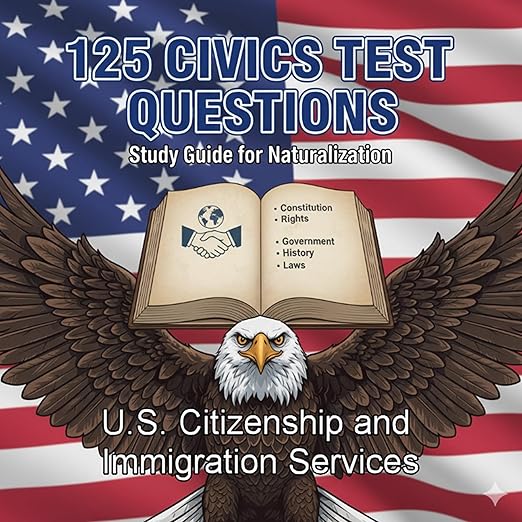
Naturalization candidates preparing for the civics interview already know something important: the test itself is oral. A USCIS officer asks questions aloud, and applicants must answer aloud. That fact alone makes the audiobook format for 125 Civics Test Questions: Study for Naturalization a more deliberate pedagogical choice than it might first appear. Hearing the questions spoken and then hearing their answers, repeatedly, in a clean listening environment, builds the kind of retrieval pathway that silent reading often doesn't. This audiobook understands the nature of the exam it's preparing you for, and the format reflects that understanding throughout.
Brooks Times the Pause Before Each Answer
Published by the U.S. Citizenship and Immigration Services itself, this guide carries straightforward authority. The 128 standardized questions and answers it covers, the discrepancy between the title's 125 and the actual 128 is explained by the way certain items are grouped, represent everything a new citizen is expected to know about American government, history, and national symbols. The test format is worth understanding from the outset: an officer asks up to 20 questions, and an applicant passes by answering 12 correctly. The oral, conversational nature of that encounter is exactly what audio study rehearses.
Tom Brooks reads the material with appropriate deliberateness. His pacing gives listeners enough space between question and answer to mentally formulate their own response before hearing the correct one, which is exactly how effective exam prep audio should work. The production quality is clean and consistent, which matters when you're returning to the same content multiple times across weeks of preparation. Nothing in the listening experience is distracting or uneven.
The special "65/20" provision deserves early mention. Applicants aged 65 or older who have held permanent residency for 20 or more years are eligible to study only the 20 starred questions and may take the test in their preferred language. For that population in particular, an audio format that can be paused, replayed, and listened to while doing other tasks reduces the barrier considerably compared to a printed study guide. The flexibility of the listening format is a genuine accessibility advantage for older candidates.
Three Sections Mirror the Test Itself
The content is organized into three sections that mirror the test's own structure. American Government covers founding principles, constitutional structure, the three branches of government, federalism, and civic rights and responsibilities. American History moves from colonial settlement and the Declaration of Independence through the Civil War, the 20th century, and the post-September 11 period. Symbols and Holidays addresses the flag, the national anthem, the Statue of Liberty, and federal holidays.
What makes this more than a rote question-and-answer list is the framing the guide itself applies. The answers aren't presented as trivia to be memorized and discarded. They're entry points into the civic story of the United States. The question about the supremacy of the Constitution isn't just a fact; it's a principle about how a diverse, self-governing nation resolves its disputes. For candidates who engage with the material at that level, the listening experience doubles as a genuine civic orientation rather than a purely instrumental preparation exercise.
The audio format is also advantageous for candidates who are managing the naturalization process while working or caring for family, many of the most common listening contexts (commuting, household tasks, walking) are compatible with studying this material in the background and then actively engaging when time permits. The short runtime of one hour and seventeen minutes makes it practical to listen through the full set of questions multiple times in a single week of preparation.
Some Answers Change Before Your Actual Interview
At one hour and seventeen minutes, this is a short audiobook scoped exactly to its purpose. Listeners who want historical context, explanatory depth, or analysis of the founding documents will need to look elsewhere. This is study material in the most focused sense: the actual USCIS content, read clearly, at useful pace.
One important practical note: some answers in the civics test change with elections and appointments. The current president, vice president, Speaker of the House, and senators from the listener's state are not static answers. The guide instructs learners to check the USCIS website for current officeholders, and this is essential advice. No static recording can keep pace with political changes, and anyone using this for active exam preparation should verify the variable answers independently before their interview date. Treating the audio as the sole study source without this supplementation would be a mistake.
The single rating in the catalog at the time of this writing doesn't provide much social signal, but the material itself is official and standardized. This isn't a third-party interpretation of the civics test, it's the actual USCIS guide in audio form. The quality of the content is institutional rather than editorial.
Simulating the Oral Exam by Answering Aloud
Anyone preparing for the US naturalization civics interview who processes information better through listening than reading is the primary audience. This is particularly valuable for candidates with limited English reading fluency, older applicants who qualify for the 65/20 exemption, and anyone who wants to simulate the oral nature of the actual exam during their preparation by hearing the questions and answering them aloud.
Skip it if you already know the material thoroughly and just need to verify specific answers, the USCIS website is faster for spot-checking. Also skip if you're hoping for historical or constitutional context beyond the standardized Q&A format; this audiobook is a study tool with a specific scope, and that scope is exactly appropriate to its purpose.
Questions Listeners Ask
Does this audiobook cover all 128 questions on the 2025 civics test?
Yes. Despite the title referencing 125 questions, the guide covers all 128 standardized USCIS civics questions and answers, organized into sections on American government, history, and symbols and holidays.
Is the audiobook format specifically useful for naturalization prep, or would a printed guide work just as well?
The audio format has a genuine advantage here because the naturalization test itself is oral. Practicing by hearing questions and formulating spoken answers more closely mirrors the actual interview format than silent reading does.
Are the answers in this audiobook current, or do some of them change over time?
Some answers, specifically those involving current officeholders like the president, vice president, and senators, change with elections. The guide instructs listeners to verify these on the USCIS website before their interview. The historical and structural answers remain stable.
Is this audiobook appropriate for applicants who qualify for the 65/20 exemption?
Yes, and it may be especially well-suited for them. Older applicants who need to study only the 20 starred questions can use the audio format flexibly, pausing, rewinding, and listening in shorter sessions, which can reduce the barrier compared to a printed guide.