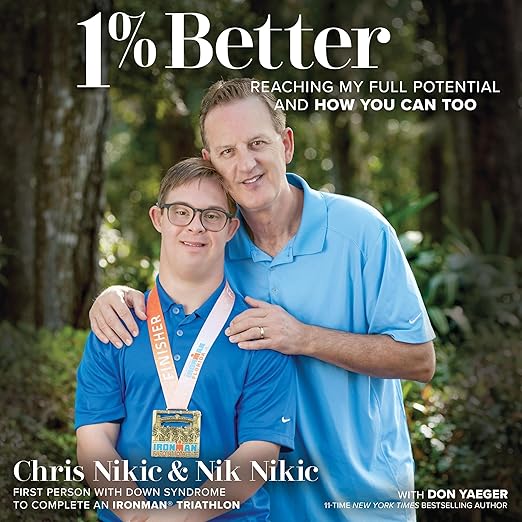
Chris Nikic's record-breaking IRONMAN completion in 2020 was the kind of story that traveled far and fast, even for people who had never followed triathlon. Becoming the first person with Down syndrome to finish the full 140.6-mile event was news in the conventional sense, but the audiobook 1% Better, narrated by Tom Parks, turns that event into something more durable: a framework for thinking about how any goal, at any scale, actually gets accomplished. The book is written in Nik Nikic's voice, Chris's father, who served as his coach through the training process. That choice of narrator shapes everything about how the story is told and what it is ultimately about.
The audiobook runs five hours and six minutes, and the pacing reflects the philosophy it describes. Nik Nikic builds the story in layers. The early chapters establish Chris not as a symbol but as a specific person with specific habits, fears, and capacities. The training sequences that follow are honest about the physical and emotional difficulty involved, and that honesty is what separates 1% Better from the kind of inspirational content that substitutes feeling for information. The publisher's note is clear: this is Nik's voice throughout, with Chris contributing through interviews and listed as coauthor.
A System Built for Us Average Joes
The coaching dynamic between Nik and Chris is the most interesting element in the audiobook, and it is also the one most likely to surprise listeners who expect a straightforward athletic triumph narrative. Nik was not prepared to be a coach. He made mistakes in Chris's training. He describes the tensions between wanting to protect his son from harm and pushing him hard enough to reach a goal that had no precedent. That willingness to include failure as part of the narrative gives the book credibility it would not have if it presented the journey as straightforwardly triumphant. A reviewer notes that the book is useful for "us average joes," and that inclusive framing is deliberate; the 1% Better system is explicitly designed for people who will never compete at the elite level.
The 1% Better system itself is clearly articulated around three premises: that small, consistent improvement compounds over time; that reframing failure as data rather than judgment sustains motivation; and that the brain's resistance to pain can be managed through what Nik calls the three irrefutable laws of motivation. These are explained through the specific experiences of Chris's training rather than through abstract principles. When a reviewer describes the book as one that "foregoes 'no pain, no gain' for slow, long lasting improvement," that accurately captures Nik's conscious rejection of the punishing training culture that dominates elite sport. The system is not original, but its grounding in a specific, documented case study makes it more persuasive than most self-help frameworks.
The section on overcoming the mental hurdles of pain is the most practically useful passage for listeners who are not primarily interested in triathlon. Nik articulates the difference between productive discomfort and genuine warning signals in a way that applies well beyond athletic training. This passage, alongside the motivational laws chapter, is where the audiobook earns its place in the self-improvement genre independently of the Nikic story's emotional power.
Parks Trusts the Story to Carry Its Own Weight
Tom Parks's narration is well matched to the material. He reads Nik's prose with the kind of measured sincerity that treats the listener as an adult. There is no manufactured emotional escalation at key moments; Parks trusts the story to carry its own weight, and it does. The passages where Nik describes watching his son on the course during race day benefit from being heard rather than read; the restraint in Parks's delivery makes them more affecting, not less. A companion PDF referenced in the product description contains the figures and appendix mentioned in the text. The audiobook stands fully on its own, but the visual framework breakdown in the appendix is useful for listeners who want to apply the system to their own goals.
At five hours and six minutes, 1% Better is efficiently sized. It does not overstay its welcome or pad its core insight across unnecessary chapters. One critical reviewer noted that the book's central idea does not require an entire book to explain, and that is fair. The value here is less in the framework's novelty than in the accumulated particularity of Chris and Nik's story, which makes the principles feel inhabited rather than prescribed. That difference between a framework presented in a business book and the same framework demonstrated through a specific life is precisely what memoir does best in this genre.
Where Chris's Own Voice Comes Through the Interview
The moments when Nik describes his own uncertainty and self-doubt as a coach are the passages that elevate the book above its genre. He is direct about the emotional cost of watching his son suffer through training and the philosophical problem of knowing when to push and when to hold back. These sections read as genuinely unresolved rather than retrospectively smoothed, which is the mark of honest memoir rather than packaged inspiration.
Listen also for the sections where Chris's voice comes through in the interview material. The transition between Nik's analytical framing and the more immediate texture of Chris's own recollections adds a layer to the story that the single-narrator format could easily have flattened. Parks handles these transitions with care.
Atomic Habits Readers Meet a Different Case Study
This audiobook will resonate most with listeners who are skeptical of self-help that relies on exceptional talent as its foundation. The story of Chris Nikic is unusual, but the framework Nik extracts from it is designed to be ordinary in the best sense: scalable to any goal that requires consistent effort over time. Parents of children with disabilities will find specific resonance in the coaching sections. Listeners already familiar with James Clear's Atomic Habits will recognize the philosophical territory while encountering a very different kind of case study, one grounded in family and athletic achievement rather than behavioral science research.
At a Glance
- Performance: Tom Parks reads Nik Nikic's father-voice prose with an even, grounded warmth that suits the motivational material without tipping into sentimentality.
- What it covers: Incremental improvement, disability and athletic achievement, parental coaching and unconditional belief
- Feel: Steadily uplifting and practical, without the hollow energy of generic self-help
- Our call: Chris Nikic's story provides the emotional core, and the 1% Better framework provides the practical scaffolding; together they make a listening experience that holds its shape after the final chapter.
Questions Listeners Ask
Does the audiobook companion PDF add significantly to the listening experience?
The companion PDF contains figures and the appendix referenced in the text. The core argument is fully accessible through audio alone, but the visual framework breakdown in the appendix is useful for listeners who want to apply the system to their own goals.
How does the audiobook handle Chris's perspective, given that Nik Nikic is the primary narrator?
Chris contributed through interviews with his father, and those conversations are woven into the narrative. The publisher's note addresses this directly. Chris's voice is present through his father's account, and several passages recreate their exchanges during training in considerable detail.
Is this audiobook suitable for children and teens, or is it aimed at adult listeners?
The book is written for adult readers but has clear relevance for motivated teenagers and their parents. Several reviewers mentioned wanting to share it with their children. The language is accessible and the motivational material avoids any content that would make it unsuitable for younger audiences.