Quick Take
- Narration: R.C. Bray is the reason to listen rather than read. His Joe Bishop and Skippy are so fully inhabited that the banter defines the series.
- Themes: Military camaraderie under impossible odds, AI consciousness, escalating cosmic stakes
- Mood: Fast, funny, and surprisingly tense when the comedy steps aside
- Verdict: Book five of the Expeditionary Force series delivers exactly what fans are there for, with a few new complications that suggest the series still has genuine surprises left.
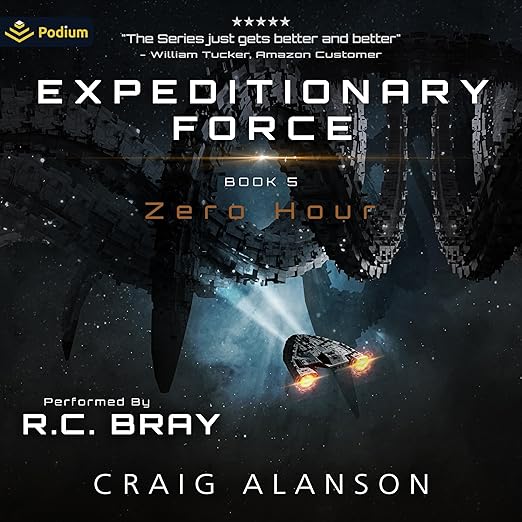
I have been following the Expeditionary Force series with the particular appreciation one develops for a comfort listen that somehow keeps raising the stakes. Zero Hour is book five, and by this point Craig Alanson and R.C. Bray have established something rare in military science fiction: a series where the jokes are as important as the battles, and where the comedy and the dread genuinely coexist rather than canceling each other out.
The setup for this installment puts the merry band of pirates in their worst position yet. Their stolen alien starship is falling apart thousands of light years from home. Skippy, the ancient alien AI they have come to depend on for both tactical genius and insufferable commentary, appears to be dead. The tension is real, and Alanson does not rush to resolve it. The opening hours of Zero Hour have a different quality than earlier entries precisely because the usual dynamic between Joe Bishop and Skippy is absent, and the absence is felt by anyone who has spent forty or more hours with this crew.
Our Take on Zero Hour
What makes this series work at book five is that Alanson has managed to maintain momentum without simply repeating the formula of earlier books. One reviewer noted that the plot outcome is genuinely hard to predict, and that the author has opened doors for several more books through breadcrumbs about Skippy’s origin, the Elders, and the Maxolhx. That observation captures something important: the series is building a mythology, not just generating adventure plots. By book five, listeners who have been paying attention can feel that architecture taking shape beneath the jokes and the space battles.
The character development critique that appears in several reviews is legitimate. We see a little, but not much, from the supporting cast. Some crew members grow in their personal stories, but the ensemble outside of Joe and Skippy remains somewhat underdeveloped. For a series running fifteen books, that is a long-term concern rather than an immediate problem, but it is worth naming. The humor also shows the first signs of strain noted by one reviewer, with some running jokes that have been running a long time. Dedicated fans will find it mostly works.
Why Listen to Zero Hour
R.C. Bray. That is the primary answer, and one reviewer said it more directly than I would: the narrator of The Martian has found his career-defining series here, and the banter between Joe and Skippy is so much more entertaining when you are hearing them. Bray gives Skippy a particular quality, equal parts unbearable arrogance and genuine genius, that makes the AI feel like a presence rather than a plot device. Without Bray’s performance, the books would be good military SF. With it, they are something you tell people about.
At seventeen hours and twenty minutes, this is a long listen. Alanson is a wordy writer, and some reviewers have noted that the prose is not spare. For the audience that chooses this series, that is almost certainly a feature rather than a flaw. More time with these characters is the point.
What to Watch For in Zero Hour
Do not start here. The Expeditionary Force series rewards listeners who start at book one. The emotional stakes of Zero Hour depend on eighteen or more hours of accumulated investment in Joe, Skippy, and the crew. The moments that land hardest in this book are callbacks and complications of relationships built across four previous entries. Listeners new to the series who begin here will find a competent military SF novel; listeners who are at book five will find something that rewards their patience.
Who Should Listen to Zero Hour
This audiobook is for existing fans of the Expeditionary Force series who are ready for book five. It delivers what the series promises while adding new mythological complexity about Skippy’s origins and the wider Elder civilization that will matter increasingly in later entries. Skip it as a starting point; go back to Columbus Day and begin there. If military SF with a heavy comedy layer is not your preference, this series will not convert you at book five, but if R.C. Bray is already a narrator you trust, this is one of his most technically demanding performances and worth hearing for that alone.
Frequently Asked Questions
Can Zero Hour be listened to as a standalone, or is it essential to have heard the earlier Expeditionary Force books?
It is not a standalone. The emotional weight of Zero Hour depends entirely on the context built across the first four books. Start with Columbus Day.
How does R.C. Bray handle the loss of the Skippy dynamic in the early sections of Zero Hour?
Very effectively. His performance during the segments where Skippy is absent creates a genuine sense of absence. The contrast when Skippy returns is part of what makes those scenes land.
Is Zero Hour a good entry point if I liked The Martian and want similar space humor?
It shares DNA with The Martian in terms of tone, but start at Columbus Day rather than book five. The humor builds on relationships and history that have to be earned first.
Does Zero Hour resolve its central crisis fully, or does it end on a cliffhanger?
It resolves the immediate crisis while opening new threads. Alanson plants significant breadcrumbs about Skippy’s origin and the Elders that will carry forward into subsequent books.