At a Glance
- Performance: Curtis Michael Holland handles a character-driven romance with gender identity at its center, his performance manages Zel's voice with sensitivity and enough range to carry the emotional arc.
- What it covers: Gender identity discovery, enemies to lovers, fairytale retelling with queer representation
- Feel: Warm, romantic, and lightly spicy with genuine emotional stakes underneath
- Our call: A Rapunzel retelling that earns its reimagining by centering gender identity discovery at the heart of the story, readers who love the concept will find the execution matches it.
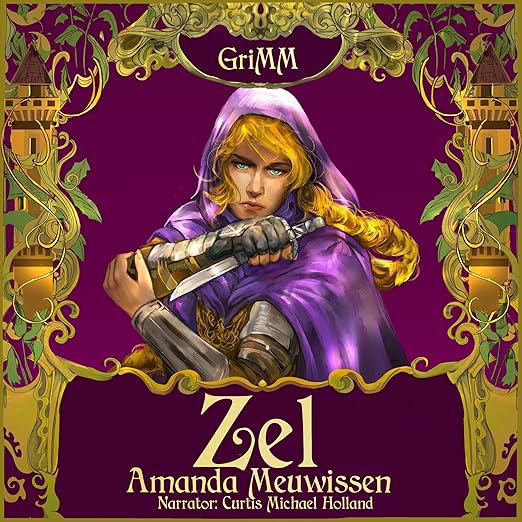
Fairytale retellings are a crowded space, and the best ones do something specific: they find the element of the original that was always more complicated than the children's version let on and push on it. Zel, Amanda Meuwissen's entry in the multi-author GriMM Tales series, does this with precision. Rapunzel's story has always been about a figure trapped in a tower, kept from the world by someone claiming authority over her body and future. Meuwissen takes that structure and asks: what if the gender assumption built into the original were itself part of the trap?
The setup is tight. Zel's parents were caught stealing the sorcerer's magical rapunzel plant, and to secure their freedom they promised that when their unborn child comes of age, she will live in the tower for a month before becoming the sorcerer's bride. The problem: Zel was born a boy, raised in secret, and has arrived at adulthood with a mission that has nothing to do with marriage. He plans to infiltrate the tower, unravel the sorcerer's immortality, and claim the treasures for the Thieves Guild. The sorcerer, Ulrich, has his own deceptions prepared. Neither of them is what the other expects.
Zel's Month in the Tower Reveals Himself
Meuwissen is working in well-worn genre territory, enemies to lovers, secret missions, slow-burn mutual pining, and she is competent in all of it. But what makes Zel specifically worth discussing is how she handles the gender identity thread. Zel does not arrive at the tower with a clear sense of who he is. His crossdressing has been a survival strategy, but the month in the tower, and Ulrich's specific way of seeing him, becomes the space where something deeper is worked out. A reviewer describes the trans and nonbinary representation as a wonderful surprise that was a joy to read, and that surprise indicates Meuwissen integrates the identity arc into the romance rather than treating it as a separate narrative burden.
Ulrich's characterization is handled well. He is introduced with the right amount of menace and mystery, a figure whose immortality and apparent cruelty obscure more complex motivations, and the book is careful not to resolve him too quickly. The enemies-to-lovers progression has genuine tension because both characters are actively deceiving each other at the story's start, and the unwinding of those deceptions is where the romance earns its emotional weight.
Curtis Michael Holland Carries Real Warmth Here
Curtis Michael Holland's narration carries the story with appropriate warmth. The GriMM Tales series is designed for audio enjoyment, and Meuwissen's prose works in that format: dialogue-driven, emotionally direct, with a pace that does not overstay its welcome at seven and a half hours. A reviewer who describes the outcome as perfect captures the satisfaction of a romance that delivers on its premise without hedging or withholding.
This is a standalone entry in the GriMM Tales series, which means you do not need to have listened to any other books in the collaboration to follow the story or care about the characters. The world has shared mythology and some characters may appear across multiple books, but Zel's narrative is complete in itself, with its own happy ending as promised in the series format.
Two Chilis Means Light to Moderate Heat
A reviewer who gave three and a half stars notes a fondness for the concept and the representation while finding some execution elements thinner than hoped. The book is clearly written with genre conventions in mind, and listeners who have read extensively in romance or paranormal romance may find the beats predictable. Meuwissen is not subverting the enemies-to-lovers formula so much as she is executing it with a queer identity layer that gives it additional meaning. If the formula itself is what you are fatigued by, the identity thread may not be enough to overcome that fatigue.
The spice level is described by reviewers as light to moderate, enough to earn a two-chili designation, but not what would be classified as explicit. Readers expecting high heat will want to calibrate expectations accordingly.
Reach for This if Retellings Interest You
Reach for this if you enjoy fairytale retellings that take their source material seriously enough to genuinely interrogate it, if queer romance with gender identity at its center interests you, or if you are already a reader of the GriMM Tales series looking for an entry with specific representation. It also works well as a standalone comfort listen for anyone who wants a story with genuine warmth and a satisfying resolution. Listeners looking for high literary complexity or subversion of romance genre conventions will find the book more conventional than its premise might suggest.
Frequently Asked Questions
How explicitly does the book address Zel's gender identity, is it a major arc or a background element?
It is a significant arc woven into the romance rather than a background detail. Zel's time in the tower becomes the space where he works through questions about his identity, and Ulrich's acceptance is central to the emotional resolution.
What is the content level for this romance, how spicy is it?
Reviewers classify it around two out of five chilis, present but not explicit. It is a romance with heat rather than a spicy read in the high-heat sense of the genre.
Does Curtis Michael Holland's narration effectively distinguish between Zel's and Ulrich's perspectives?
Reviewers are generally positive about the narration, finding it emotionally appropriate to the material. Holland manages the tonal shift between Zel's guarded exterior and Ulrich's gradually revealed interiority without flattening either.