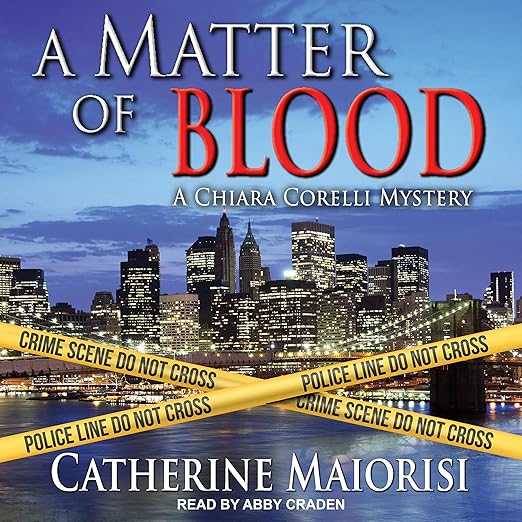
Catherine Maiorisi launches the Chiara Corelli Mystery series with a premise that sets up more than a single investigation: a decorated NYPD detective who has just aborted an undercover operation, exposed herself in the process, and must now navigate a department that considers her a traitor while simultaneously solving a brutal murder. This audiobook runs over eight hours, and while it operates comfortably within the police procedural genre, the character architecture underneath the investigation is what distinguishes it from the crowded field of New York-set crime fiction. Abby Craden's narration is the vehicle through which that architecture comes into focus, chapter by chapter.
Corelli and Parker's Need Starts Pragmatic, Turns Personal
Chiara Corelli is a specific kind of protagonist: highly competent, deeply isolated, and carrying a professional history that the department around her resents. Her undercover operation against a ring of dirty cops put her at a crossroads she could not complete, and the aftermath has left her ostracized by the colleagues whose loyalty matters most in a homicide unit. Into this dynamic Maiorisi introduces P.J. Parker, daughter of a vocal NYPD critic, who wants desperately to work in homicide and recognizes that Corelli, however hated, is also undeniably the best detective available. The mutual need that develops between them is handled with care: pragmatic at first and gradually more personal, without being rushed toward sentiment the characters have not earned.
Every Suspect Gets a Real, Viable Motive
The murder investigation at the book's center involves a cast of characters who all have plausible and fleshed-out motives, which one reviewer describes as each one seeming like a viable candidate for the crime. The who-done-it mechanics work properly because Maiorisi has given each suspect a genuine interiority rather than a thin motivation designed purely to mislead. The resolution is satisfying without feeling obvious, and the process of elimination that Corelli and Parker work through has real procedural logic behind it rather than relying on last-minute revelation.
One reviewer who went on to read all four currently available books in the series describes the main characters as women with strong intuition and reasoning skills and the secondary cast as equally fleshed out. Another notes that the central relationship was initially puzzling but became clear and earned through the narrative. That trajectory, from guardedness to something more complex, is what gives the series its forward momentum beyond the procedural plotting. Maiorisi is building a long-term relationship whose evolution across books appears to be as central to the series as the individual cases.
Craden Balances Corelli's Authority and Vulnerability
Abby Craden is an excellent casting choice for this material. Corelli requires a narrator who can convey authority and vulnerability simultaneously, and Craden manages the tension between those registers without collapsing either. Parker's perspective provides the outsider view on both the department and Corelli herself, and Craden gives Parker a distinct vocal quality that maintains the distinction throughout without making the shift between perspectives jarring. The supporting cast receives equally careful character work, which matters for a who-done-it that depends on each suspect having genuine presence.
At eight and a half hours, the runtime is comfortable for a police procedural. Maiorisi does not rush toward resolution, but neither does she pad the investigation with unnecessary detours. The balance between developing the Corelli-Parker relationship and advancing the murder case is well managed, and neither element overshadows the other across the listening experience.
Exposing Dirty Cops Reads as Betrayal Here
The dirty cop storyline, which forms Corelli's personal backstory and professional predicament at the novel's opening, is not fully resolved in this book. It establishes a threat that carries through the series rather than concluding within the first installment. Listeners who want all threads tied up by the final chapter will find the book's approach more serialized than episodic. The murder investigation itself reaches a complete and satisfying conclusion, but the larger institutional corruption story is clearly designed as a multi-book thread.
The LGBTQ+ representation in this book is integral rather than incidental. Both Corelli and Parker's identities shape how they navigate the NYPD's culture and their own developing relationship. Maiorisi does not treat queerness as a footnote or a complication to be managed, which means the book will feel most at home with listeners who want that dimension fully explored. Readers who want LGBTQ+ characters but prefer their identities handled more obliquely may find the directness more prominent than expected.
The New York City setting deserves recognition as a character in its own right. Maiorisi's NYPD is institutional in the way the real department is: hierarchical, protective of its own, and deeply resistant to internal accountability. The political dimension of Corelli's situation, the fact that exposing dirty cops is treated as betrayal rather than integrity by many of her colleagues, gives the procedural its moral weight. The investigation is not just a who-done-it; it is a test of what kind of detective, and what kind of person, Corelli will remain under pressure.
This Series Is Meant to Be Lived With
Readers of LGBTQ+ crime fiction who want a police procedural with fully realized female protagonists and a complex institutional context will find this precisely what they have been looking for. Fans of Sara Paretsky's V.I. Warshawski novels or S.J. Rozan's Lydia Chin series will recognize the combination of sharp investigative plotting and genuine character development. The New York City setting is used rather than merely referenced, and the NYPD's institutional culture feels researched and specific rather than generic procedural backdrop.
Listeners who prefer their mysteries lighter or who want a clean procedural without significant character-driven subplots will find this richer than they need. A Matter of Blood is the beginning of a series intended to be lived with rather than consumed in isolation, and the reader who commits to book one is likely to continue through all four currently available installments in the Chiara Corelli Mystery series.
Before You Press Play
- Performance: Abby Craden captures both Corelli's controlled intensity and Parker's guarded skepticism, making the dynamic between the two leads work at the center of this audiobook.
- What it covers: Institutional corruption and loyalty, trust between women in a hostile workplace, identity and belonging in law enforcement
- Feel: Sharp and character-driven, with the procedural momentum of classic police fiction and genuine emotional intelligence underneath
- Our call: A strong series opener that earns its place in LGBTQ+ crime fiction, particularly for listeners who want a homicide investigation with real character depth behind it.
Is A Matter of Blood the right audiobook to start the Chiara Corelli Mystery series?
Yes, this is book one in the series and the intended entry point. It establishes Corelli and Parker's relationship and the institutional context that carries through subsequent books. Listeners who start here consistently report wanting to continue through all four available installments.
How does Abby Craden handle the dual-protagonist structure in this audiobook?
Craden distinguishes Corelli and Parker with precision that makes the dual perspective easy to follow. Her vocal characterization extends to the supporting cast, giving each suspect in the murder investigation a distinct presence rather than a generic voice.