Before You Press Play
- Performance: Allanah Fitzgerald handles the dual narrative of Luminara and Rianthran with clarity and emotional range, giving both characters distinct voices that serve the political complexity of the worldbuilding.
- What it covers: broken prophecy and the cost of destiny, forbidden love as political act, empire and cycles of war
- Feel: Immersive and tense, with the emotional depth of character-driven fantasy
- Our call: Bronte-Marie Wesson's debut epic delivers intricate worldbuilding and a forbidden romance with real stakes, making The Ascension of Souls a strong first entry in the Broken Cycle trilogy.
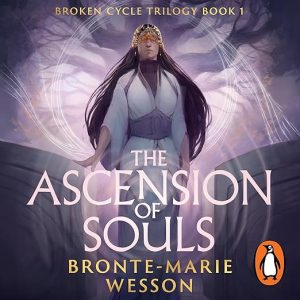
Luminara and the forbidden bond she forms at Rianthran's birthday celebration are the emotional heart of Bronte-Marie Wesson's debut fantasy audiobook, and the context of that meeting is more complicated than most forbidden-love premises. The Ascension of Souls, narrated by Allanah Fitzgerald across twelve hours and twenty-five minutes, opens with a world trapped in a prophecy-driven cycle of war between two countries, a cycle that has repeated for so many generations it has calcified into something that feels like fate rather than choice. When Luminara, a palace servant, sneaks into a celebration she has no invitation to, she is not only crossing class lines. She is entering the machinery of an empire about to break.
This audiobook is the first in the Broken Cycle trilogy, and Wesson is working at the scale that description implies. The worldbuilding is described as intricate in the promotional material, and the synopsis delivers on that promise. There are ancient prophecies, a ritual of Ascension that Rianthran must undergo as the newly anointed ruler, a unique magic system, and political schemes running alongside the central romance. Wesson has built a fantasy world with its own internal logic, and Fitzgerald's twelve-hour-and-twenty-five-minute performance gives that logic time to establish itself.
Our Take on The Ascension of Souls
The structural conceit at the heart of this trilogy is genuinely interesting: a world in which a prophecy does not simply fail to come true but actively breaks, causing destiny itself to unravel. This is a different kind of fantasy problem than the standard quest narrative. Rather than a hero pursuing a goal, Wesson has written a story about characters discovering that the framework they live within has been compromised, and the empire's entire sense of order is collapsing alongside it. That destabilization extends to Luminara and Rianthran's relationship, which is forbidden not just by class but by the weight of what Rianthran's role represents in the prophetic cycle.
Luminara's secret powers begin manifesting as Rianthran prepares for the Ascension ritual, and the visions she receives, haunted by images of the past, connect her own emergence to the larger fracture in the prophecy. Wesson is interested in the question of whether cycles can be broken by human will or whether destiny, even a broken one, has its own momentum. That question gives the political scheming and the romantic arc a shared thematic foundation, which is what distinguishes well-constructed fantasy from world-building that exists purely for spectacle.
The LGBTQ+ genre classification is worth noting not as a warning but as a straightforward descriptor of what the book is doing. The central romance between Luminara and Rianthran is same-sex, and Wesson treats it as neither the only thing the book is about nor as a complication requiring separate dramatic justification. It is central to the story because Luminara and Rianthran are central to the story, and the politics of their relationship are inseparable from the political stakes of the empire they inhabit.
Why Listen to The Ascension of Souls
Allanah Fitzgerald's narration is well matched to the material. Epic fantasy with intricate worldbuilding makes specific demands on a narrator: character differentiation across a large cast, consistent tonal management through both political scheming and intimate romantic scenes, and the ability to make complex world-building exposition feel like story rather than encyclopedia. Fitzgerald handles all of these competently and, in the scenes between Luminara and Rianthran specifically, with genuine emotional intelligence.
The twelve-hour-and-twenty-five-minute runtime is appropriate for the scope Wesson is working at. Debut fantasy that shortchanges its world-building in the first volume often creates problems in the second, and Wesson takes the space she needs. Listeners who find the political plotting dense in the early sections should stay with it; the investment pays off as the broken-cycle conceit gains momentum in the second half.
What to Watch For in The Ascension of Souls
As a debut novel opening a trilogy, The Ascension of Souls does what first books must: it establishes the world, introduces the central cast, builds the central relationship, and ends on a note that makes the second volume necessary rather than merely possible. Readers who find first-book-of-trilogy syndrome frustrating, the sense that the most important things are being held back for later, will feel some of that here. Wesson sets questions in motion that this volume does not fully resolve, because they cannot be resolved until the trilogy completes.
The magic system is described as unique, and the synopsis gives enough of its shape to confirm it is integrated into the plot rather than decorative. Luminara's powers manifesting alongside Rianthran's Ascension preparation is not coincidence within the story's logic, and Wesson is careful to lay the groundwork for what those powers mean without over-explaining before the time is right. Listeners who appreciate fantasy that withholds information strategically will find the pacing satisfying. Those who prefer full transparency about how magic works from the first chapter may find this approach frustrating.
Who Should Listen to The Ascension of Souls
Listeners who want LGBTQ+ fantasy that takes its worldbuilding as seriously as its romance will find Wesson's debut a strong option. The story operates at the scale of epic fantasy while keeping the emotional core firmly on Luminara and Rianthran, and Fitzgerald's narration gives both women equal weight. Fans of complex political fantasy who also want meaningful romantic stakes, readers who respond to Tamora Pierce or early Robin Hobb, will find the balance Wesson is striking familiar and well-executed.
Those who prefer fantasy that resolves cleanly within a single volume should know this is an opening move in a trilogy. The setup is rich and the characters are engaging, but the full payoff requires commitment to the series. For listeners ready to invest in the Broken Cycle from the start, The Ascension of Souls offers a world worth returning to.