In Brief
- Performance: Michael Lesley is the credited reader for a romance that alternates between two first-person voices
- What it covers: MM slow burn romance, grief and twin loss, found family, empathic gifts left unexplained, small-town Alaska
- Feel: Tender, aching, patiently cold-weather
- Our call: A genuinely original empath premise inside a very slow romance, sold with stale planning notes still attached.
Ten years after being found on an Alaskan roadside with no memory of who he was, Namid has built something that looks from outside like an ordinary life. The complication is that he feels other people's emotions as though they were his own, which makes an ordinary life expensive to maintain. Rayne Hawthorne opens the Unexpected Love trilogy on that premise and pairs him with Jayce, the town mechanic, whose twin brother has just died. The audiobook runs nine hours to a hard-won happy ending, and the distance covered on the way is the entire point.
The Verdict, Briefly
JBenoit, at five stars, wrote the clearest account of the setup available anywhere on this page: a decade after arriving in a small Alaskan town with no memories, Namid has carved out a nice life but mostly keeps to himself, because feeling everyone else's emotions turns overwhelming fast. Then he sees Jayce in town, completely buried in grief after losing a twin brother, and for once is not struck by the urge to run from the strong feeling. An empath drawn toward the worst emotion in the room rather than away from it is the book's real engine, and it is a sharper idea than the sales copy manages to communicate.
The Alaska setting earns its keep too. Hawthorne itemizes the contents in the description with unusual candor: angst, grief, found family, longing, forests, road trips, stargazing, sweet dates, and a happy ending waiting on the far side of all of it. That list works as an accurate contents label and it also tells you the pacing. This is a slow burn in the strict sense of the term, where the friendship has to be completely built and tested before the book will permit anything else to happen.
Why Beneath the Indigo Sky Works as an Audiobook
Atmosphere is what listeners keep responding to. The account filed under the handle natalies.marvelous.books, five stars from the United Kingdom, describes wanting to curl up under the stars in a cabin in the woods and watch the aurora, and singles out how quietly confident Namid is despite never having been quite welcome in town. That is the register the whole book runs in: small town, cold nights, two people being extremely careful with each other. It suits a recording unusually well, because a slow burn works by accumulation and audio will not let you skim ahead to the part you want.
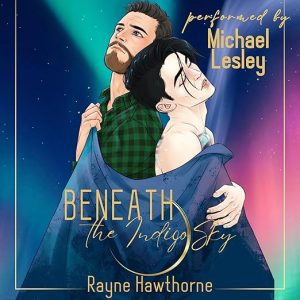
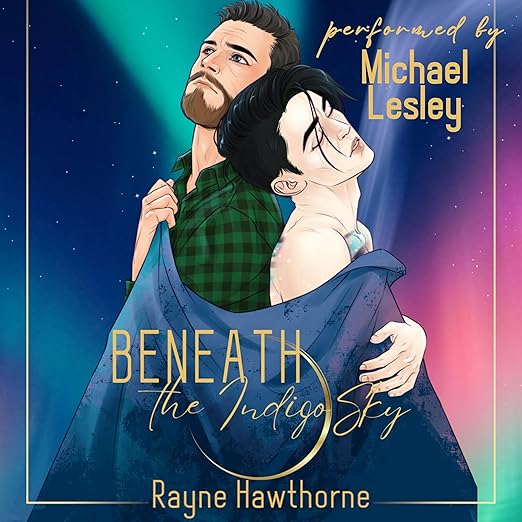
The reading credit belongs to Michael Lesley. The description is laid out as two first-person statements, one headed Namid and one headed Jayce, each describing how the situation feels from inside it. If the book keeps that structure, a dual first-person romance handed to a single credited reader is a real casting decision, and it will shape the experience more than any individual plot beat does. Both voices carry a great deal of interior monologue, which is where a reader either earns their fee or does not.
Grief writing is the other reason to take this in audio rather than in print. Jayce's half of the book is largely about the mechanics of loss: rooms full of memory, a voice still audible in his head, the refusal to start filling in gaps. Material that internal can go slack on a page, where an eye moves fast enough to skim past feeling. A recording sets the pace instead, and the slowness that makes the romance a slow burn also makes the mourning land at the speed the author intended, which is the harder half of the book to get right.
Points to Consider
GingerMa2009, the sole four-star notice, names both reservations precisely, which makes it more useful than any of the fives. The praise is warm: Jayce's grief heartbreaking, Namid's kindness unexpected and heartwarming, the friends-to-soulmates progression rendered in more depth than most books in this lane attempt. The deductions are structural. A big chunk of the plot runs on miscommunication, which is a taste question on the page and becomes an endurance question in audio, where you cannot flip forward past a misunderstanding you can see arriving from three chapters out.
Something else in the description should have been cleaned up before publication. It closes on planning notes rather than sales copy: a line announcing Unexpected Love as a trilogy with current estimated release dates of fall 2024 through spring 2025, and a further note that each book follows a different couple with overlapping cameos but that the three are meant to be read as a series rather than as standalone books. Those estimated dates had already come and gone by the time this recording appeared in May 2025, and the two sentences argue with each other about whether you are committing to one book or to three.
Two smaller flags. The description quotes a word count, seventy-five thousand words, which is a print measure that tells a listener nothing and is the clearest tell of copy written for a different edition and pasted across unchanged. And the tag list on this listing is completely empty, leaving one broad category to carry a book with this many specific hooks. Found family, empath romance, Alaska, grief, slow burn: not one of those is searchable here, which is a real discovery problem for a self-published title with no marketing department behind it.
One structural point sits underneath all of that. The paranormal element is never explained, and the author says outright that it is left open to reader interpretation. For most listeners that will register as restraint and good taste. For anyone who wants a mechanism, an origin, or an answer to the obvious question of where Namid came from, the book declines to provide one, and it declines across the whole length rather than saving a revelation for the end. Going in expecting that answer is the clearest way to be disappointed by an otherwise generous story.
Should You Listen to Beneath the Indigo Sky?
Slow burn readers, before anyone else. Mark F, at five stars, came to it during Pride Month while deliberately choosing books with LGBTQ+ themes or by authors from the community, and described it as the story of two men feeling lost and alone in the world who find each other exactly when they need it most. That is the entire promise, delivered without a suspense subplot propping it up. It also suits readers who want paranormal elements kept faint, since Hawthorne states plainly that they are minor and deliberately left open to interpretation, so nobody is required to buy into a magic system to follow the romance.
Anyone wanting heat early, plot momentum, or a self-contained story will struggle. Grief takes up a large share of the running time, the miscommunication device is load-bearing rather than incidental, and the deliberateness of the pacing is a design choice rather than an accident. Listeners who need a fully resolved arc in a single sitting should know that the happy ending here is genuine and thoroughly earned, and that the road to it is deliberately, unapologetically long.
Is the Beneath the Indigo Sky audiobook a standalone or do you need the whole trilogy?
It resolves its own couple with a happy ending, though the author's note asks readers to take all three books in order rather than treating them as separate stories, since cameos and plot threads carry over. This is the first, so nothing precedes it and starting here is safe.
Who reads the audiobook of Beneath the Indigo Sky, and how are the two perspectives handled?
Michael Lesley holds the reading credit. The book alternates between Namid and Jayce, each speaking in the first person, so a single voice carries both interior monologues across the full length. How that division gets handled goes unremarked by everyone who wrote in.