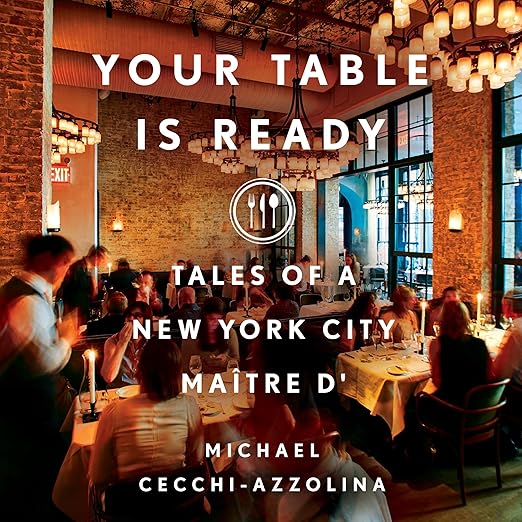
Quick Take
- Performance: Cecchi-Azzolina reads his own memoir with the timing and authority of a man who spent decades running a room, and AudioFile called it right: he has good pace and rhythm.
- What it covers: the vanishing world of fine dining service culture, economics of the restaurant industry, class and performance in New York City
- Feel: Rollicking and sometimes raunchy, with genuine warmth for the people and places described
- Our call: The strongest restaurant memoir in years for listeners interested in front-of-house culture rather than kitchen life.
I have read Kitchen Confidential more times than I can count, and I have always been aware that Anthony Bourdain's version of restaurant life looked entirely one direction: toward the kitchen, toward the cooks, toward the back of the house where things happened that polite diners were not supposed to see. Your Table Is Ready goes the other direction entirely. Michael Cecchi-Azzolina spent decades as a maitre d'hotel in New York City's most demanding restaurants, and his memoir occupies the front of the house with the same kind of insider authority Bourdain brought to the kitchen.
The restaurants here are real and specific: Raoul's in Soho, Buzzy O'Keefe's River Cafe, Keith McNally's Minetta Tavern, Le Coucou in Nolita. These are not generic upscale dining establishments but specific institutions with specific cultures, specific patrons, and specific stories attached. Cecchi-Azzolina was there for the period when restaurants replaced clubs as the primary theater of New York social life, and he has the anecdotes to prove it.
Where This One Lands
The AudioFile review quoted in the book's own synopsis describes him as trained in acting, and that background is visible throughout the narration. He understands timing, and he understands the difference between describing an incident and performing it. When he recounts managing a table of difficult celebrities, or navigating a sewage backup during a full house service, or managing the particular social theater of who gets seated where in a room where visibility is its own currency, there is a quality to the telling that suggests a man who has told these stories before and knows which details land.
The book covers roughly thirty years of service life, from his early days at La Rousse serving Tennessee Williams and Dustin Hoffman through the last pre-pandemic dinner services at Le Coucou. That sweep allows Cecchi-Azzolina to document how the industry itself changed, how the economics of fine dining shifted, how the relationship between owners, managers, and staff evolved over decades. Reviewer Admiralu described his account of "employment dynamics and customer craziness" as a genuine behind-the-scenes education, and that framing captures what the book does best.
What Makes Your Table Is Ready Worth Hearing
Self-narrated memoirs succeed or fail on whether the author can hold an audience, and Cecchi-Azzolina can. His training as an actor gives him awareness of the listening experience that many authors lack. He does not rush the good stories. He builds them. AudioFile's description of "authentic New Yorker" cadence is accurate in the best sense: opinionated, specific, occasionally profane, deeply attached to a particular time and place that no longer exists in quite the same form.
Reviewer KJ called it "a really crazy-fun-informative hot mess of a book," and that is a fair characterization. It is not a perfectly structured memoir. It wanders. It doubles back. It occasionally prioritizes anecdote over analysis. But in audio form, that quality translates well, because Cecchi-Azzolina is genuinely good company, and you are spending nine hours with someone who has earned his stories.
What Gives Us Pause
Reviewer Babe Didrikson came in expecting something closer to Cork Dork, the sommelier memoir, and found the early chapters' emphasis on drug use, drinking, and sexual content among restaurant staff to be significantly more than expected. That is an honest characterization of the first third of the book. Cecchi-Azzolina does not sanitize the subculture he was part of during New York's wilder decades, and the memoir is explicit about behaviors that were normalized in that environment. If that context is not of interest, the book does become more focused on restaurant operations and management in its later sections, but the early material is what it is.
The New York specificity is also worth naming. This book is deeply, essentially about New York, about a particular ecosystem of restaurants and the particular social rituals attached to being seen in the right room at the right table at the right moment. Listeners outside that specific context will still find the professional insights valuable, but the texture of the stories depends on caring about Le Coucou versus Minetta Tavern, about Soho versus Nolita, in ways that may not travel universally.
Should You Listen to Your Table Is Ready?
Food culture enthusiasts, especially those with any connection to New York dining, will find this essential. Anyone who has worked in restaurant service will recognize the world Cecchi-Azzolina describes, and the front-of-house perspective is genuinely rare in this genre. Skip it if you want a more conventional culinary memoir focused on food itself rather than service culture, or if the raunchier aspects of industry life during New York's 1980s and 1990s are not what you are looking for.
A Few Questions About Your Table Is Ready
Is the author narration distracting, or does it work for this material?
It works unusually well. Cecchi-Azzolina has acting training, and his professional background gave him a lifetime of managing how stories land with an audience. AudioFile specifically praised his pace and rhythm, and the self-narration adds an authenticity that a professional voice actor could not replicate for material this personal.
How much of the book is focused on specific New York restaurants versus general industry insights?
The book is heavily New York-specific. Le Coucou, the River Cafe, Raoul's, and Minetta Tavern are central rather than incidental. The general industry observations about economics, staff dynamics, and customer management are present but embedded in the New York context rather than extracted from it.