Quick Take
- Narration: Max Meyers handles the visceral horror and the quieter moments of Crane’s interiority with equal control, making the body horror land as psychological rather than purely physical.
- Themes: bodily autonomy, trans identity under external control, survival versus belonging
- Mood: Claustrophobic and nauseating, but with genuine intellectual and emotional weight
- Verdict: A horror novel that uses genre conventions to make a specific and demanding argument about marginalized existence, best approached by listeners who can sit with discomfort without needing resolution.
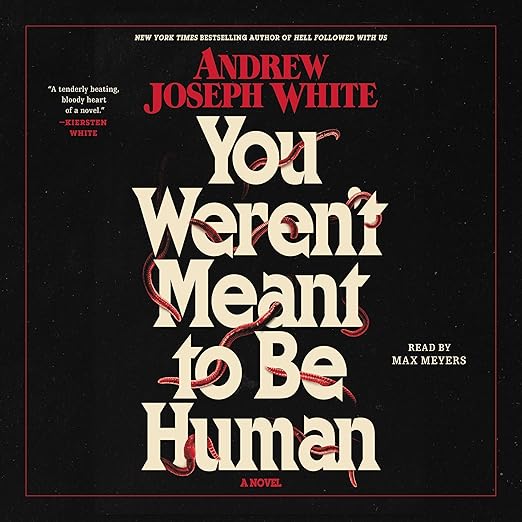
I want to be specific about what kind of audiobook You Weren’t Meant to Be Human is, because the marketing comparisons to Alien and Midsommar are both accurate and potentially misleading. Yes, this is body horror. Yes, there are hive-minded alien parasites and cult dynamics and graphic violence. But Andrew Joseph White is doing something with that apparatus that goes well beyond genre exercise, and understanding that changes what you’re listening for and why it matters.
I finished this one on a Thursday evening and spent most of Friday thinking about it, which is not a comfortable experience but is, I think, the experience the book is designed to produce. Crane, our protagonist, is a trans man who has found in his alien hive community something that the human world refused to give him: a context where his identity is recognized and his body is treated as his own. That the community extracting this agreement is made up of worm-and-fly parasites offering salvation in exchange for corpses is not incidental to the argument. It’s the argument.
Our Take on You Weren’t Meant to Be Human
White, whose previous work includes the YA horror novel Hell Followed with Us, is writing his first adult novel here, and the shift shows in how uncompromisingly the material is handled. The pregnancy that drives the plot is not a metaphor. The hive’s demand that Crane carry the child to term regardless of his own wishes is not a subplot. It is the book’s central horror, and White is very precise about what he is mapping it onto. A reviewer who describes it as a cruel mirror to what women, AFAB, trans, and queer people experience at the hands of patriarchy and Christian nationalism is reading the allegory correctly.
But allegory is a limited frame for what White is doing. Crane’s experience is not reducible to a political statement. He is a specific person with specific damage, specific attachments, and a specific relationship to a specific man, Levi, an ex-Marine who is genuinely brutal and who Crane loves in ways that are fully felt and fully complicated. One reviewer describes having finished the book and immediately forgetting how to function, which is perhaps the most accurate critical response the book has received. It is not designed to leave you intact.
Why Listen to You Weren’t Meant to Be Human
Max Meyers’s narration manages something technically difficult: delivering body horror content with genuine visceral impact while keeping Crane’s interiority legible throughout. The book requires that the listener feel the horror of the physical situations and the emotional coherence of why Crane makes the choices he makes at the same time, and those are not easy things to hold simultaneously. Meyers finds the right register for both. The quieter scenes, where Crane is constructing something like peace from available materials, are given the same care as the scenes of genuine dread.
At under ten hours, the pacing is tight. White does not dwell. The horror accumulates through specificity and volume rather than through extended set-pieces, which means the book moves fast despite the density of its content. The Washington Post and Publishers Weekly recognition as a best SF/Fantasy/Horror novel of 2025 reflects a critical consensus that the ambition is matched by the execution, which is not always the case in literary horror.
What to Watch For in You Weren’t Meant to Be Human
The body horror here is not metaphorical body horror. It is explicit and specific and designed to produce genuine physical discomfort. Reviewers who describe it as visceral, nauseating, and physically affecting are not exaggerating for effect. White’s prose generates the kind of reading experience that a portion of the audience actively seeks in horror and another portion actively avoids. Know which camp you’re in before starting.
The ending is also not a resolution in any conventional sense. One reviewer who describes it as devastating and frustrating is identifying something real about White’s refusal to offer the kind of release that genre horror often provides. The book’s fidelity to Crane’s perspective means that what constitutes an ending depends entirely on what you believe Crane deserves. That question, the answer to which White forces you to locate in yourself, is part of what makes the book serious rather than just disturbing.
Who Should Listen to You Weren’t Meant to Be Human
Readers who found books like Stephen Graham Jones’s The Only Good Indians or Carmen Maria Machado’s In the Dream House, works that use horror conventions to examine specific cultural violences, worth the difficulty will find White operating at a comparable level of intentionality. Trans and queer listeners who want horror that takes their experience as its actual subject rather than its backdrop will find Crane’s story genuinely personal in ways that most horror fiction is not. Listeners who need their horror to resolve into safety or who find body horror without redemptive framing genuinely distressing should proceed with real caution. This is not a book for the casual horror listener looking for fun scares. It is a book about what survival costs when the world that offers salvation is itself a form of captivity.
Frequently Asked Questions
How explicitly disturbing is the body horror in this audiobook?
Very. White is not using horror as a decorative register. The physical descriptions are specific, cumulative, and designed to produce genuine discomfort. Reviewers consistently describe it as one of the most visceral horror novels they’ve encountered. This is a real content consideration for sensitive listeners.
Does the novel’s trans protagonist require the listener to have personal familiarity with trans experience to engage with the story?
No, but trans and queer listeners will likely find the allegory more personally resonant. The novel functions as horror for all readers, but the specific political and psychological mapping of Crane’s situation lands differently depending on how close the reader is to the experiences being mirrored.
How does Max Meyers’s narration handle the dual register of visceral horror and emotional interiority?
With control. Meyers resists the temptation to pitch the horror scenes at maximum intensity, which would make Crane’s quieter moments of attachment and hope feel incongruous. The restraint makes both registers more effective than either would be if played at full volume throughout.
Is the ending satisfying, and does the book offer any form of resolution?
Not in any conventional genre sense. White refuses the catharsis that horror often provides. The ending requires you to assess what you believe Crane deserves and whether the outcome is proportionate to that belief. Some readers find this devastating and right. Others find it frustrating. Both responses are reasonable.