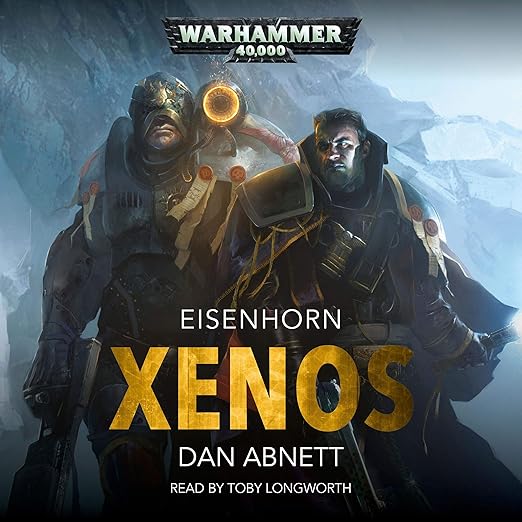
Gregor Eisenhorn operates at the margins of what is permissible, and Dan Abnett understands that tension better than almost anyone who has written in the Warhammer 40,000 universe. The craft of this audiobook lies in how Abnett establishes that moral geography in the very first act, before the plot mechanics of the Necroteuch even begin to accelerate. This is the first novel in the Eisenhorn series, narrated by Toby Longworth, and it remains the ideal entry point for listeners who have never rolled a die or painted a miniature in their lives.
The 40K universe is notoriously forbidding for newcomers. Decades of lore, faction jargon, and nested mythology can make even a summary paragraph feel like an untranslated text. What Abnett does brilliantly here is drop the listener directly into Eisenhorn's perception of that world: not explained from the outside, but inhabited from within. One reviewer who came in without any background noted being dropped into the realm and figuring it all out along the way, and that precisely describes the reading strategy Abnett has deployed. This is immersion over exposition, and Longworth leans into it, giving Eisenhorn a voice that implies fluency in a world the listener is still mapping.
How Xenos Holds Up
Xenos opens with Eisenhorn pursuing an old foe and being dragged instead into something larger, more architecturally sinister, and more personally costly. The villain architecture here is not the simple kind: the interstellar cabal Eisenhorn unravels is built from human ambition and alien intelligence in equal measure, and the Necroteuch functions less as a MacGuffin and more as a moral attractor, pulling every faction toward corruption at different speeds. Abnett is particularly good at showing how the Inquisition's own methods and the darkness it fights exist on a continuum rather than in sharp opposition. Eisenhorn does not emerge from this novel clean.
Longworth's performance is precise where it needs to be and warm where the material allows. Eisenhorn's retinue gradually populates the narrative across this 9-hour-and-55-minute runtime, and Longworth differentiates each member without resorting to caricature. The result is that listeners come to care about these characters not because the novel announces their importance, but because the voices make them feel real within a setting that could easily have remained abstract. The slow accumulation of trust between Eisenhorn and his growing circle of allies is one of the series' long-running investments, and this first installment makes that investment feel worthwhile from the start.
Why Xenos Works as an Audiobook
This is an audiobook that earns most of its runtime. The pacing has the deliberate quality of a detective procedural in the first half, building the investigative texture that makes the escalation of the back half land with genuine weight. Listeners who favor science fiction that takes its worldbuilding seriously will find the 40K universe here rendered with the kind of specificity that makes you want to know more. Reviewer Jim Taylor came in looking for the broader Eisenhorn Omnibus, found this reprinted standalone instead, and noted that it required more than an average first novel from its readers. That is a fair warning and a fair compliment simultaneously. Abnett respects his audience enough to trust them.
The political and theological scaffolding of the 40K universe, its theocratic authoritarianism, its casual acceptance of sacrifice in the name of the Imperium, runs through Xenos not as ideology to celebrate but as context to interrogate. Eisenhorn is loyal to the Imperium but not unaware of what that loyalty demands. That ambivalence, voiced through Longworth's controlled delivery, gives the novel more staying power than straightforward action fare. The alien threat at the center of the plot is rendered with enough internal logic that the confrontation feels like a genuine collision of incompatible worldviews rather than a species-versus-species shootout.
Weak Spots in Xenos
Pay attention to the way Abnett builds Eisenhorn's code of conduct early in the novel and then systematically tests it. Each compromise Eisenhorn accepts to advance his case is presented without editorial comment, leaving the listener to track the accumulating moral debt. This is the mechanism that will drive the entire series across its subsequent volumes, and this first installment plants the seeds carefully. The xenos threat is not rendered in the familiar shorthand of science fiction monsters; it has a logic and a culture, however alien, that adds texture and consequence to the final act.
Longworth handles the tonal shifts between the procedural, the political, and the confrontational with the confidence of a narrator who has lived in this material rather than simply performed it. His ability to sustain Eisenhorn's internal monologue as a coherent voice across varied pacing modes is the performance's central achievement and the reason this audiobook functions as well as it does for listeners who have no prior investment in the franchise.
The Right Listener for Xenos
Listeners who have been curious about Warhammer 40,000 fiction but intimidated by its enormity will find this the most welcoming starting point in the canon. Abnett does not assume prior knowledge; he builds it through experience. Fans of authors like Dan Simmons or Peter F. Hamilton, writers who trust their readers with dense speculative architecture, will recognize the approach and appreciate the economy with which Abnett deploys it at novel length. Listeners who want political intrigue as a structural element alongside the action, rather than window dressing, will find this satisfying. Those who prefer light world construction or self-contained standalone science fiction may find the implied depth of the 40K universe somewhat distracting. This is a series opener in the fullest sense, and it commits fully to that role.
Before You Listen
Do I need to know Warhammer 40,000 lore before listening to the Xenos audiobook?
No prior knowledge is required. Dan Abnett builds the world through Eisenhorn's perspective rather than through exposition, so listeners are oriented through experience. Several fans of the novels have no background in the tabletop game at all.
Is this audiobook a good entry point into the Eisenhorn series, or does it assume knowledge of prior books?
Xenos is Book 1 of the Eisenhorn series and is explicitly designed as the starting point. It introduces the character, his methods, and the political landscape of the Inquisition from the ground up.