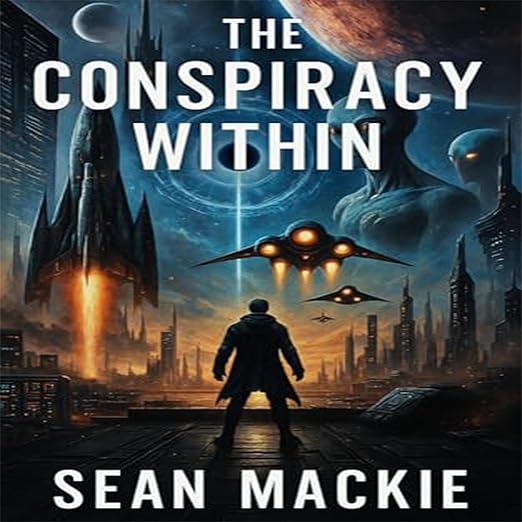
Alex Belle is tired. A field liaison for the Norn, the benevolent alien species that has reorganized human civilization around perfect guidance and remarkable technology, he has spent enough time at the margins of that system to know that the disappearances add up wrong. The Conspiracy Within, the debut science fiction audiobook from Sean Mackie narrated by David Moeller, runs twelve hours and thirty-eight minutes and opens with that specific exhaustion: not the cynicism of a thriller protagonist who has seen too much, but the genuine discomfort of someone who wants to believe in the system he serves and is finding it increasingly difficult.
First, the Big Picture
Mackie structures his debut around three perspectives that triangulate the same problem from different angles. Alex is the doubtful insider, close enough to the Norn's operations to see the seams but too embedded to easily step outside them. Richard, his longtime friend and the Norn's public-facing advocate, has made a different calculation: freedom is chaos, and the Norn's management of humanity is the only thing standing between civilization and the kind of collapse the pre-Norn era produced. Then there is Grayle, whose visions of something beyond the digital order locate the book's most overtly spiritual dimension and make her simultaneously a catalyst for the plot and a threat to the system's internal logic.
The Norn themselves are the audiobook's most interesting structural choice. Mackie resists the temptation to make them straightforwardly villainous. Their guidance genuinely works; cities thrive, crime rates have dropped, and the chaos of the old world is not a propaganda construction but a documented historical memory. The horror of the book is not that the Norn lied about what they are, but that the peace they have delivered may require a cost that humanity agreed to without fully understanding what it was surrendering. Alex's investigation repeatedly runs into the problem that uncovering the truth about the Norn's disappearances might destroy something that is working. That is a more ethically complicated thriller scenario than the genre typically sustains, and Mackie handles it with more patience than debut authors usually manage.
The audiobook also benefits from the specific detail Mackie builds into the Norn's relationship with human spiritual life. Grayle's visions represent a problem the Norn's guidance system has no framework to address, because they originate in something outside the digital order the Norn manages. That gap in the Norn's competence is carefully established rather than introduced as a convenient plot device, and it has implications for the theology the audiobook is developing beneath its thriller surface. Reviewers have noted that the book has the quality of a first novel, both in its ambitions and in some of its execution. The philosophical dialogue is occasionally more explicit than the drama requires, with characters articulating their worldviews at moments when the action might be better served by implication. And Richard's arc, while thematically essential, can feel schematic in its movement from true believer to something more troubling. But for a debut, the structural ambition is genuine and largely earned.
David Moeller's narration is the audiobook's primary consistency asset. With three rotating perspectives, the risk is that listeners lose their bearings when the viewpoint shifts, and Moeller manages this through disciplined vocal differentiation: Alex's weary field pragmatism reads as distinct from Richard's polished ideological confidence, and Grayle's searching quality is different again. The shifts are readable without being exaggerated. Across twelve hours and thirty-eight minutes, that clarity is essential. The audiobook builds its tension through accumulation rather than through set pieces, and Moeller's steady delivery keeps that accumulation going across the longer stretches.
The science fiction architecture behind the Norn is also built with more internal consistency than the synopsis suggests. The relationship between the Norn's promised harmony and the specific mechanisms of control that produce it is the subject of the investigation, and Mackie withholds enough that the discovery in the latter half of the audiobook lands with genuine impact rather than as a twist that was always the obvious destination.
What to Watch For in The Conspiracy Within
Grayle's subplot is the one that rewards the most careful attention. Her visions of a world outside the digital order seem like a spiritual subplot grafted onto a political thriller, but Mackie makes them structurally essential to the resolution in a way that is more earned than it initially appears. Listeners who track the specific language she uses to describe what she sees will find that the audiobook's final quarter recontextualizes it in ways that matter. Her relationship to the Norn's definition of the human soul is also the place where the audiobook's engagement with faith and free will becomes most specific and most interesting.
The novel ends with resolution on its immediate narrative conflict while holding the larger philosophical questions deliberately open. Reviewers who expressed impatience about unanswered questions should note that this is structural rather than incomplete, and that the announced second volume will presumably address those threads. Listeners who are comfortable with this kind of ending will find the audiobook a satisfying first installment.
Is This One for You?
Science fiction listeners who appreciate premises that use alien contact as a lens for examining human questions about faith, control, and free will will find The Conspiracy Within a rewarding debut. Fans of cinematic science fiction with a thriller structure and philosophical ambitions, comparable to early Peter F. Hamilton in its willingness to ask large questions through genre mechanics, will find much to engage with here. Readers who want a fully closed narrative with all questions resolved should know that the ending opens a second volume; this is the beginning of something larger rather than a complete standalone.
Is The Conspiracy Within audiobook a standalone story, or does it end on a cliffhanger that requires reading the sequel?
The immediate narrative conflict is resolved within this audiobook, but the larger philosophical and political questions about the Norn are deliberately left open for a second volume. It functions as a complete first act rather than a frustrating stopping point.
How does the audiobook handle the three alternating perspectives between Alex, Richard, and Grayle?
David Moeller differentiates the three protagonists through distinct vocal registers, making perspective shifts immediately identifiable. The rotating viewpoints build the central conspiracy from multiple angles without requiring frequent recalibration.
Does the audiobook lean more toward action-thriller or philosophical science fiction in its balance?
The book operates primarily as a thriller with substantial philosophical underpinning. The action is present and well-paced, but the central tensions are ideological, centering on what humanity has given up in exchange for the Norn's peace.
Is this audiobook appropriate for listeners new to science fiction, or does it assume genre familiarity?
Mackie's science fiction framework is explained clearly enough for general readers, and the thriller structure provides a conventional entry point. The more technically specific science fiction elements are used sparingly, making the audiobook accessible to readers who primarily read literary fiction or thrillers.