
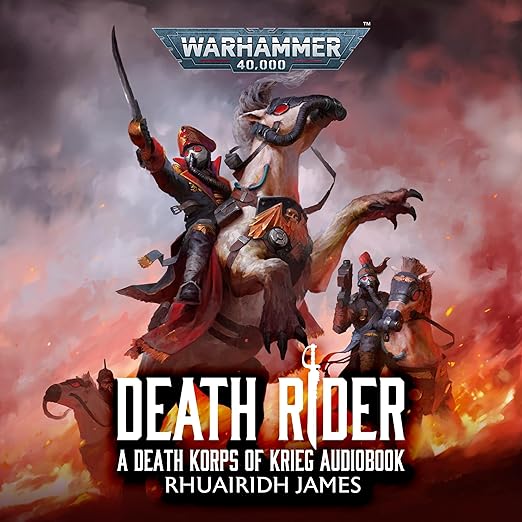
Commissar Valian Hesh faces a problem that most military fiction simply cannot accommodate: he must convince soldiers to value their own survival. Death Rider, written by Rhuairidh James and narrated by Andrew Wincott for Black Library, takes this premise seriously in a way that lifts it above standard Warhammer 40K action fare. This audiobook runs 10 hours and 5 minutes and follows Hesh as he attempts to prevent the 472nd Siege Regiment of Krieg from marching straight into a suicidal assault on t'au lines, on a planet already condemned to death by the Imperium's own battleship.
Hesh Must Convince Soldiers to Want to Live
The Death Korps of Krieg are one of Warhammer 40K fiction's most psychologically compelling factions. They are soldiers shaped by their world's nuclear devastation into something that no longer places self-preservation among its values. Their effectiveness as a military force comes precisely from this absence of self-regard, and their horror as human beings comes from the same place. James understands this duality and uses Hesh, a commissar whose function is normally to maintain discipline through fear of execution, as the vehicle for an ironic reversal. Hesh's job here is not to threaten his soldiers into fighting but to persuade an army with a death wish that dying right now is the wrong kind of dying. That is an unusual frame for a 40K story, and the narrative earns its runtime by staying inside that tension rather than resolving it with conventional action beats. The reviewer who describes the book as the best Krieg novel and highlights the commissar challenge as its central achievement is pointing at exactly the right thing. The making of a commissar who must think rather than command his way through a crisis is the moral engine of the plot. Jens, the prefectus militant who serves as Hesh's sole reliable ally, adds texture to a story that could easily become a one-character study. The planet Rezlan VI itself, condemned by Imperial decree and slowly dying from atmospheric poisoning, functions as a physical expression of the story's central thesis: Hesh is trying to save people on a world that has already been written off. That structural irony is what gives Death Rider its particular quality of sustained tension without resolution.
Wincott's Measured Register Suits a Dying World
Andrew Wincott's narration is the production's central asset. Black Library audiobooks live and die by the match between narrator register and factional identity, and Wincott has the measured, austere quality that Krieg fiction requires. Hesh is a character who cannot afford to sound either passionate or defeated, and Wincott threads that needle consistently across 10 hours. The t'au military presence provides a technological contrast that James uses effectively: the Death Korps' overwhelming-force doctrine, built for grinding attritional siege warfare, becomes a liability against an enemy with superior ranged technology and positional control. That tactical imbalance creates external pressure on Hesh's internal struggle, and Wincott's performance keeps both tracks in balance. The atmosphere of Rezlan VI, poisoned air, dying infrastructure, abandoned strategic value, gives the story a peculiar kind of bleak beauty that Wincott sustains without overdramatizing. Hesh must find arguments for survival that have no strategic backing, and the way Wincott delivers those arguments gives them the weight they need to function as genuine persuasion rather than as empty leadership rhetoric. For listeners who have spent time in other Death Korps fiction, the sense of being returned to a familiar and deeply uncomfortable world is a feature of this production that Wincott's consistent register reinforces throughout.
Two Men Carry This Entire Impossible Story
Listeners new to Death Korps of Krieg material should understand that this is not an introductory text. James writes with a confidence in reader familiarity with Warhammer 40K's broader military and political structures that assumes existing knowledge. The opening chapters establish context quickly rather than extensively, and some of the factional specifics, the significance of the 472nd's particular doctrines, the commissar's precise institutional role, the t'au's caste-based military organization, will carry more resonance for readers with background in the setting. The story's philosophical center, the question of how you lead soldiers who want to die, receives James's full attention, but the supporting cast remains relatively underdeveloped outside of Hesh and Jens. This is a character study of two men in an impossible position rather than an ensemble narrative. The pacing is deliberate in the middle third, appropriate to the tactical stalemate the story describes, but it may test the patience of listeners who want action across the full runtime. The reward for that patience is a resolution that earns its weight rather than manufacturing urgency through action alone. James does not permit an easy out. The conditions that Hesh faces at the start of the story are not improved by the story's end so much as navigated, which is a more honest treatment of impossible military situations than most genre fiction allows itself.
Psychological Complexity Outweighs Kinetic Action Here
Warhammer 40K readers with existing familiarity with the Death Korps of Krieg will get the most from this audiobook, as the faction-specific material resonates most fully with that context. Listeners who enjoy military fiction that prioritizes psychological and moral complexity over kinetic action will find this a rewarding Black Library entry. Genre readers with no Warhammer background who are comfortable following an unfamiliar fictional universe should find the core human story accessible, though some of the political and institutional texture will be opaque. Listeners who need constant action and a heroic resolution should look elsewhere in the Black Library catalog.
Good to Know
Is Death Rider a standalone audiobook or part of an ongoing Black Library series?
Death Rider is presented as a standalone Death Korps of Krieg story rather than a numbered series entry. It can be listened to without prior Black Library reading, though the Krieg setting has been covered in other Black Library productions.
How graphic is the combat content in this audiobook?
The violence is present and atmospheric rather than gratuitously graphic. Black Library audiobooks typically depict battlefield horror in ways that serve narrative tension, and Death Rider follows that pattern. It is appropriate for mature listeners comfortable with military fiction's standard conventions.
Is Andrew Wincott a regular narrator for Warhammer 40K audiobooks?
Andrew Wincott is an experienced Black Library narrator with a range well-suited to the setting's military and gothic registers. His performance in Death Rider reflects familiarity with the demands of 40K fiction.






