
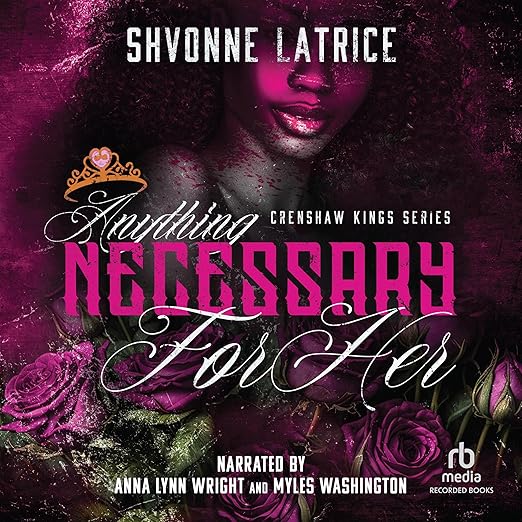
Banks St. Thomas closes out the Crenshaw Kings saga exactly the way a nine book series finale should: not by tying up every loose end tidily, but by giving its most protective, most fought over heroine one more test worthy of everything readers have watched her survive. This audiobook runs nearly sixteen hours, and Shvonne Latrice spends every one of them earning an ending at least one longtime reader has called the perfect close to the series.
Banks is the daughter of street legend Prime, a trained ballerina, a college graduate, and by this point in the series the only boss of her own life despite her brothers' objections, and this entry pairs her with Low, a drug empire heir who was told explicitly and repeatedly to stay away from her. The forbidden romance at the center is not new territory for street lit, but book nine's job is different from book one's: it has to justify why this specific pairing was worth building toward across an entire series.
Anna Lynn Wright narrates a cast defined largely by tension between protection and control, Banks's seven brothers per one listener's account, a father's legendary street reputation hanging over every relationship she tries to have on her own terms, and the performance has to differentiate a genuinely large family ensemble without letting any one voice blur into another. That is a harder technical task in book nine of an established series than it would be in a standalone, since listeners already carry expectations for how each character should sound.
Low's characterization benefits from real specificity rather than stock bad boy tropes: raised by an unreliable, alcohol dependent mother, functioning as a de facto parent to his own younger siblings well before stepping into control of a drug empire, his hardness reads as earned circumstance rather than genre furniture. The romance works because both leads carry genuine weight into it, not because the plot manufactures obstacles neither character has to actually reckon with.
Reviewer Alexis Lott described laughing, crying, and getting butterflies across the full series, a fair preview of the tonal range this specific entry asks a narrator to cover: real danger and loss sit alongside genuine warmth and humor, sometimes within the same scene, and Wright's performance has to shift registers quickly without either tone undercutting the other.
The series' title itself, Crenshaw Kings, signals a focus on power and legacy passed between men, but this particular entry's real center of gravity is Banks asserting she is not property to be protected or bargained over by any of them, brothers or lovers alike, and that thematic tension between the series name and its actual heroine's arc gives the finale a sharper point of view than a simple romantic conclusion would need.
The book's own title doubles as Low's stated code and the story's clearest thesis statement, and Wright's steady, unhurried delivery in scenes where he explains exactly what that phrase means to him keeps the line from tipping into empty tough guy posturing; it lands instead as a genuine, if unsettling, statement of devotion consistent with everything the character has survived up to that point.
Banks's ballet background is a specific, somewhat unexpected detail for this genre, and the series has used it consistently enough across nine books that it reads as genuine characterization rather than a decorative one time detail; disciplined, controlled physicality sits at odds with the chaos her family and her romance keep generating around her, and that contrast is part of what makes her a durable protagonist across a long series.
Sixteen Hours Balance the Danger and Domestic Plots
Street lit and urban romance built around real family stakes rather than pure heat rewards audio specifically because so much of the genre's tension lives in how a threat is delivered, a brother's warning, a rival's confrontation, and a skilled narrator differentiating those voices does real work a page of dialogue tags alone cannot replicate.
At nearly sixteen hours, this is a substantial listen even by the standards of a genre known for long, immersive series entries, and that length gives Latrice room to let both the danger plot, Low's empire, and the domestic plot, Banks asserting independence from her brothers, develop with real proportion rather than rushing either one to make space for the other.
For listeners who have followed all eight prior Crenshaw Kings entries, the appeal of closure itself is significant; one reviewer's account specifically praises this as the perfect ending, and a well executed series finale is its own distinct pleasure, different from and in some ways harder to deliver than a strong opening volume.
The series' consistent five star reception across its listener reviews, evident even in this small sample, suggests Shvonne Latrice has built real trust with her audience across nine entries, the kind of trust that lets a finale take bigger emotional risks than an opening volume could, since returning listeners already have the patience and investment a first time reader would not yet have earned.
Book Nine Assumes You Know This Family
This is explicitly book nine of the Crenshaw Kings series, and nothing about the synopsis or reviews suggests it functions as a standalone entry point; new listeners should expect to start from book one rather than jumping in here, since the emotional weight of Banks's arc depends entirely on the eight books of history the series has already built.
The content itself carries real intensity, forbidden romance, drug trade violence, family control dynamics bordering on coercive, and listeners sensitive to any of those specific themes should know this is not a lighter entry in the genre; the synopsis itself describes a man turned into something dangerous specifically to protect what he has found, language that signals real stakes rather than a soft landing.
Because this is the ninth entry in a long running series, runtime and pacing assume deep familiarity with established relationships and grudges; listeners who try to sample this specific book in isolation, without the prior eight, will likely find character motivations underexplained, since the book is not written to reintroduce eight books' worth of history from scratch.
Sibling Loyalty Earns This Finale Its Weight
This suits committed Crenshaw Kings readers ready for the finale their investment has earned, and fans of street lit romance that takes sibling loyalty as seriously as the central love story. Anyone who has followed Banks across the series specifically should not skip this closing entry.
Skip it, for now, if you are new to the series; start with book one instead and build toward this ending the way it was designed to be experienced, since arriving here first will cost you most of what makes this specific entry land as hard as longtime readers describe.
Quick Take
- Narration: Anna Lynn Wright differentiates a large, tense family ensemble while keeping the forbidden romance at the emotional center.
- Themes: forbidden love, street empire inheritance, sibling protection versus independence
- Mood: Intense, emotional, and high stakes
- Verdict: A satisfying finale for committed Crenshaw Kings listeners, though newcomers should start at book one first.
Questions Listeners Ask
Do I need to listen to the first eight Crenshaw Kings books before this audiobook?
Yes, this is book nine and functions as a series finale; the emotional weight depends entirely on the history built across the earlier entries, so starting here is not recommended.
How intense is this audiobook's romantic and street content?
The synopsis describes an intense, all consuming romance with real heat, consistent with the series' established tone, though specific content warnings are not spelled out anywhere on the listing itself.
Is this audiobook a satisfying conclusion to the series?
At least one longtime reader described it as the perfect ending to the series, suggesting Shvonne Latrice sticks the landing for readers who have followed Banks's full arc.
How long is this audiobook?
It runs nearly sixteen hours, substantial even by the standards of a genre known for long series entries.






