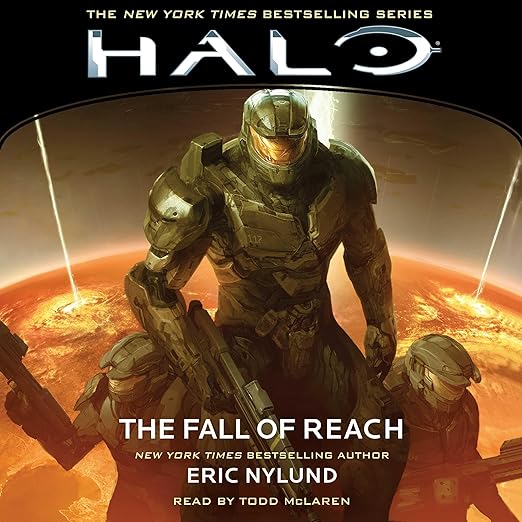
A tie-in novel has one job that matters, and it is to make somebody who has never held a controller care about the person inside the armor. Eric Nylund does it by refusing to open on heroism. He opens on a doctor named Catherine Halsey, a list of seventy-five children, a top-secret program, and a six-year-old boy called John. That is why this audiobook still works for people with no stake in the franchise, and it is why the listing wrapped around it deserves a closer look than most.
The Review
Four ratings, five written responses. The listing posts 4.8 stars across four, and 4.8 is precisely what those five written grades average out to: four fives and a four, twenty-four points spread across five people. When the visible mean lands exactly on the posted figure, the average is the field telling the truth and the counter is the one that has gone wrong, because five paragraphs cannot sit underneath a population of four. Worth knowing before you set that 4.8 against a book carrying a thousand ratings somewhere else.
Which makes the September 2023 entry the strangest object here. It carries five stars and opens by stating flatly that the writing is not good, that the book develops a character who is never allowed to have any character, and that countless things were changed in this text before the present version. A grade and its own argument pointing in opposite directions is a real hazard on a page with four ratings, where one mismatched star moves the average visibly. It is also the only place on this listing where anybody mentions that more than one version of the text exists.
Why Halo: The Fall of Reach Works as an Audiobook
Nylund writes the Spartan program as procedure, and that is the source of the grip. The April 2025 five-star puts it cleanly: the structure is fast-paced and action-oriented, it refuses to waste time reaching the meat of the story, and the slower scenes exist to keep the pace honest rather than to pad it. That reader expected a lot more fluff and did not find any, then adds a disclosure worth weighing, which is that Halo shaped their own novels. Influence is not neutrality. A writer who has built on a book will forgive it things a newcomer will not.
What survives into audio is the coldness of the early chapters. The program begins with seventy-five children, and the training that follows is described in the same measured institutional register used for requisitioning equipment, and nothing in the telling pauses to be appalled on your behalf. Eleven hours and three minutes gives that arc room to land in the order it was built. The twenty-sixth-century politics around it, a United Earth Government losing its grip on hundreds of colonies and staring down open insurrection, arrives as background pressure rather than as a lecture, and the alien alliance the copy calls the Covenant is framed as the greater peril still ahead. The human problem carries this book.
Combat is written to be followed rather than admired. Positions, distances and consequences get stated plainly, which is precisely the kind of writing that survives a format where you cannot flick back a page to check who is standing where. Nylund also keeps his set pieces short and his consequences permanent, so the training chapters and the fighting chapters reinforce each other instead of sitting in separate halves of the book. It is unfashionable, unliterary construction, and it is the reason a novel commissioned to support a shooter has outlasted several of the games it was written for.
The Caveats
One response predates everything else on the page by more than a decade. A four-star filed in January 2005 describes the book as the story before the events of the first Halo game and praises the way the action plays out, which means it was written about a text that existed fourteen years before the January 2019 date this listing carries. Nothing marks it as belonging to an earlier edition. It simply sits in the same column as an entry from February 2026, feeding the same average.
Nobody here has written a word about Todd McLaren's reading, and on this particular book that gap costs something specific. The novel runs on rank, call sign, ship name and acronym, with Spartan designations carrying numbers attached to them. A single reader has to keep several dozen proper nouns distinct by voice alone, in a genre where listeners lose the thread the moment two officers start sounding identical. That is the question to put to a sample before committing eleven hours, and this page will not answer it for you.
Two smaller notes on the metadata. The publisher field runs two names together, an audio house and a franchise imprint, so the party actually responsible for this recording is not obvious at a glance. The shelving, meanwhile, files a video game tie-in under literary fiction alongside science fiction, which is generous and which will put the book in front of browsers who have no idea what a Spartan is. Neither point is fatal. Both make a page harder to read than it needs to be, on a listing that already has a counter it cannot support.
The Right Listener for Halo: The Fall of Reach
A February 2026 five-star makes the best case for the newcomer. That reader walked in with zero interest in Halo, joined a book club, got halfway through, and came out planning to play the games. It is a partial verdict filed mid-book and should be weighed as one. It is also the only response on the page written by somebody with no prior investment in the franchise, which makes it the most useful single data point here for anyone standing in the same place.
Come to it for the origin story, for military science fiction that treats its violence as logistics, and for a series opener that genuinely functions as one; both series fields here are filled in correctly, which is rarer than it ought to be. Steer clear if you want prose above plot, because sentence-level pleasure is not what this novel was built to deliver. Steer clear too if you assume the games are a prerequisite, though nothing on this page suggests they are. What the book is finally offering is an itemized price list for a manufactured hero, with none of the figures softened.
Before You Listen
Do you need to have played the games before starting this audiobook?
No prior play is required. The novel builds the Spartan program from the ground up and treats twenty-sixth-century politics as new information, so acronyms arrive with explanation attached rather than as fan service. If anything the traffic runs the other way, from the book toward the console.
Is eleven hours a long sitting for a video game tie-in audiobook?
Eleven hours and three minutes is standard length for military science fiction and short for an origin story covering roughly two decades. The structure helps: the selection, the training and the first campaign break into clean blocks, so stopping between them costs nothing in continuity.
Does this audiobook still work for listeners who already know the lore?
A two-line five-star filed from Brazil in February 2026 says it goes deep into franchise lore and recommends it without reservation, which is the only response here written from inside the fandom. Existing players get the origin of the Spartan program in full rather than in cutscene fragments.