Quick Take
- Narration: Isabella Tugman handles the split perspectives of Andra and Quinn with clear differentiation, keeping the fractured-group tension legible throughout.
- Themes: Survival under impossible odds, fractured alliances, found family under pressure
- Mood: Tense and relentless, with emotional stakes that build from the earlier books
- Verdict: A confident third installment that deepens the Cursed World series, though it rewards listeners who have already invested in the earlier books.
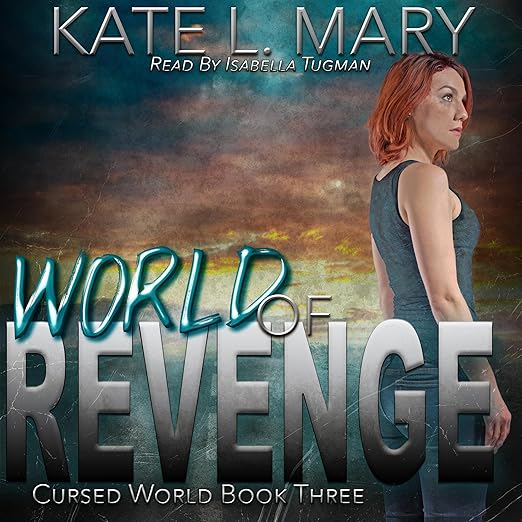
I started the Cursed World series without a roadmap, which is exactly how I prefer to encounter post-apocalyptic fiction. Kate L. Mary has been building her reputation in this corner of genre fiction for some time, and by the time I reached World of Revenge I had a clear sense of what her strengths are: grounded world-building, characters who make imperfect decisions under pressure, and an instinct for pacing that keeps a series moving without relying on artificial cliffhangers to drag you into the next book. This third installment, released in March 2026, does not discard any of those qualities, and it adds a new character who changes the dynamic of the whole series in retrospect.
The premise heading into book three is tight and well-constructed. Andra and Quinn, the series’ core partnership, are separated when an unpredictable teenage girl named Kendall arrives and complicates everything. Andra is on her own, using her wits to stay alive in a world already made lethal by hellish creatures, now also navigating the internal politics of a hostile group of survivors she cannot fully trust. Quinn, working on the outside with Andra’s volatile brother Gray, has to figure out whether an alliance with other survivors is a lifeline or a trap. The dual storyline keeps the tension from collapsing into a single perspective, and Mary manages the crosscutting well enough that neither thread feels like a placeholder for the other.
Kendall and the Character Who Changes the Series
One reviewer on Audible specifically highlighted Kendall as the element that most enriched the book, noting that a standalone Kendall novel deepened their appreciation of the earlier entries in the series. That tracks with my experience. Kendall is written as genuinely unpredictable in a way that feels earned rather than chaotic, a teenager whose anger has specific roots and whose choices, however frustrating, make internal sense once those roots become clear. Mary has a history of creating characters who appear to be one thing and reveal themselves as something more complicated, and Kendall is a strong example of that instinct at work across a third volume where series momentum could easily cause a writer to coast on what has already been established.
Another reviewer noted that the book occasionally feels repetitive in its middle section, and that is a fair observation worth acknowledging. The back-and-forth of Andra’s captivity and Quinn’s external maneuvering covers some of the same emotional terrain more than once before the third act picks up momentum again. The escalation is real and the resolution feels earned, but there are stretches in the second act where pacing flattens slightly before recovering its stride.
Isabella Tugman’s Performance Across Fractured Perspectives
Isabella Tugman narrates, and she is a good fit for this material. Post-apocalyptic fiction that splits its focus between multiple viewpoints puts real demands on a narrator, because the tonal shifts between a character under direct physical threat and one doing tactical problem-solving need to be registered without becoming theatrical. Tugman handles this with consistent clarity. Her Andra feels resourceful and frightened in equal measure, and her Quinn reads as a man calculating under pressure rather than performing heroism for an audience. The supporting cast, particularly Gray, stays distinct enough that the listener rarely needs to backtrack to reorient themselves within a scene.
At nine and a half hours this is a comfortable listening length for a series installment, substantial enough to feel complete but not padded in the way that some third entries can be when a publisher is thinking about volume count rather than story shape.
Creatures, Stakes, and Where the Series Is Heading
Multiple reviewers specifically highlight the monster concept and origin story as a distinguishing feature of the series, noting the unique take on post-apocalyptic fantasy and the realistic world-building and challenges the creatures create. Mary appears to have built something more original than standard zombie or infection narratives, and the creature mythology continues to develop in this installment in ways that suggest the author has a clear endpoint in mind rather than an indefinitely extensible franchise. Several reviewers noted that this book ends on a smaller cliffhanger than its predecessor, which is itself a structural choice worth noting. After the major break of book two, Mary seems to be consolidating rather than escalating, setting the stage for what feels like a final push rather than indefinite continuation. One reviewer commented that they usually lose interest after the first book in a series; the fact that World of Revenge held them through a third installment speaks to Mary’s ability to sustain investment across volumes. If you have read the first two Cursed World books, this is exactly what you want next.
Whether to Start Here or at the Beginning
For listeners who have not yet tried the Cursed World series, the recommendation is unambiguous: start with book one and let the story build. The creature mythology and the emotional architecture of the Andra-Quinn relationship need the earlier installments to land with full force. For existing fans who have been waiting since book two’s cliffhanger, this delivers on the promise of that setup while making clear that the story still has places left to go. Mary’s Broken World series won awards in the post-apocalyptic space, and reviewers note that this series is matching that earlier work in ambition. Book three is where a series either proves it has the depth to sustain itself or starts showing its limits; World of Revenge passes that test convincingly.
Frequently Asked Questions
Can World of Revenge be read as a standalone, or does it require the first two Cursed World books?
It is very much a continuation and benefits substantially from the character groundwork laid in books one and two. The synopsis drops you directly into an ongoing situation, and the emotional weight of Andra and Quinn’s separation only lands if you have invested in their relationship from the start. Begin with book one.
How does the creature mythology in the Cursed World series compare to typical zombie apocalypse fiction?
Multiple reviewers specifically highlight the monster concept and origin story as a distinguishing feature of the series. Mary appears to have built something more original than standard zombie or infection narratives, though the exact nature of the creatures is best discovered through the earlier books to avoid spoiling the world-building.
Does Isabella Tugman’s narration work for both Andra’s and Quinn’s perspectives?
Yes. Tugman differentiates between the two central perspectives clearly without overcorrecting into distinct character voices that feel artificial. Her approach is grounded rather than theatrical, which suits the realistic emotional register Mary uses throughout the series.
Is World of Revenge the final book in the Cursed World series?
Based on reviewer comments and the synopsis framing, the series is ongoing beyond book three. The ending of World of Revenge is described by reviewers as a smaller cliffhanger than book two’s, suggesting Mary is building toward a conclusion rather than extending the series indefinitely.