Quick Take
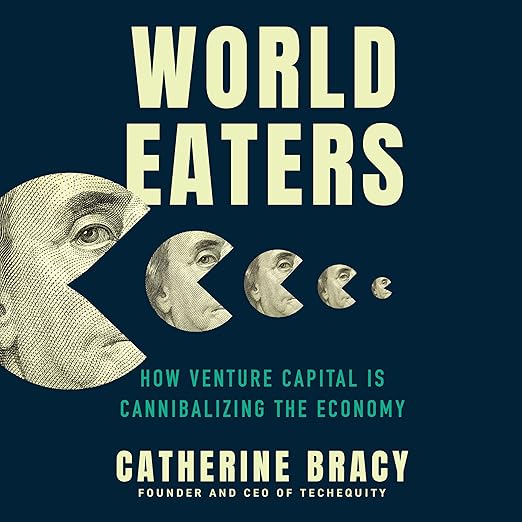
- Narration: Catherine Bracy narrates her own book with authority, though the self-narration reinforces the book’s insider voice in ways both effective and limiting.
- Themes: Venture capital as systemic harm, the gig economy’s human cost, the absence of viable funding alternatives for most startups
- Mood: Urgent and analytical, with a polemical undercurrent in the final third
- Verdict: A longlisted business book that makes the strongest available case against VC as a default funding model, despite a tonal shift in its closing section.
I listened to World Eaters on a week when two different people I know were dealing with the fallout of venture-backed companies imploding. The timing made Catherine Bracy’s argument feel less like a critical perspective on Silicon Valley and more like a clinical description of something I had been watching happen in real time. That is not a comfortable listening experience, but it is a useful one.
Bracy’s central claim is specific: the venture capital playbook, built around hypergrowth, exit-orientation, and a particular tolerance for collateral damage, has escaped its original context and is now reshaping industries and labor markets that were not designed to absorb it. Healthcare, food, entertainment, the gig economy. The harms are not incidental byproducts of VC’s operation. They are structural features of a model that treats every market as a roulette table and every company as a bet to be made and exited.
Our Take on World Eaters
What distinguishes this book from the standard VC critique is the analytical nuance Bracy maintains through most of it. She is not arguing that venture capital is inherently wrong or that no company should accept VC funding. She is making a more specific case: that VC is right for a narrow set of companies and outcomes, and that the current landscape offers so few alternatives that founders are taking on a model that does not fit their actual needs. One reviewer identified this as the most compelling argument throughout the whole book, and I agree. The section on the absence of alternative early-stage funding mechanisms is where the analysis is sharpest.
Bracy conducted original research for this book, interviewing founders, fund managers, contract and temp workers in the gig economy, and limited partners across the landscape. That breadth of sourcing gives the first half of the book a texture that transcends ideology. She is not summarizing what critics say about VC from the outside. She is reporting what participants across the system describe from within it.
Why Listen to World Eaters
Bracy narrating her own work is a specific choice that carries both advantages and costs. The authority is immediate. This is someone who lived inside the ecosystem she is describing, and her voice carries the confidence of firsthand knowledge. The limitation is that self-narration can reinforce the book’s own perspective in ways that leave less room for the listener to develop independent distance from the argument. You hear conviction throughout, and conviction is useful until it becomes insulation from complication.
At six hours and forty-five minutes, the book is efficiently structured. The runtime is appropriate for an argument of this scope. Bracy does not pad, and the pacing through the institutional sections maintains focus without becoming dry.
What to Watch For in World Eaters
The final quarter of the book is where the reviews diverge most sharply, and both the positive and critical reactions to it deserve examination. One reviewer found the last section preachy and politically slanted, with a very liberal bent. Another reviewer described the overall analysis as compelling food for thought that anyone involved in Silicon Valley or tech should engage with. The truth is that both reactions are pointing at something real. The final section does shift in register, moving from analytical reporting to something closer to advocacy. Whether that shift undermines the book’s credibility or represents Bracy applying the conclusions of her research depends significantly on what you bring to it.
Listeners who came specifically for the structural and institutional analysis of VC’s mechanics may find the closing section less satisfying than what precedes it. Listeners who share Bracy’s broader concerns about economic equity will likely find it a natural extension of the argument.
Who Should Listen to World Eaters
Founders considering VC funding who want the clearest available analysis of what they are actually signing up for. Policy researchers and regulators interested in the mechanics of how VC shapes adjacent industries. Readers of Winners Take All or Super Pumped who want something with more institutional rigor and less narrative drama. Skip the last third if the analytical first two-thirds are what you came for, and you find the register shift frustrating rather than clarifying.
Frequently Asked Questions
Does World Eaters argue that venture capital should be abolished?
No. Bracy’s argument is more nuanced: VC is appropriate for a specific subset of companies pursuing hypergrowth and fast exits, but it is the wrong model for most startups, and the lack of alternative early-stage funding options forces many founders into a misaligned relationship with a system not designed for their actual goals.
Why does the book divide reviewers in its final section?
The book shifts in its closing third from analytical reporting to something closer to political advocacy around equity and structural reform. Reviewers who came for the institutional analysis found this tonal shift preachy or unbalanced; those who share Bracy’s broader concerns found it a natural conclusion to the evidence she had built.
How does Catherine Bracy’s self-narration affect the listening experience?
The authority is clear and immediate. Bracy speaks with firsthand familiarity about the world she is describing. The limitation is that self-narration tends to reinforce the book’s own perspective, and listeners may find they have less room to develop independent distance from the argument than they would with a third-party narrator.
Is this a good listen for someone who works in tech or startups but has not worked directly with VC?
Yes. Reviewers specifically described this as the book they had been looking for to understand VC’s actual mechanics and societal reach. Bracy’s interviews with founders, fund managers, and gig workers give the analysis a texture that is accessible to people inside the tech industry but outside the funding layer specifically.