Quick Take
- Narration: David de Vries delivers a clean, professional read that suits the book’s businesslike tone without adding much interpretive color.
- Themes: Long-term wealth mindset, trend spotting before the mainstream, strategic discipline over instant gratification
- Mood: Motivating and practical, with a self-help cadence
- Verdict: A solid entry in the wealth-building genre that works best for readers ready to rethink their relationship with patience and risk.
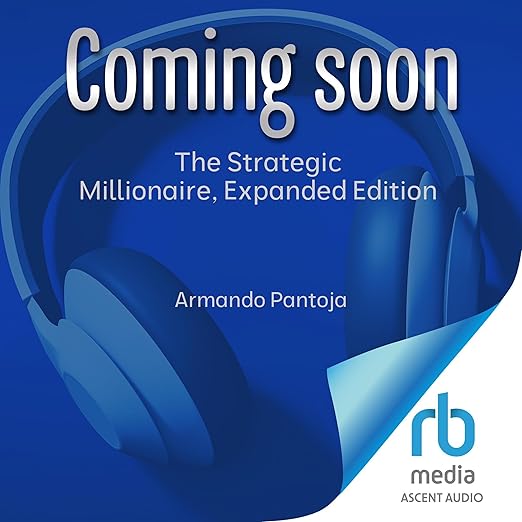
I listened to The Strategic Millionaire during a week when I had been rereading a stack of finance books that all seemed to repeat the same set of ideas at different volumes. Armando Pantoja’s expanded second edition arrived with a premise that immediately distinguished it from most of the genre: the problem with most wealth-building thinking, he argues, is not lack of information but a bias toward immediate reward over long-term positioning. That framing is not entirely new, but the way Pantoja builds on it is more structured than I expected.
The core of the book is the Seven Laws of Wealth, and they are presented with the kind of practical specificity that separates useful finance writing from motivational decoration. Pantoja walks through how to recognize emerging trends before they become mainstream, how to build networks that extend your access to opportunity, and how to invest in income-generating assets rather than chasing appreciation alone. The expanded edition adds material on building a balanced lifestyle and sustained productivity, which is where the book gestures most explicitly toward the broader self-help genre.
Our Take on The Strategic Millionaire
Pantoja is a veteran in financial technology, and that background gives the book a grounding that purely theoretical finance writing often lacks. He is not describing a system from the outside looking in. Reviewers noted that one of his particular strengths is explaining complex financial and technological concepts through simple, memorable analogies, and that observation tracks with my experience of the audio. The analogies are not dumbed down, but they are accessible, which matters over five and a half hours in your ears.
The review landscape for this edition does include the complicating fact that one of the five-star reviews was posted by Pantoja himself, which he acknowledged directly in the review. I mention this not to undermine the book but because transparency matters when evaluating a title’s reception. The remaining reader reviews are substantive and varied, including a genuine account from a buy-and-hold investor who found the book shifted his thinking about locking in profits.
Why Listen to The Strategic Millionaire
David de Vries handles the narration with competence and control. He does not inject personality where the text does not call for it, which suits the instructional register of the book. At five hours and thirty minutes, the runtime is efficient rather than padded. There are no extended anecdotes that serve mood over substance, and the pacing treats the listener’s attention as something worth respecting.
The audience Pantoja identifies explicitly includes entrepreneurs, founders, investors, traders, and finance and tech enthusiasts. That is a fairly accurate self-description. This is not a book for someone who wants foundational concepts explained from scratch. The Seven Laws assume a listener who already understands basic investing language and is looking for a framework that connects mindset to execution.
What to Watch For in The Strategic Millionaire
The final section of the book leans harder into rest, collaboration, and lifestyle design than the earlier material might lead you to expect. For some listeners this will feel like a natural extension of the strategic mindset being built throughout. For others it may feel like a tonal shift into territory that sits closer to wellness writing than financial strategy. It does not undermine the practical value of what comes before it, but knowing it is there helps you pace your expectations.
One reviewer noted the book prompted a genuine rethink of a long-held investment strategy, moving from pure buy-and-hold thinking toward something more dynamic. That kind of specific impact, when it appears in a review, is usually a more reliable signal than generalized enthusiasm.
Who Should Listen to The Strategic Millionaire
Entrepreneurs and investors who have read the standard canon of wealth-building books and are looking for something that bridges mindset and practical strategy without retreating into pure motivation. Also a strong choice for anyone in fintech or tech who wants a framework for translating industry knowledge into personal wealth positioning. Listeners who prefer deeply emotional or narrative-driven nonfiction may find the tone too instructional for sustained engagement.
Frequently Asked Questions
How does the expanded edition differ from the original Strategic Millionaire?
The expanded second edition adds material on building a balanced lifestyle that incorporates rest and collaboration, as well as additional content on sustained productivity. Readers who loved the original have noted the new version continues and extends what made the first edition worth reading.
Is this book suitable for beginners to personal finance?
Pantoja’s target audience includes entrepreneurs, investors, and finance and tech enthusiasts, which implies a baseline level of financial literacy. The book’s analogies are accessible, but it works best for listeners who already understand core investment concepts and are ready to think about long-term strategy.
How is David de Vries as a narrator for this type of content?
De Vries brings a clean, businesslike delivery that matches the book’s instructional tone. He does not add performative energy, which suits Pantoja’s approach. The narration is reliable rather than distinctive.
Is the Seven Laws framework tied to any specific investment products or programs?
Based on the synopsis and reviewer accounts, the Seven Laws are presented as general strategic principles around trend recognition, network building, and asset investment. Reviewers describe it as practical and clear rather than tied to a proprietary product or upsell.