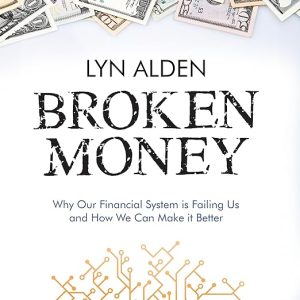
- Narrator: Guy Swann delivers the dense historical and technical content with measured clarity, his pace matching the analytical weight of Lyn Alden's arguments.
- Subjects: Monetary history, technology and money, Bitcoin, power structures, financial systems.
- Tone: Rigorous and expansive, like a long intellectual conversation with someone who has genuinely done the work.
- Bottom line: One of the most complete and intellectually serious treatments of monetary history and Bitcoin available in audio format.
Why does money keep breaking? Lyn Alden's central question in this audiobook is not rhetorical. It is an analytical frame for one of the most ambitious attempts in recent years to explain money, its history, and its present dysfunction through the single consistent lens of technology. At seventeen and a half hours, Broken Money is not a weekend listen. It is a course, and one of the most rewarding courses available in audio on the subject of how financial systems actually work and why they persistently fail to serve the people who depend on them.
Guy Swann, who has built a substantial reputation narrating economics and Bitcoin content, is the ideal reader for this material. He handles the transitions between historical narrative, theoretical framework, and technical explanation without losing pace or clarity. Alden's writing is precise, and Swann's narration honors that precision. The seventeen hours feel structured rather than interminable.
Alden Offers a Map Instead of a Conclusion
Alden's organizing thesis is that politics can shape monetary systems temporarily and locally, but technology drives what money becomes over the long arc of history. This is not a fringe argument. It is a serious analytical claim, and Alden backs it with a historical survey that runs from shells and commodity money through gold standards, paper currency, central banking, and the invention of the telegraph as a financial infrastructure event, all the way to Bitcoin's emergence as a new monetary technology. The through-line holds. Each transition she traces is driven primarily by a shift in what technology makes possible, with politics responding to that shift rather than directing it.
What distinguishes this book from most monetary history writing is the framework it builds for comparison. Rather than advocating for a single monetary system, Alden gives listeners a set of analytical tools: what properties make a monetary technology more or less sound, what historical forces have shaped the tradeoffs, and how to evaluate competing claims about different systems. That framework is the most valuable thing in the book, because it applies to conversations that will outlast any particular monetary regime.
At 4.8 stars, the early rating reflects a listener base that found the content genuinely transformative. Reviews describe readers who considered themselves financially literate discovering significant gaps in their understanding of how the current monetary system evolved and what it is actually doing. That response tracks with Alden's own intent: the book aims to give listeners a map, not a conclusion.
Neither Maximalist Evangelist Nor Dismissive Skeptic
The clearest reason is depth. Most popular finance audiobooks operate at the level of investment advice or personal money management. Broken Money operates at the level of what money fundamentally is, how it has changed across centuries of technological development, and what current monetary dynamics mean for real people and power structures. That depth is rare and genuinely useful for understanding financial news, policy debates, and investment logic that remain opaque without historical context.
The Bitcoin section is handled with notable rigor. Alden is neither a maximalist evangelist nor a dismissive skeptic. She evaluates Bitcoin as an engineer evaluating a new technology: what problem does it solve, how does it compare to prior monetary technologies, what are its genuine limitations, and what does its adoption trajectory suggest about its role in a broader monetary ecosystem? That analytical approach is more useful than the partisan treatments that dominate most Bitcoin coverage.
For listeners interested in macroeconomics, monetary policy, or geopolitical financial dynamics, this book also provides strong grounding. The sections on how central banking developed, how currencies gained and lost reserve status, and how the telegraph and later communications technologies restructured global finance are substantive historical treatments, not just context-setting for a Bitcoin argument.
Seventeen and a Half Hours, Built Cumulatively
This is a demanding listen. The historical and theoretical sections assume an engaged listener willing to follow extended arguments. Passive listening will not do the material justice. Plan for active listening, possibly with note-taking or reference to the companion PDF, which covers visual content the audio cannot convey.
The book's Bitcoin coverage may also land differently depending on where you stand going in. Alden does not hide her view that Bitcoin represents a meaningful monetary technology, but she builds to that conclusion through the historical and analytical framework rather than asserting it. Listeners who are skeptical of Bitcoin should engage with her argument on its own terms before reacting to the conclusion.
The runtime is genuinely long. Seventeen and a half hours is a serious investment. The book is organized to support non-linear listening if you want to move between sections, but Alden's framework builds cumulatively. The Bitcoin sections will make more sense if you have followed the monetary history that precedes them.
Bitcoin Skeptics Get a Genuinely Fair Hearing
Anyone trying to understand macroeconomic and monetary dynamics in a serious way will find this essential. This includes investors who want to understand what drives long-term currency trends, policy-engaged citizens who want to evaluate debates about inflation and monetary supply, and professionals in finance or economics who want a technology-first framework as a counterpoint to institutional economic theory.
Bitcoin skeptics who want a fair, rigorous treatment of why serious people find it compelling will do better here than almost anywhere else. Alden earns her conclusions rather than asserting them.
History enthusiasts with particular interest in economic and financial history will find the pre-Bitcoin sections rewarding in their own right. The account of how shells, gold, paper, and electronic systems each represented technological innovations in money is genuinely fascinating material even if you have no interest in cryptocurrency.
Questions Listeners Ask
Is this audiobook primarily about Bitcoin, or does it cover broader monetary history?
It covers the full sweep of monetary history first, from shells and gold through central banking and electronic finance. Bitcoin appears as the endpoint of a much longer technological argument, not the primary subject of the book.
Do I need economics training to follow this audiobook?
No formal training required. Alden writes clearly and builds her framework from first principles. Listeners with no economics background report finding it accessible, though the content is dense and rewards active listening.
How long is the Broken Money audiobook and is it worth the runtime?
The audiobook runs 17 hours and 31 minutes. Reviewers consistently say the length is justified by the depth and the framework it builds, which continues to pay off in how you understand financial news and debate.
Does this audiobook take a position on whether Bitcoin is a good investment?
Alden evaluates Bitcoin as a monetary technology rather than as an investment vehicle. She builds an analytical framework for comparing monetary systems and lets listeners draw their own investment conclusions.