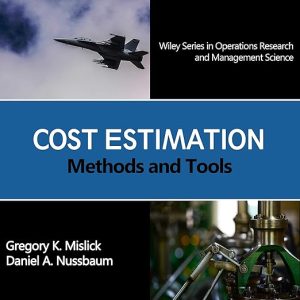
Cost Estimation: Methods and Tools by Gregory K. Mislick is not a book that wandered into the audiobook format from the popular business section. Matthew Boston's narration across 15 hours and 46 minutes is delivering a professional reference text , a comprehensive guide to quantitative cost estimation methodology used in industrial, business, defense, and manufacturing contexts. The PDF companion included with the audiobook purchase is not optional here; it's nearly essential for following the mathematical content that cannot be fully conveyed in audio alone.
I want to be precise about the audience for this text, because getting that wrong costs listeners real time. This is a specialist resource. The foreword from Dr. Douglas A. Brook, a professor at the Naval Postgraduate School who spent years in Department of Defense acquisition, signals the professional register. One reviewer describes using it daily to assist in numerous cost estimates and referencing it by program Milestone. Another calls it the best resource available for DoD estimators outside the DAU syllabus. These are not casual recommendations from curious readers , they're endorsements from practitioners using this as a working reference.
Theory Comes Before Application, Deliberately
The book's organization follows the logic of the cost estimation field itself. Mislick begins with historical perspective and key terminology, building the conceptual foundation before introducing the quantitative methods. The techniques covered include inflation indices, regression analysis, learning curves, analogical estimation, cost factors, and wrap rates , the core toolkit of professional cost analysis. That sequencing is pedagogically sound and reflects Mislick's background in teaching the subject rather than just practicing it.
For listeners coming from operations research, systems engineering, or defense acquisition, the coverage will feel both comprehensive and well-structured. The learning curve chapter in particular is a strong treatment of a method that sounds simple but carries considerable mathematical nuance in practice. Mislick explains the underlying theory before moving to application, which is the right order for building genuine understanding rather than just procedural competence.
Matthew Boston Reads the Chapter Questions Too
The audio format for a technical textbook requires some adaptation, and Boston's narration handles it with the right approach: he reads the material clearly and at a pace that allows for following the logical structure, without attempting to dramatize content that works through systematic argument rather than narrative. For practitioners who use the audiobook while commuting or traveling, the format provides access to dense reference material in a portable form , though the PDF companion needs to be available for the sections that involve mathematical notation or graphical data.
The chapter-end questions are worth noting. Mislick includes multiple questions at the end of each chapter, which Boston reads as part of the text. For listeners using this as a study resource , particularly those pursuing Cost Estimating and Analysis professional certification or taking graduate coursework , those questions are useful checkpoints. The audiobook can function as a supplementary study tool for listeners who are also working through the written text.
Wright and Crawford Models Get Full Treatment
This is emphatically not a general business book about estimating project costs in the conventional sense. Mislick's coverage is technical at a graduate level , the regression analysis chapter presupposes statistical literacy, the learning curve content requires comfort with exponential relationships, and the risk and uncertainty section engages with analytical frameworks that belong to operations research rather than popular project management literature.
The 15 hours and 46 minutes runtime reflects the depth of coverage. This is not a book to sample and summarize. It builds systematically from historical context through foundational methods to software and risk analysis, and the later chapters assume the earlier ones. Listeners who are not professionally or academically engaged with cost estimation will find the material rewarding as intellectual exposure but not immediately applicable in the way that business self-help promises application. Set expectations accordingly.
The treatment of learning curves in this book is worth highlighting specifically for listeners from the defense acquisition community. Mislick's explanation of the Wright model and the Crawford model, the distinction between unit and cumulative average curves, and the practical application of slope determination from historical data represents the kind of rigorous yet accessible treatment that distinguishes a good textbook from a good reference. Practitioners who have been applying learning curve methods without a firm theoretical grounding will find the foundational chapters valuable precisely because they explain why the methods work, not just how to use them.
The treatment of risk and uncertainty analysis in the later chapters is worth highlighting as material that extends beyond standard cost estimation curricula. Mislick introduces probability distributions, Monte Carlo simulation concepts, and sensitivity analysis in the context of cost estimation, giving practitioners tools for communicating the confidence interval around an estimate rather than presenting a single-point figure as definitive. That shift from point estimates to range estimates is increasingly standard in defense acquisition environments, and the audiobook's coverage of this area reflects current professional practice.
DoD Estimators Call This the Best Resource
Cost analysis engineers, defense acquisition professionals, and graduate students in operations research, engineering economics, or systems engineering will find this a genuinely comprehensive and well-organized reference. The DoD estimator audience specifically has endorsed it as the best available resource outside the DAU syllabus, and that recommendation from practitioners is credible.
General business listeners or project managers looking for accessible project cost estimation guidance should look elsewhere. This book is precise about what it covers and for whom. Its value is substantial within its defined professional context, and minimal outside it. If you work in cost analysis, this audiobook with the PDF companion is a desk reference worth having in audio form. If you don't, the depth is likely to feel excessive for your purposes.
At a Glance
- Narration: Matthew Boston handles the technical material with professional competence , his delivery keeps the quantitative methodology clear without flattening the structure that practitioners need to follow.
- Themes: Quantitative cost modeling, regression and learning curve methods, defense acquisition and industrial applications
- Mood: Dense and rigorous, with the systematic quality of a professional textbook rather than a business read
- Verdict: A serious reference text for cost analysis professionals and graduate students , valuable and well-executed, though its technical depth makes it better suited for specialists than general business listeners.