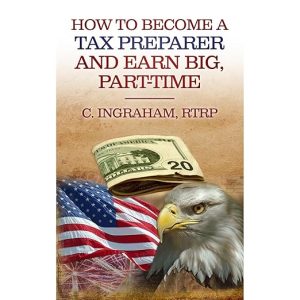
Forty-four minutes. That is the whole running time of this audiobook, and it has to hold ten numbered chapters plus a closing section called Additional Help, which works out at roughly four minutes each. Before that reads as a complaint, look at what the book actually is: a printed table of contents, an IRS checklist and a marketing plan, compressed on purpose and sold as a briefing. The audio is not a truncation of something longer. The book was always this short.
Ten Chapters, Two Spellings, One Twenty-Minute Briefing
Two spellings of the author's name sit on the same page. The byline reads C. Ingrham RTRP, while the description twice names the author C. Ingraham, RTRP, with an extra letter. One of the two has to be a typo, and the byline is the field people actually search. A listener who finishes, wants the online course the copy mentions, and goes looking for the same person may be searching a name that does not exist.
Ten chapters run from the IRS requirements for becoming a preparer through enrolled agent status, training, self-employment business structures, office equipment, professional tax software, marketing, retirement planning and a worked example of what you can charge. The full table of contents is printed in the description, which is more disclosure than most titles on this shelf bother with. Nothing about the scope is hidden. The only real question is what four minutes per chapter can carry.
A twenty-minute read is how the April 2016 five-star describes it, and the description is meant approvingly: simple ideas, straight to the point, nothing padding it out, and a handful of new usable ideas at the end. That verdict is the strongest defense the book has against its own length. Somebody wanted a briefing, received a briefing, and did not come away feeling shortchanged by it.
More Marketing Than Tax, Delivered by Machine Narration
Practical scope is what the March 2022 four-star took away. That response comes from a long-time tax preparer for whom starting a small tax business had been sitting on a bucket list for years, and it credits a quick pass through the book with broadening the idea of how to succeed at it. Somebody already inside the profession found something new, which counts for more than approval from a beginner with nothing to compare against.
Marketing occupies more of this book than tax does, and knowing that in advance changes the purchase. Advertising online and offline, social media, a blog, a website, ad campaigns, and how to build a sales funnel without knowing any HTML all get covered, alongside where to find clients and what to do once you have found them. This is a small-business setup guide that happens to be about tax preparation.
No performer is credited on this release at all. The reader slot carries the words Virtual Voice, machine speech generated from the text rather than a person recorded in a booth, and it collides with one specific promise in the description: that you will be connected directly to the IRS web pages to get started immediately. Spoken web addresses and agency form numbers are what synthetic reading handles worst, and nothing in the format lets you ask for a spelling.
Contingent IRS Rules and a Course Upsell Inside
Tax law is the risk this format carries, and the copy says so about itself. It notes that the IRS exam was not in place at the time the book was published, and includes tips on passing that exam should the IRS overturn the court decision behind its absence. A book openly describing its own regulatory information as contingent is being sold as a 2025 audio release, with nothing on the page recording when the underlying text was last revised.
Three stars is the lowest written verdict here, filed in December 2019, and even that one calls the information very helpful for making better informed decisions about a virtual tax business. Dates are the problem rather than grades. The five written responses run from February 2014 to December 2022, so the most recent predates this recording by two and a half years and the oldest by more than eleven, on a subject that changes every filing season.
Udemy turns up inside the description as somewhere to take the author's online course, which puts a paid upsell into the sales copy of a forty-four-minute product. That is neither dishonest nor unusual, and it does tell you how the book is positioned: as the entry point to a larger offering rather than as the offering itself. Anyone expecting completeness should recalibrate before pressing play.
Web addresses aside, the credentials in the copy are specific: more than 22 years of tax preparation experience, basic tax classes taught for two major tax franchises in the San Francisco Bay Area, and an internet marketing background that explains the weighting of the chapters. Neither franchise gets named. State-level rules get a single clause, almost any state, and no individual state appears anywhere in the description.
For Career Changers Testing the Idea First
Career changers testing an idea before committing money to it are the natural buyers. The February 2014 five-star, typed entirely in capitals, reports coming away with a lot of good ideas and then using the information to find a tax class online that fitted around a busy schedule. That is the book performing exactly as designed: not as instruction, but as a map of the steps, with the training itself bought somewhere else.
Existing preparers weighing a move to independent work are the second group, since the chapters on business structures, office equipment and software are about running a business rather than about preparing returns. Anyone who already has the technical side handled is buying the operational half and skipping nothing they needed. At this length that is a perfectly reasonable trade.
Avoid it when what you want is the tax content itself, because not one of the ten chapters teaches you how to prepare a return and the copy never pretends otherwise. Avoid it as well when current regulatory detail matters, since the page carries no revision date and the text flags its own IRS material as contingent. Otherwise take it for what it is: a short, unusually candid outline of the steps from somebody who has walked them.
Good to Know
Does this audiobook teach you how to prepare a tax return?
No, and it does not claim to. The chapters cover requirements, credentials, where to get training, software, business structure, marketing and pricing. Preparing the returns themselves is the one thing routed elsewhere, to the classes and franchises the copy points you toward.
What does the December 2022 five-star mean by planning to refer back to it?
That response calls it a quick read with a lot of good information and expects to return to the advice later. On a forty-four-minute file that is a real limitation worth naming: a checklist you intend to consult repeatedly is far easier to use as text than as audio you have to scrub through.
Can this audiobook be used outside the United States?
Not usefully. Everything in it is built on IRS requirements, the preparer identification process, and the US franchise and software market. The pricing chapter, the marketing chapter and the credentialing chapter would all need replacing to work under any other tax authority.
Does the audiobook explain what an enrolled agent is?
Yes, that gets a chapter of its own, second in the running order and directly after the IRS requirements chapter. Given the total length, expect a definition and the reason the status matters rather than a route map through the qualification itself.