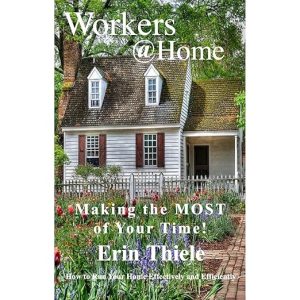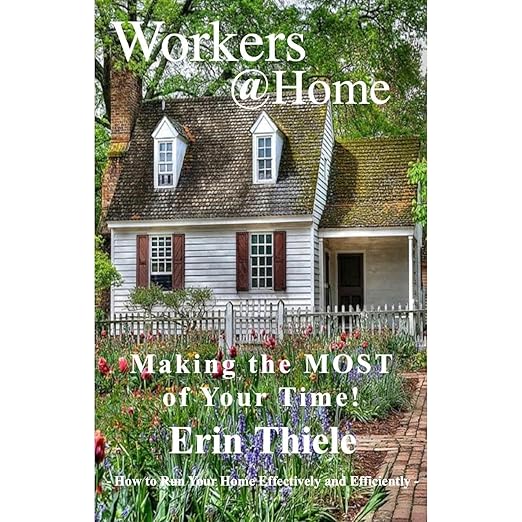
Erin Thiele wrote Workers @ Home from inside the experience rather than observing it from a distance. The synopsis makes that clear immediately: five children still at home, homeschooling three of them, running a worldwide ministry as a single parent, writing more than a dozen books, producing videos, speaking internationally. This is not a writer who researched domestic organization. This is someone who developed systems because the alternative was chaos, and who shares those systems with the directness of someone who knows they work because they have tested them under conditions most homemaking guides do not contemplate.
The audiobook, narrated by Virtual Voice, runs just under six hours, which puts it in the territory of a genuine reference guide rather than a quick inspiration read. The runtime accommodates Thiele's coverage of organizing and scheduling time, managing meals and clutter, cleaning routines, laundry systems, and even sewing, a category rarely addressed in contemporary homemaking literature. The breadth signals that this is meant to be consulted repeatedly rather than absorbed once and shelved.
Scheduling Advice Built on a Ministry Foundation
The book's most distinctive quality is its integration of faith and practical management without treating them as separate categories. Thiele does not write a secular homemaking guide and then add scripture references as a garnish. The biblical framework is structural. Her argument is that managing a home well is itself a form of ministry and discipleship, not a distraction from spiritual life but an expression of it. Reviewer Ursie noted that the book is grounded in Biblical basics and is encouraging to read, and that describes the tone accurately. This is not a devotional padded with household tips. It is a practical systems guide built on a theological foundation.
The scheduling section is particularly strong. Thiele's approach to time management is both specific and adaptable, which is a difficult balance to achieve in writing. She provides concrete frameworks for structuring a homemaking week without insisting on a single template that requires a specific household composition to function. Given that her own household situation, single parent, multiple children, homeschooling, and a demanding ministry schedule, is more complex than the average reader's, her recommendations carry the credibility of having been developed under pressure rather than in ideal conditions.
Isolated Chapters Survive Listening Better Than Warmth
The Virtual Voice narration is functional but limited in a specific way. Thiele's appeal as a writer is significantly personal. She communicates through her own story, and the warmth and authenticity that make the print book feel like advice from a trusted friend are harder to sustain in AI narration. The information comes through clearly, but the sense of relationship, which many readers of homemaking literature find as important as the content, is attenuated. For listeners who are primarily after the systems and the practical content, this limitation matters less. For those who want to feel accompanied by the author through the material, the audio version is a compromise.
That said, the reference-style nature of this audiobook makes the format workable in a particular way. Individual chapters on clutter, laundry, or meal planning can be listened to in isolation when a specific system needs addressing without replaying the entire book. Shorter chapters and a clear organizational structure make navigation practical, even in audio without chapter search tools. Reviewer Rachel C. described it as chock full of practical ideas, and the density of that practical content survives the audio translation better than the relational tone does.
This Guide Assumes a Christian Household Already
The faith dimension of this book is not peripheral. If you are looking for a secular homemaking guide with broad applicability across religious backgrounds, this is not it. Thiele's approach to home management is inseparable from her understanding of calling, stewardship, and the spiritual significance of domestic labor. Listeners who find that integration alien or off-putting will be in regular friction with the material, not because the practical content is invalid, but because the framework it lives inside will feel foreign.
The 4.3 rating across only 5 reviews is a small sample, with one outlying 1-star review that concerns itself with theological disagreements rather than the practical content. The positive reviews from listeners who share Thiele's faith orientation are consistent in praising the combination of spiritual grounding and actionable household advice. The book has a defined audience, and within that audience it performs well. Outside it, the theological integration that makes it distinctive for its intended readers will be the primary limiting factor.
Christian Women With Complex Households Will Recognize This
This audiobook is best suited to Christian women managing complex households who want a homemaking framework grounded in their faith. Parents navigating the demands of homeschooling, large families, or single-parent households will find Thiele's experience directly applicable in ways that many organizational guides, written from less demanding domestic circumstances, are not. Faith-based women's ministry groups looking for a practical complement to devotional programming will find it useful as a shared resource.
Listeners who approach homemaking organization from a secular perspective will find the theological integration a persistent friction point. Those seeking a narrowly focused guide on one aspect of home management, meal planning only, or organizational systems only, will find the book broader than their need. But for the listener who wants an honest, tested, and spiritually grounded approach to running a complex household, Thiele's guide delivers the kind of hard-won advice that comes from someone who developed every system under genuine pressure, not from a position of leisure or theoretical authority.
Is Workers @ Home audiobook suitable for listeners who are not practicing Christians?
It depends on your tolerance for embedded faith content. The biblical framework is structural to the book, not incidental. Practical homemaking advice is present throughout, but it is delivered within a theological worldview. Listeners who find that integration enriching will get the most from it; those who prefer secular organization content will find frequent friction.
Does the audiobook cover homeschooling-specific home management, or is it general homemaking?
The coverage is general homemaking with scheduling, cleaning, meal management, and organization, but Thiele's personal context as a homeschooling single parent informs the practical advice throughout. The systems she describes were developed to function in that demanding context, which makes them useful for households with similarly complex demands.
How does the Virtual Voice narration affect the listening experience for a book this personal in tone?
Noticeably. Thiele's appeal on the page is substantially personal, and AI narration smooths over the warmth and individuality that distinguish this from a generic systems guide. The practical content survives the transition, but the sense of being accompanied by someone who has lived this experience is diminished in the audio version.
At just under six hours, is this audiobook organized for reference listening or is it meant to be heard straight through?
Both approaches work. The first listen through gives you the full framework and the faith-based rationale for each system. After that, individual chapters on specific topics like meal planning or laundry routines are short enough to revisit when you are working on a particular area. The structure supports reference use rather than requiring a linear return each time.