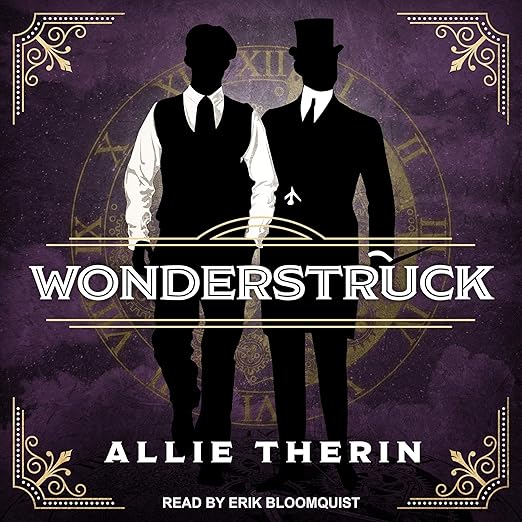
Allie Therin's Wonderstruck carries the weight of a series conclusion from its opening chapter. This audiobook is the third and final installment in the Magic in Manhattan series, set in 1925 New York and, in this volume, Paris. Arthur Kenzie and Rory Brodigan have been at the center of the series from the start, and arriving at their conclusion with the full cast intact - Zhang, Jade, and the newly expanded circle of allies and adversaries - gives the book the density of accumulated character investment that only a series conclusion can have. Listeners arriving here without the previous two books will follow the surface story; they won't feel its full emotional charge.
A Closer Look at Wonderstruck
The stakes in Wonderstruck are as high as Therin has set them: a supernatural relic capable of destroying every nonmagical mind in the world, a power-hungry faction of supernaturals converging on Paris, and an auction at the world's fair as the operational setting for what may be the most consequential thing Arthur and Rory have ever attempted together. But the novel's true subject, as it has been throughout Magic in Manhattan, is the relationship between Arthur and Rory and the specific way their bond is tested by the question of who protects whom and at what cost. Arthur's protectiveness has always run up against Rory's determination to prove his own capability and worth, and Wonderstruck brings that dynamic to its most explicit and honest point. The resolution of that tension is what the series has been building toward.
Reviewer Alex noted that the whole gang - Rory, Arthur, Zhang, and Jade - works together to find a way to destroy the relic before it falls into the wrong hands, and that the ensemble quality of the resolution is one of the series' genuine satisfactions. Reviewer Eponine821 was particularly taken with the development of Lord Fine, noting anticipation for a spinoff series that apparently follows from events in this book. That response is characteristic of Therin's world-building: the secondary characters feel dimensional enough that readers want to follow them into their own stories, which speaks to the care that went into building them across all three volumes.
The 1925 Paris world's fair setting is given enough historical texture to feel specific rather than generic. Therin uses the fair's public-facing excitement and international convergence as both plot mechanism and atmosphere, and the contrast between that festive backdrop and the supernatural danger playing out beneath it gives the audiobook a pleasantly doubled quality. The world's fair as a convergence point for people with power, ambition, and conflicting agendas is a natural choice for a series climax, and Therin earns it rather than simply using it as set dressing.
What Makes Wonderstruck Worth Hearing
Erik Bloomquist has narrated the series throughout, and his familiarity with these characters is audible in how he handles their distinct voices. By the third book, the emotional vocabulary between Arthur and Rory is established enough that the variations in their dynamic - the tension, the tenderness, the miscommunications that matter - register in Bloomquist's delivery without requiring explanatory prose to frame them. The audiobook format, with that accumulated character knowledge built into the narrator's voice, is in many ways the ideal format for a relationship-forward fantasy of this kind. You hear the history in how he voices them.
The period-appropriate slang that reviewer Eponine821 noted was slightly less present in this volume than in earlier installments is a minor observation, but it speaks to the care Therin has brought to historical voice across the series. The 1920s setting is not just visual texture but linguistic texture, and its presence gives the supernatural elements a specific period atmosphere that generic fantasy settings can't replicate. What Bloomquist communicates in that register - the slightly formal social surface beneath which the real relationships operate - is one of the series' sustained pleasures in audio form.
Things to Know Before Starting Wonderstruck
Listener Eponine821's review included a note of disagreement with how the group deals with the Baron after his defeat, without specifying details. This is relevant for readers who care about moral resolution in their fantasy fiction - the ending makes a choice that not everyone will find satisfying, and it's a considered choice rather than an oversight. Therin has a perspective on how justice operates in the supernatural world she's built, and Wonderstruck is where that perspective becomes most explicit. Coming in expecting a clean moral resolution may set you up for friction; coming in open to the author's own view of how this world works will serve you better.
The book's content note for mature themes is worth taking seriously: this is an adult LGBTQ+ fantasy romance, and the relationship between Arthur and Rory is depicted with full emotional and physical intimacy. That's part of what makes the series distinctive within the historical fantasy genre, and listeners should arrive knowing this is a love story with genuine heat alongside the supernatural adventure, not a gentle romance that happens to have magic in it. The intimacy is central to the story rather than incidental.
Who Allie Therin Is Writing For
Magic in Manhattan series readers have been waiting for this conclusion, and the audiobook delivers both the plot resolution and the emotional payoff that the first two volumes built toward. The series is best experienced in order, and listeners who have come this far will not be disappointed by how Therin chooses to close the story. Erik Bloomquist's narration carries the accumulated weight of the characters' relationship in a way that makes the audio format the most complete version of this conclusion.
Listeners new to the Magic in Manhattan series should start with Book 1. The supernatural world, the specific nature of Rory's psychometric ability and its dangers, and the full history between the characters are all load-bearing elements in Wonderstruck that the earlier books establish. Jumping directly to the conclusion loses the cumulative effect that makes the Paris mission feel genuinely urgent rather than merely plotted, and loses the emotional investment in Arthur and Rory that the finale requires in order to land fully.
Is Wonderstruck accessible as a standalone audiobook, or is it only for listeners who've read the full Magic in Manhattan series?
The plot has enough internal exposition to follow without the earlier books, but the emotional investment in Arthur and Rory's relationship is built across all three installments. The stakes of the Paris mission and the resolution of their dynamic carry full weight only if you've traveled with them from the beginning. Starting with Book 1 of Magic in Manhattan is strongly recommended before attempting this audiobook.
Does Erik Bloomquist's narration hold up as a series concluder given that he's voiced all three audiobooks?
Bloomquist's series continuity is one of the audiobook's consistent strengths. By the third book, his familiarity with Arthur and Rory's distinct voices and emotional registers allows for nuanced delivery that conveys relationship history without requiring prose to explain it. The accumulated narrator-character relationship mirrors the accumulated story investment and makes the finale feel appropriately earned.