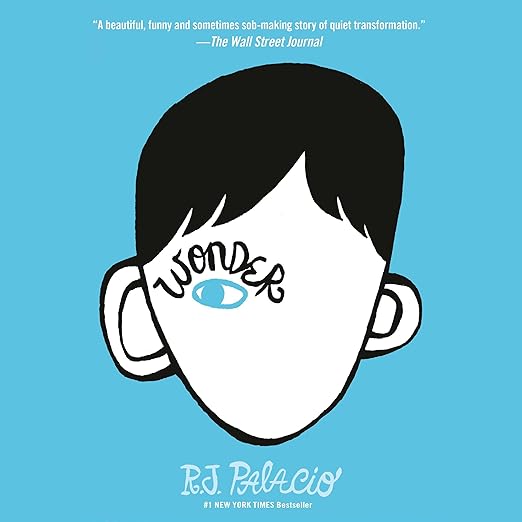
Auggie Pullman's first day at Beecher Prep sets the audiobook's stakes immediately: a ten-year-old with a facial difference who has never attended school walks into fifth grade knowing that every person who sees him for the first time will react, and that he cannot control what that reaction will be. R. J. Palacio built an entire novel around that specific, ongoing exposure and what it costs and what it teaches, and the result, sixteen million copies later, remains one of the clearest arguments children's literature has made for the value of sustained empathy. Kaya McLean's narration brings that argument home with the specific kind of lightness Auggie's perspective requires.
What Auggie Cannot See About Himself
Palacio's formal decision to narrate through multiple perspectives, Auggie, his sister Via, Via's boyfriend Justin, Auggie's friend Jack, and others, is the book's structural signature and its strongest feature. Each perspective arrives with a distinct voice and reveals something about Auggie that Auggie cannot see about himself. Via's chapter in particular offers a view of what it has cost her to grow up alongside a brother who absorbs every room's attention even when that attention is compassionate, a complexity that a first-person Auggie narration alone could not access. The multi-POV structure makes Wonder a novel about community rather than simply a novel about a singular extraordinary child.
Kindness Is Difficult, and the Book Shows It
Palacio has described the book as 'a meditation on kindness,' and that frame is accurate but potentially undersells how specific and honest the book is about why kindness is difficult. Jack's arc, moving from Auggie's friend to someone who betrays him in front of peers to someone who understands what the betrayal cost, is a more truthful account of the social pressures on middle schoolers than most children's fiction attempts. The book does not pretend that kindness is natural or easy. It shows the effort.
The Choose Kind movement the book inspired reflects a real cultural impact. But Wonder earns that impact inside the text itself rather than relying on external framing. The school year arc, from Auggie's first day to his final assembly, has a structure that resolves emotionally without being falsely triumphant. Auggie grows, but the world does not become simple.
McLean Shifts From Guarded to Private and Bitter
Kaya McLean's narration handles the multi-voice structure with the differentiation the format requires. Seven hours and ten minutes across multiple POV sections means each character needs to be immediately legible in audio without constant reminder of whose chapter you are in. McLean achieves that legibility through vocal choices that are distinct without being caricatured, which is the specific challenge of single-narrator multi-POV audiobooks. The shift from Auggie's somewhat guarded, observational voice to Via's more private and occasionally bitter register is handled particularly well.
For classroom use, Wonder in audio form creates a different engagement pattern than silent reading. Auggie's humor, which is a genuine presence throughout his chapters, lands more immediately when voiced. The classroom scenes, cafeteria scenes, and hallway scenes that make up much of the daily texture of the school year feel inhabited in audio rather than described. This is material that was designed for reading aloud, and the audiobook format confirms that instinct.
The E.B. White Read Aloud Award that Wonder received is relevant here: it honors books specifically suited to being heard. McLean's narration earns that designation.
A Visual Quirk McLean Cannot Replicate
Wonder's emotional directness, which is one of its great virtues for its target audience, can register as sentiment for adult readers expecting more ironic distance. Palacio is writing for children, and she does not obscure her moral position. For adult co-listeners reading alongside a child, that directness is appropriate and often effective. For adults reading solo, the unguarded quality of the emotional appeals may feel more manipulative than honest depending on one's tolerance for earnestness in fiction.
The multiple POV structure, while formally strong, creates some unevenness in chapter length and depth across perspectives. Justin's sections, rendered without capitalization in the print version, are unusual in audio because the stylistic choice is visual and McLean cannot replicate it vocally. Listeners who start in the audio version rather than print will not miss what they did not know was there, but it is worth noting as a formatting note.
The school year resolution, while emotionally satisfying, wraps up more neatly than middle school social politics typically allow. The book knows this and compensates through Via's more nuanced arc, but the central resolution still leans optimistic. For some readers that is a feature; for others it is a limitation.
Useful for Adults Who Work With Children
Fourth through seventh graders are the primary audience, particularly those navigating the social complexity of a new school environment or those who have felt excluded or conspicuous in peer settings. Parents who want a shared audiobook that generates conversation about empathy, peer pressure, and what loyalty looks like under social stress will find Wonder one of the most reliable choices available. Classroom teachers using the book as a shared text will find the audio version an effective way to unify the experience for diverse readers in the same room.
Adults who work with children, who teach, parent, or counsel, will find Wonder's account of middle school social dynamics precise enough to be useful rather than idealized. At seven hours and ten minutes, the whole school year fits in a weekend of family listening, and the conversation it generates afterward tends to be worth the time.
Palacio's decision to give multiple characters their own narration sections rather than filtering everything through Auggie is the formal bet that pays off most completely in the audiobook format. Via's chapter, in particular, adds a perspective that would be impossible to access through Auggie's narration: what it costs to be the sibling of someone who absorbs every room's attention even when that attention comes from kindness. That cost is real and not prettified, and McLean's handling of Via's more guarded and occasionally frustrated voice gives the audiobook a dimension beyond the central story of Auggie's year at Beecher Prep. Kaya McLean makes the full cast distinct without overcrowding the production.
What age group is Wonder audiobook best suited for?
The core audience is children aged 8 to 12, with grades 4 through 7 being the primary classroom range. The material is accessible for younger children with adult co-listeners and holds up for adults reading independently, though the emotional directness is calibrated for a younger primary audience.
Is this audiobook appropriate for classroom use?
Yes, Wonder is widely used in classroom settings and is specifically designed for read-aloud contexts; it won the E.B. White Read Aloud Award. The audio version works particularly well for shared classroom listening because the multi-voice narration makes the perspective shifts immediately legible.
Does Wonder audiobook cover the full book or is it an abridged version?
This is the full unabridged audiobook, covering the complete multi-POV narrative across all sections, including Auggie, Via, Justin, and Jack's chapters. Nothing has been cut.
How does the audiobook handle the multiple narrator perspectives in Wonder?
Kaya McLean narrates all perspectives as a single narrator, differentiating character voices through tonal and pacing shifts rather than assigning separate voice actors to each POV. The approach works well for audio and keeps the production cohesive across the seven-hour runtime.