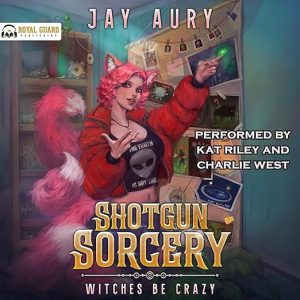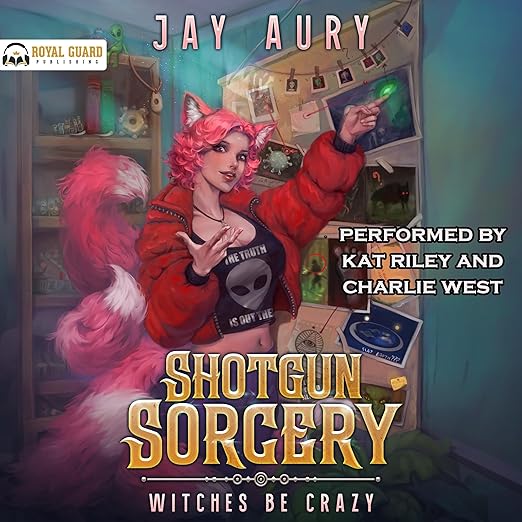
Vampires running pharmacies and a gremlin mechanic obsessed with monster trucks are just the background noise in Jay Aury's Shotgun Sorcery world, where the actual plot involves a coven of witches trying to recruit the narrator's girlfriend and a new street drug turning people into mushroom-infested monsters. Witches Be Crazy is the second audiobook in Aury's series, and it leans even harder into the genre-blending premise than the setup alone suggests, so what does a slayer do when the FBI is covering up half a missing cornfield and the mayor herself is running the local coven?
The Review
The appeal here sits squarely in the Dresden Files and Nightside tradition, urban fantasy that treats the supernatural as an open secret woven into ordinary civic life, pharmacies, real estate flipping, small-town mayoral politics, rather than hidden in some separate shadow realm. One reviewer, Kyle Wilson, specifically called out that lineage, praising a main character who isn't an all-powerful mage but comes across as sharp and well-prepared, with a stubborn toughness that doesn't require dominating every room to feel capable.
The tonal mix runs wide: conspiracy-minded kitsunes, ancient spirits with an oddly specific fondness for mid-2000s pop music, witches with genuine anger management issues, and a zombie count high enough that the synopsis jokes about needing a stick to shake at them all. That kind of tonal whiplash, from comedy to action to genuine occult worldbuilding, is the series' whole identity, and book two commits to it fully rather than settling into a more predictable groove.
The Shotgun Sorcery title itself signals the genre blend directly: shotgun evokes blue-collar, practical American action-adventure, while sorcery pulls in the fantasy elements, and the series lives specifically in that overlap, monster hunting as a trade with mundane business logistics rather than as high ceremonial magic. Vampires running pharmacies and dwarves flipping haunted houses both work as jokes precisely because they graft ordinary small-business concerns onto supernatural creatures, a specific comedic device that recurs throughout the series rather than a one-off gag.
The synopsis's own choice to describe the book as men's adventure is a specific, slightly old-fashioned genre label, harkening back to pulpy men's adventure paperbacks of the 1970s and 1980s, all plot momentum and wisecracking competence under pressure, now grafted onto urban fantasy's supernatural furniture. That lineage explains a lot about the book's priorities: less interested in slow-burn worldbuilding or literary prose than in keeping a reader entertained scene to scene, a defensible and honestly executed choice rather than a limitation, provided a listener knows that's the specific tradition being invoked.
Kat Riley's narration carries a large ensemble of very different supernatural creature types, and reviewers specifically praised the character development of three central women in this installment, which puts real pressure on a narrator to keep each voice distinct across a cast spanning witches, kitsunes, and whatever the mayor turns out to be. Comedic urban fantasy like this lives or dies on pacing, jokes that land a beat too slow go flat fast, and the strong rating average here suggests that timing is working for listeners.
This is a men's adventure-flavored entry in the urban fantasy genre specifically, which means a faster, punchier pace than more introspective fantasy tends to offer; a listener gets action, intrigue, and comedy braided together almost constantly rather than spaced out between slower character studies. One reviewer noted the book rarely lets a page go by without something happening, whether that's a fight, a joke, or a new occult complication.
One reviewer, Mangus, wanted more development for the book's three central female characters even while rating the book highly overall, and flagged some frustration with how the antagonist's final confrontation played out. That kind of specific, engaged criticism from an otherwise enthusiastic reader is a useful signal: this is a series with a real, invested fanbase paying close attention to character arcs, not just casual genre tourists skimming for action beats.
Reviewer Immel13 specifically praised how the book blends occult horror, paranormal elements, and science fiction into a single coherent tonal package on top of the established comedy, a genuinely difficult combination to sustain without one genre element undercutting another. That kind of tonal juggling act succeeding across a full sequel, rather than just an opening chapter's novelty, says something real about the author's control over the material even within a fundamentally pulpy, fast-moving format.
What to Watch For in Witches Be Crazy
This is explicitly a sequel, and while the synopsis and reviews suggest the humor and voice carry over cleanly, series continuity matters here; a listener starting cold with book two will miss the established relationships and running jokes book one presumably set up. New listeners should start with the first Shotgun Sorcery entry rather than jumping in at this installment.
One reviewer flagged some content on the spicier, more adult end of the spectrum, alongside the horror and comedy, so listeners sensitive to that mix should know it's part of the blend here, not an occasional aside. A second reviewer also noted this entry lacked some of the first book's particular charm even while still landing as solid overall, suggesting the sequel is a slightly different, not strictly better, experience than the opener.
The series' comedic instincts extend to its supporting cast of creatures as much as to its plot, kitsunes who are conspiracy theorists, spirits with oddly specific pop-culture nostalgia, and the humor depends on a narrator who can deliver those absurd juxtapositions completely straight rather than winking at the audience. Comedy that leans on deadpan delivery of ridiculous premises is a harder needle to thread than broader slapstick, since overplaying the joke undercuts it just as easily as underplaying it does.
Who It's For
Fans of Jim Butcher's Dresden Files or Simon R. Green's Nightside books who want something pulpier and more comedic will likely feel right at home here, especially listeners who like their urban fantasy protagonists competent but never all-powerful. Anyone already invested in the Shotgun Sorcery series after book one has every reason to continue; the rating average suggests the sequel holds up.
Readers drawn to found-family dynamics within a monster-hunting crew will also find real material here; the synopsis's mention of a coven, a mechanic, and various allied creatures suggests an ensemble the protagonist relies on rather than a lone-wolf slayer archetype, which shifts the emotional center of the series toward community even as the plot stays fast and violent.
Listeners who prefer their fantasy worldbuilding more serious and less overtly comedic, or who would rather avoid mature content mixed into their supernatural action, should look elsewhere in the genre. This is also not the place to start the series; go back to book one first, or the jokes and character dynamics here will land with much less impact.