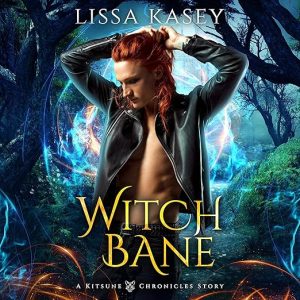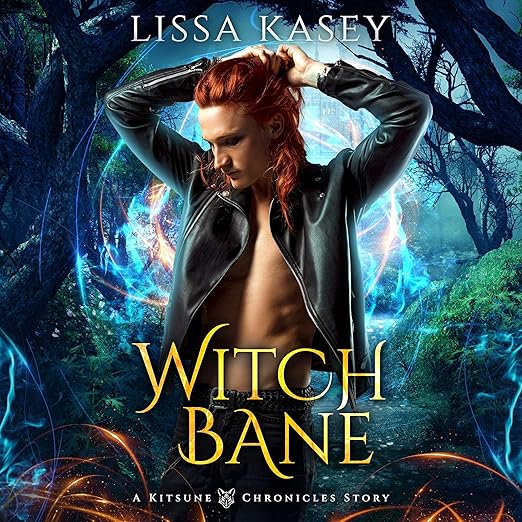
The third Kitsune Chronicles audiobook, Witchbane, builds on Lissa Kasey's specific and genuinely frightening premise: what happens when the power you carry threatens to destroy not the people you hate but the people you love most? Sebastian, bound to his fated mate Liam and embedded in a werewolf pack he finally considers home, is now opening portals to monster-filled dimensions in his sleep. His fae magic is wild and growing, and the most dangerous thing about it is precisely that he cannot control it even when he most needs to.
The Verdict, Briefly
This audiobook sits twelve hours into a series that rewards patience across its installments, and Kasey uses that accumulated investment ruthlessly. By this point, the reader has enough history with Sebastian and Liam's relationship to feel the specific weight of watching it come under threat, not from an external villain but from Sebastian's own nature. The fae inheritance he carries is described as 'a wild thing he's unable to control,' and that phrase accumulates meaning as the story develops. The uncontrollable power trope carries different emotional stakes when the person most likely to be hurt is the character you've spent two books learning to love alongside the narrator.
One reviewer's description, 'your emotions will be all over the place as you try to keep Seb and Liam safe,' captures the specific texture of a high-stakes paranormal romance where the threat to the central relationship is internal rather than external. Kasey does not give her readers an easy enemy to root against here. The danger is Sebastian himself, which makes the emotional stakes considerably more complex than a standard series-installment conflict and requires the reader to hold multiple feelings about the same character simultaneously.
Why Witchbane Works as an Audiobook
Tyler Kent's narration carries the dual demands of this story with consistency: Sebastian's intimate first-person voice and the escalating chaos of Underhill, the collapsing fae world the pair must enter to find a solution. The twelve-hour listen allows Kasey to build the Underhill sequences with genuine world-building weight. This is not a brief excursion but an extended immersion in a dying magical landscape with its own rules and its own inhabitants. Kent manages the transition between Sebastian's domestic interiority at home and the alien urgency of Underhill without the tonal whiplash that might undermine a shorter, less careful audiobook.
The secondary cast earns genuine attention throughout. Carl, whose banter with Sebastian drew specific reviewer praise, provides comedic texture against the book's darker currents. Ari also drew affection from readers. The fate of supporting characters like Toby, Nick, and Kiran creates stakes beyond the central pairing. Kasey has built a pack community that feels real enough that its members' danger registers as actual loss rather than narrative decoration. One reviewer who came in enthusiastic noted 'you'll agonize over the fate of kitsunes or werewolves,' which tells you something about the degree to which the world has been successfully populated.
Points to Consider
This is book three of a trilogy, and while Kasey provides enough context for a reasonably capable follow-along from a standing start, the emotional investment the book demands is proportional to the investment the reader has made in the first two installments. One reviewer noted preferring the first two books, and that preference for earlier entries in a trilogy, where the central relationship is newer and the foundational world-building fresher, is a common pattern in serialized romance. The book asks you to care deeply about how Liam resolves a specific problem at the climax, and that caring is built across twelve hours and two prior volumes.
The ending drew discussion from reviewers, with one noting that Liam's ultimate decision in resolving the central crisis was not the outcome they would have chosen, though they understood 'why it played out the way it did.' This suggests Kasey takes a genuine structural risk with her resolution rather than delivering a fully conventional series conclusion, which will land differently depending on the reader's relationship to the characters by that point. The resolution is earned, but it earns its complexity by asking something of the listener rather than simply satisfying expectations.
Who Should Listen to Witchbane
Readers who have completed the first two Kitsune Chronicles installments should come here directly. This completes an arc that requires prior investment to pay off in the way Kasey intends. LGBTQ+ paranormal romance listeners who enjoy M/M fated-mate narratives with genuine magical stakes will find this a strong entry in that niche. Listeners new to Lissa Kasey's work should start from the beginning of the series; the emotional machinery Kasey has built over three books does not transfer to cold-start readers with the same force. Those who want lighter, lower-stakes paranormal romance will find this more emotionally demanding than comfortable. This is a book that asks something of its reader in exchange for what it delivers, and for the right listener with the right preparation, that exchange is more than fair.
The twelve-hour runtime rewards the kind of committed single-session or two-session listening that audiobooks allow. Kasey builds tension through accumulation rather than sudden shocks, and the emotional payoff in the later chapters depends on everything that comes before it being absorbed rather than skimmed. Tyler Kent's consistent narration across the full length makes that kind of committed listening sustainable. Readers who have been with Sebastian and Liam since the beginning of the Kitsune Chronicles will find this conclusion earns the investment they have made.
Before You Press Play
- Read by: Tyler Kent brings the right register to Sebastian's dual interiority, fae magic and intimate love story, maintaining emotional clarity through the book's most chaotic set pieces.
- At its heart: Uncontrollable power and the fear of harming those you love, fated mates and the limits of that bond, survival in a collapsing magical world
- Vibe: Urgent and emotionally dense, with the specific anxiety of watching someone you care about destroy themselves trying to protect others
- Short version: A satisfying third installment that raises the stakes considerably for Sebastian and Liam, best experienced with the first two Kitsune Chronicles behind you.
Is this audiobook accessible to new listeners, or does it require the first two Kitsune Chronicles books first?
It is designed as a trilogy conclusion and works best with the first two books behind you. Kasey provides context for newcomers, but the emotional stakes of the ending depend significantly on investment built across the series. New listeners are strongly recommended to start at book one.
Does Tyler Kent's narration suit the combination of intimate romance and high-stakes fantasy in this audiobook?
Yes. Kent maintains Sebastian's first-person voice across the tonal range the book demands, from the domestic warmth of pack life to the alien urgency of Underhill. The secondary character voices are distinct enough to follow without confusion across a twelve-hour listen.