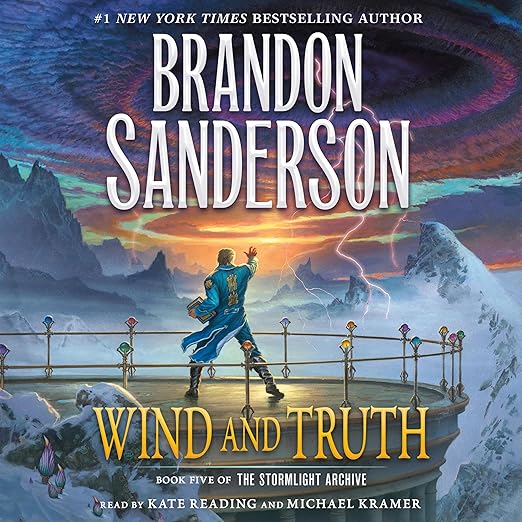
Wind and Truth arrives at a specific moment for the Stormlight Archive's readers. Brandon Sanderson began this series fifteen years ago with The Way of Kings, and that first volume was understood from the outset to be the opening of something vastly longer than a single book or trilogy - a planned ten-novel sequence whose first five books would form a complete arc before the narrative shifted in focus and character. Wind and Truth is the fifth book and the conclusion to that first arc, and the audiobook at sixty-two hours and forty-eight minutes is how the majority of the series' most dedicated readers have experienced it.
Where This One Lands
What Sanderson manages across the book's enormous span is something few writers at this scale attempt: he allows his characters to change in ways that feel earned rather than mechanically produced by plot. Kaladin's arc in particular, which began in The Way of Kings as one of the most compelling in contemporary fantasy, reaches a stage here that only makes sense as the product of four prior books of development. His work with Szeth in Shinovar - two broken people trying to help each other while completing an impossible mission - is the emotional center of Wind and Truth in a way that the geopolitical stakes never quite displace. Sanderson trusts that readers who have followed Kaladin this far will find his story more important than any contest of champions.
The scale Sanderson is managing here is genuinely staggering. Multiple simultaneous plotlines across different continents and character perspectives: Dalinar negotiating against the newly ascended Taravangian, who has taken Odium's place with a craftiness and ruthlessness the original god lacked; Szeth and Kaladin in Shinovar, where the mission to cleanse the homeland from the Unmade's corruption runs parallel to Kaladin's attempt to help Szeth fight his own psychological darkness; Shallan, Renarin, and Rlain pursuing the mystery of Ba-Ado-Mishram and her role in the enslavement of the singer race; Adolin in Azir, Sigzil and Venli at the Shattered Plains, Jasnah in Thaylenah. What makes this work as a novel rather than collapsing under its own logistical weight is Sanderson's genuine investment in character alongside the worldbuilding machinery. One reviewer noted that he "treats almost all of his major characters with humanity and depth," and that investment is what elevates the book beyond its ambition.
Another reviewer acknowledged the high exposition load honestly: the book "is full of exposition" with backstory that "doubles what we had been given for all the series so far." That is a fair description of something Sanderson does deliberately - he is closing out an arc and answering questions that have been open for fifteen years, and the answers require ground that has not been covered before. That same reviewer found the outcomes "not predictable at all" and the resolutions more satisfying than expected, which suggests the exposition pays its way.
The Library Journal gave the Kramer and Reading partnership a starred review for this series, describing them as "imbuing each character with distinct, complementary voices regardless of which reader is narrating." AudioFile praised them for maintaining narration of a "fascinating fantasy epic" that "keeps newcomers intrigued by its deep world-building." Those are institutional assessments, but what they are capturing is something genuinely extraordinary in performance terms: maintaining vocal differentiation across an enormous cast for sixty-two hours without confusion or inconsistency is a technical achievement that few narrators ever face at this scale. Kramer has narrated substantial portions of the broader Cosmere catalog as well, which means he brings cross-series familiarity to characters and concepts that appear here in new configurations. For listeners who have followed the series from the beginning, this is the payoff for hundreds of hours of prior listening investment, and Kramer and Reading deliver it with the confidence of practitioners who know exactly what they are doing.
Things to Know Before Starting Wind and Truth
The books also functions as a clear transition point. Sanderson has been explicit that the second arc of the Stormlight Archive - books six through ten - will focus on different characters and aspects of Roshar, with the current main characters stepping back. Wind and Truth manages that transition while resolving the first arc's central conflicts, and the result is a book that simultaneously ends something and opens something new. Listeners who have lived with Kaladin, Shallan, and Dalinar for fifteen years may find that dual nature bittersweet, which seems to be exactly the emotional register Sanderson intended.
The entry requirements are significant and not casual warnings. This is not a book that can be meaningfully listened to without the preceding four Stormlight Archive novels, and ideally the novellas Edgedancer and Dawnshard which fill in character development and plot context the fifth book assumes. One reviewer went further, noting that some key plot elements - particularly those involving the nature of Odium and the Cosmere's theological mechanics - require understanding of the Mistborn original trilogy to fully parse. That is an unusual demand for any fantasy series to make, and potential listeners should take it seriously before committing sixty-two hours to a conclusion they may not fully understand. The Cosmere connections run particularly deep in Wind and Truth in ways that reward readers of the broader catalog while remaining navigable for those who have read only the Stormlight Archive.
Recommended For
Readers who have followed the Stormlight Archive from The Way of Kings and feel genuine ownership of Roshar and its people will find Wind and Truth provides the conclusion to character arcs that have been building since that first volume. Sanderson's long-term Cosmere readers will find this volume unusually rich with cross-series payoff. Those new to Sanderson who are drawn by the cultural conversation around this release should start with The Way of Kings without exception - this is not an entry point but an earned conclusion. And for the listener who has already spent two hundred or more hours across the first four Stormlight books: sixty-two hours more, with Kramer and Reading at the height of their collaborative performance, is not a sacrifice. It is the return on a significant and deliberate investment in one of the most ambitious ongoing projects in contemporary fantasy.
Do Michael Kramer and Kate Reading share the narration across this audiobook?
Yes. Kramer and Reading have co-narrated the Stormlight Archive since the beginning. The Library Journal specifically praised their partnership for maintaining vocal consistency and distinct character voices across the enormous cast regardless of which narrator is reading a given chapter.
At 62 hours, how does Wind and Truth compare in length to previous Stormlight Archive audiobooks?
It is among the longest in the series, comparable to Rhythm of War which also exceeds fifty hours. The length reflects Sanderson's approach to arc conclusions - comprehensive character development, extensive worldbuilding answers, and multiple simultaneous storylines all running to resolution. Some reviewers noted the exposition load as heavy even by series standards.
Does this audiobook require familiarity with other Cosmere series beyond the Stormlight Archive?
The primary storyline is navigable for readers who have completed books one through four of the Stormlight Archive. However, one reviewer specifically noted that some key plot elements involving Odium's nature and certain Cosmere-level mechanics carry full meaning only with Mistborn trilogy context. The core narrative functions without it, but the Cosmere depth adds significant resonance for those who have it.