In Brief
- Read by: John Sackville reads a first-person science book whose author never appears at the microphone, which is a defensible choice and worth knowing in advance.
- At its heart: sleep deprivation and disease risk, REM and dreaming, caffeine and alcohol, sleep across a lifetime
- Vibe: Urgent, evidence-heavy, faintly alarming by design
- Short version: The clearest popular account of sleep science available in audio, provided you accept its consistently alarming register.
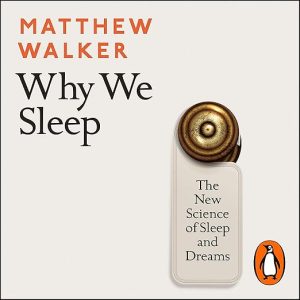
Thirteen and a half hours is a long time to spend being told you are not resting enough, and Matthew Walker never once acknowledges the joke. That restraint is the craft decision that makes this audiobook work. Read by John Sackville for Penguin and released in December 2017, Why We Sleep sets out to convert an ordinary biological necessity into the central health variable of a life, and it does so by stacking twenty years of laboratory work into a case that accumulates rather than repeats. The register stays level even when the claims are extreme, which is the only way an argument this large stays credible across a full working week of listening. I came out of it more alarmed than instructed in places, and I suspect that is deliberate.
Every Major Disease Traced Back to Sleep
Walker's thesis arrives early and never softens. Every major disease in the developed world, the description states, carries strong causal links to deficient sleep, and Alzheimer's, cancer, obesity and diabetes are named directly. Walker builds toward that from an unusually wide base, drawing on creatures across the animal kingdom alongside major human studies, then narrowing into the questions a general listener actually holds: what happens during REM sleep, how caffeine and alcohol interfere with it, and why the shape of a night changes between adolescence and old age. The scope is what distinguishes it from the sleep-hygiene shelf, where the advice arrives without the physiology underneath it.
Structurally the book runs in four parts, and one reader turned that into a method. A five-star dated August 2024 reported working through them out of order, going straight to jetlag, sleeping pills, dreams and healthy sleep, and naming part one as This Thing Called Sleep. What that reader valued most was the myth-dispelling. Modularity of that kind is unusually friendly to audio, where skipping is otherwise punishing, and it means a listener with one specific question can reach the relevant hour without wading through the preceding six.
John Sackville Voices a Scientist's Own Research
Publisher copy makes a strong claim for the book's novelty, billing it as the first title of its type produced by a working scientist, and the texture supports the boast even if the phrasing is promotional. What you get is a researcher explaining his own field at length rather than a journalist assembling interviews, and the difference shows in how the studies are introduced. Methods come before results. Caveats survive the translation into plain English. For a subject that has generated more confident nonsense than almost any other corner of health writing, that discipline is the reason to choose this over the alternatives.
One five-star, filed in the United Kingdom in January 2019, traced its own route in, having first encountered the research through a radio interview with the author, and described being impressed by how the study was designed, then developed and expanded. That listener reported reading the book feeling, for the first time, that these were genuine findings rather than someone's unproven opinions, and finished calling it eye-opening. That reaction is worth taking seriously, because it names the exact quality the subject usually lacks: a sense that the evidence came first and the recommendations followed.
Two format facts belong in the buying decision. The reader credited here is John Sackville, not Walker, on a book written throughout in the first person by a scientist describing his own laboratory, so the voice you hear is a professional standing in for an author who is otherwise very present on the page. The description also promises a bonus PDF of graphs and diagrams. That is not decoration. A book explaining sleep architecture across a night, and across a lifetime, does part of its arguing in pictures, and the audio necessarily converts those pictures into sentences.
One Scratched Copy Skews the Star Average
Star averages pool formats, and this pool proves it. A three-star filed from Ireland in October 2025 says nothing whatever about the argument and states as much, reporting instead that the item arrived sticky and scratched, looking as though it had already been read, and unpleasant to hold. That is a review of a shipped physical object sitting on a record for a thirteen-hour recording. It is a small thing, and a useful reminder that a 4.7 badge here is not a verdict on the listening experience specifically.
The rest of the page carries the same mixture. One five-star is written entirely in Italian, filed from Italy in September 2021, praising the density of supporting studies and insisting the book is not the university textbook that description implies. The publisher copy is British trade material, leading with a Sunday Times bestseller line and a run of British press books-of-the-year citations, which sits oddly on a listing sold to an American audience. The author field, meanwhile, repeats the doctorate twice, which is the kind of small metadata error that suggests nobody proofread the record.
Sleep Is the Foundation Under Diet and Exercise
Anyone who has ever treated sleep as the flexible item in a schedule is the intended reader, and the book is unsentimental about that habit. A five-star from June 2023 opened by quoting the book's own reversal, that sleep is not the third pillar of health alongside diet and exercise but the foundation the other two sit on, and that weakening it makes careful eating and exercise less effective. That response ranked the book among the two most important it had encountered. Shift workers, new parents, students and anyone managing jetlag will find whole chapters aimed squarely at them.
Listeners who are already anxious about their sleep should approach with care, since a book arguing that deficient rest drives the major diseases of modern life is not calming bedtime material. Readers wanting a step-by-step insomnia protocol will also find this is the reasoning behind such programs rather than the program itself. Everyone in between gets the most complete popular account of the subject currently available in audio, at a length that respects how much there actually is to say.
A Few Questions About Why We Sleep
Does the audiobook come with the supporting figures from the print edition?
A bonus PDF is listed as part of the package, although where it lands depends on the app and library you use. Those figures earn their place, since the book works through what happens during REM sleep and how sleep patterns shift across a lifetime, and both of those are easier drawn than spoken.
How technical is this audiobook for someone with no science background?
Walker writes for a general listener, and what he supplies is a working researcher's account of his own field. Expect described studies, animal research and trial results rather than equations. The demand is volume rather than difficulty: thirteen and a half hours of accumulating evidence asks for sustained attention.