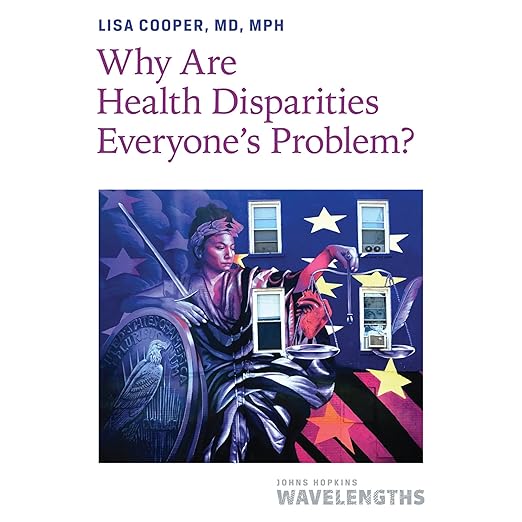
A university press has put a question mark in the title and then spent seven hours refusing to treat it as rhetorical. This audiobook is the spoken edition of a Johns Hopkins University Press book, produced by University Press Audiobooks and read by Jeanné Giddens, and its author is not a policy commentator but a physician who spent thirty years inside the system she is describing. Lisa Cooper trained as a clinician, became a health equity researcher at Johns Hopkins, and arrived at both from a childhood in Liberia. The argument she builds from that vantage is narrower and more useful than the title suggests.
Cooper Centers Communication Over Access and Insurance
Communication is the variable Cooper keeps returning to. Not access alone, not insurance alone, but what actually passes between a patient and a clinician, and what the quality of that relationship does to the outcome afterward. Thirty years of clinical work and research sit behind the claim, and it is the sort of claim that sounds soft until somebody with a medical career attaches evidence to it. From there the book widens: disparities as a cost driver, disparities as a source of adverse outcomes across the whole population, disparities as an enormous and mostly invisible burden of suffering that the system pays for whether or not it acknowledges the bill.
Herd immunity is the risky part of the argument and also the memorable one. Cooper asks for a new kind of herd immunity, reached when enough people across race and social class become immune to harmful social conditions, and describes the mechanism as a vaccination with solidarity, delivered through institutional and societal practice. Read quickly, that is a slogan. Read properly, it is a structural argument: immunity in the epidemiological sense never belonged to the individual, and the whole point of the concept is that your protection is manufactured by other people's. Applying it to social conditions is a genuine intellectual move rather than a decoration.
Giddens Voices a Story That Isn't Her Own
One written response exists, and it says the useful thing. The record's single text, dated October 2025, carries five stars and praises Cooper for writing clearly and concisely about disparities in today's health care system and about how everyone is affected, which is precisely the test a book like this passes or fails. Note the date: that reader was holding the printed edition a full five months before the audio existed, so the verdict covers the prose and cannot cover the performance. Clarity does survive the crossing into audio better than most virtues, and on a subject this easy to fog with abstraction it is the one worth confirming.
A book whose thesis is that the manner of an exchange changes its outcome is itself an exchange, and Jeanné Giddens is the one conducting it, speaking a first-person account of a Liberian childhood and a Johns Hopkins career that belongs to somebody else. That is a common arrangement in university press audio, where authors rarely narrate, and it is not a flaw. It does mean the memoir passages arrive at one remove, and seven hours and three minutes is short enough that a sample will tell you within minutes whether the remove bothers you.
Thirty-Four Votes, One Written Explanation
Thirty-four votes stand behind the badge and precisely one of them arrived with words attached. At 4.6 those thirty-four votes carry a running total somewhere between 155 and 158 stars, against 170 available, which is a strong result and a completely opaque one: the twelve to fifteen missing stars belong to people who never explained themselves. On an academic title this pattern is normal and it is still a problem for a buyer, because the specific complaints that matter here, whether the statistics are readable aloud, whether the policy chapters drag, whether the memoir and the research sit comfortably together, are exactly the complaints nobody has filed.
Three categories hold this record, and the mix is odd enough to mention. It files under health and wellness, under politics and social sciences, and under money and finance, and the first of those categories comes with an expectation of practical health advice, mindfulness and personal well-being that the book does not meet and never promised. It also carries a series name, Wavelengths, with no number attached and nothing else linked from the page. A listener who arrives expecting tips will be disappointed by chapter two. A listener who arrives expecting health policy will find the shelf undersells what they are getting.
Clinicians and Policy Readers Gain the Most Here
You will get something out of it if you work anywhere near patients, budgets or policy, and especially if you have watched a system produce a bad outcome without anyone in it behaving badly. Cooper's material is built for that reader: clinical experience, research training and a first-hand view of what happens when the person in front of you does not trust the institution behind you. It also rewards anyone interested in how a career gets made, since the route from Liberia to a research chair is a story the book tells rather than a credential it lists.
Leave it alone if you want a self-help program, because nothing here is addressed to your own health, and the promise being made is collective rather than personal. Anyone who wants a purely statistical treatment should think twice as well, since the memoir strand is load-bearing and cannot be skipped without losing the argument's foundation. Seven hours is a modest commitment for a book that asks a question in its title and then answers it with the whole of a professional life. The record around it undersells that, but the recording does not.
Quick Take
- Performance: Jeanné Giddens speaks a first-person clinical memoir that belongs to somebody else, the usual university press arrangement, on a seven-hour file short enough to sample cheaply.
- What it covers: Health equity, doctor-patient communication, solidarity as public health, one physician's route from Liberia to Johns Hopkins.
- Feel: Calm, evidence-led, quietly angry.
- Our call: A physician's case for treating inequality as an epidemiological problem, clear enough to survive the move into audio.
A Few Questions About Why Are Health Disparities Everyone's Problem?
Is this audiobook a memoir or a policy argument?
Both, deliberately. The description follows Cooper from a childhood in Liberia through thirty years as clinician and health equity researcher, and uses that career as the evidence base for a wider case about cost, outcomes and suffering. The personal material supports the argument rather than decorating it.
Does the audiobook offer practical health advice for individuals?
No, and the shelf label is misleading on this point. The book addresses systems, institutions and policy rather than personal wellness routines. Anyone arriving from the health and wellness category expecting tips on diet, sleep or mindfulness will find none of that in seven hours.