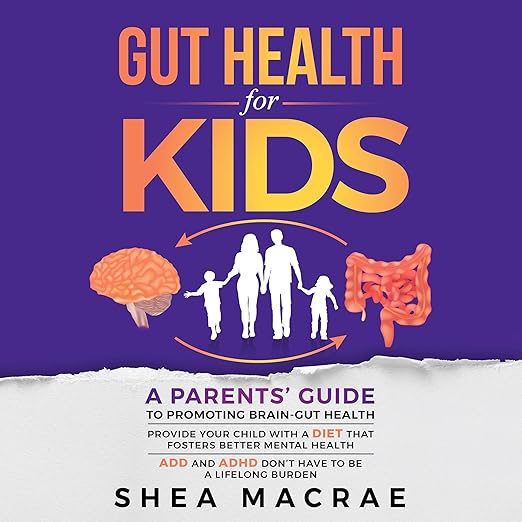
Quick Take
- Narration: Megan Meyer delivers the content cleanly and accessibly, maintaining a parent-friendly register that suits the book’s practical orientation without oversimplifying the science.
- Themes: Brain-gut connection, childhood nutrition, ADHD and behavioral health, microbiome and immune function
- Mood: Informative and action-oriented, with occasional urgency in the framing that listeners should calibrate against current evidence
- Verdict: A useful entry point for parents curious about the gut-brain axis and its implications for children’s mental and behavioral health, though the science should be treated as a foundation for conversation with healthcare providers rather than a standalone treatment guide.
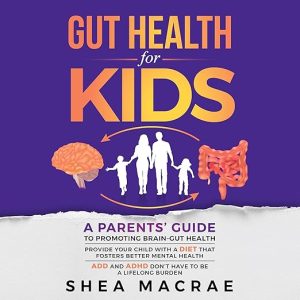
I came to this one on a recommendation from a parent who had spent months trying to understand why her child’s mood and focus shifted so dramatically with diet changes, in ways that her pediatrician was unable to fully explain. The gut-brain connection is a legitimate and actively researched area of science, the enteric nervous system’s relationship with the central nervous system, the role of microbiome composition in neurotransmitter production, the connection between gut dysbiosis and neurological conditions. It is also an area that has attracted more than its share of wellness speculation. Shea Macrae’s book lives somewhere between careful parent education and more enthusiastic claims, and knowing which is which will help you get the most out of it.
The foundational science is solid and clearly sourced. The Harvard Medical School research on gut-brain communication that Macrae cites is well-established, as is the National Center for Biotechnology Information literature on the connections between gut health and conditions including ADHD, autism spectrum disorder, anxiety, and depression. The basic mechanism, that gut bacteria influence neurotransmitter production, which influences brain function, which influences behavior and cognition, is not fringe science. It is genuinely useful for parents to understand, and Macrae does a reasonable job of making it accessible without making it misleading.
The Distance Between Correlation and Intervention
Where the book requires the most care is in the step from research correlation to dietary intervention. The science establishing connections between gut health and conditions like ADHD is strong enough to take seriously, but the translation from gut health influences ADHD symptoms to specific dietary changes will measurably improve ADHD symptoms in your child is more variable than the confident framing sometimes suggests. Macrae’s list of five diet types that can help improve ADHD symptoms is useful as an orientation to approaches with evidence behind them, but the evidence base for each varies considerably, and outcomes are individual.
This is not a reason to dismiss the book, it is a reason to bring it to conversations with your child’s pediatrician, nutritionist, or specialist rather than implementing it as a standalone treatment protocol. Reviewers who have found the content valuable describe it as an eye-opening foundation that changed how they thought about their child’s diet, not as a replacement for professional guidance. That framing seems right.
What the Recipes Add
The inclusion of gut-healthy recipes for children is a practical touch that lifts the book above pure information delivery. Understanding that certain food additives are associated with behavioral dysregulation is useful; knowing what to cook instead closes the gap between knowledge and action. The recipes are apparently simple and family-tested in their orientation, which suits a parent audience that doesn’t need gourmet complexity, just workable alternatives to the processed foods the book identifies as problematic.
The companion PDF, which is available in the Audible library alongside the audio, is worth downloading. Macrae covers a substantial amount of specific information, food additives, ingredient labeling, dietary protocols, that is genuinely easier to reference in written form than to retrieve from audio. The list of ten artificial ingredients to avoid, including the alternative labeling names manufacturers use, is the kind of information you will want to have in a format you can take to a grocery store. The PDF companion makes this a two-format experience by design.
Megan Meyer’s Narration and the Length Question
At just over four hours, this is a concise listen. Megan Meyer keeps the pacing brisk without feeling rushed, the chapters are well-organized, moving from the foundational science through the specific dietary factors to the practical recipes and recommendations. Meyer’s tone is appropriately practical for a parenting guide: engaged but not alarmist, which is the right register for a book that deals with topics that can easily tip into fearmongering if the delivery isn’t careful. She mostly stays on the right side of that line.
A reviewer described the content as filled with info that could possibly heal those with some serious gut issues, which captures both the book’s ambition and its limitation. The information is real and dense. For a parent starting from zero on the gut-brain connection, this is a solid first listen. For a parent already working with healthcare providers on their child’s gut health, it will likely confirm things they’ve already been told and may add specificity around particular ingredients and dietary approaches.
Who Should Listen
Parents who have noticed connections between their child’s diet and their mood, focus, or behavior and want a scientific framework for what they’re observing will find this genuinely useful. Parents of children with ADHD, autism, anxiety, or digestive issues who want to understand how gut health relates to those conditions will get a solid foundation here. Skip it if you’re looking for condition-specific clinical guidance, this is a general framework, not a targeted treatment protocol for any specific diagnosis.
Frequently Asked Questions
Does the book provide a specific elimination diet protocol, or does it describe multiple dietary approaches?
It describes multiple approaches rather than prescribing a single elimination diet. Macrae covers five diet types with evidence supporting improvements in ADHD symptoms and overall gut health, giving parents a range of options to discuss with their child’s healthcare provider rather than a single mandatory protocol.
Is the companion PDF genuinely necessary, or can you get the full value from the audio alone?
The companion PDF significantly enhances the book’s utility. Lists of artificial ingredients to avoid, including manufacturers’ alternative labeling names, are the kind of specific reference information that needs to be in written form to be practically useful. The audio version provides the framework and explains the why; the PDF provides the what in a format you can actually use at a grocery store or while meal planning.
Does the book address the gut-brain connection specifically for autism spectrum disorder and ADHD, or primarily for neurotypical children?
The book explicitly addresses autism spectrum disorder and ADHD as conditions with documented connections to gut health, alongside anxiety and depression. The dietary interventions discussed are framed as applicable across these conditions, though the specificity to individual conditions varies. Macrae uses research from the National Center for Biotechnology Information on the connections between gut microbiome and these diagnoses.
How does the recipe section relate to the science section, are the recipes organized around specific conditions or issues?
The recipes are generally framed as gut-healthy rather than organized by specific condition. They are designed to incorporate foods that support beneficial gut bacteria and exclude ingredients associated with dysregulation, making them broadly applicable rather than targeted to a single diagnosis.