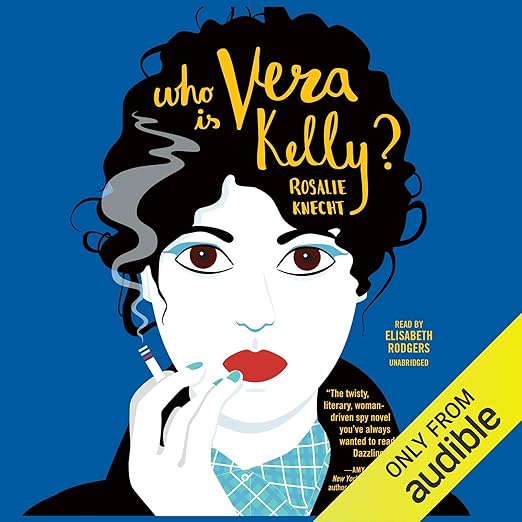
Quick Take
- Narration: Elisabeth Rodgers captures Vera’s dry, observational intelligence without sentimentalizing it; the narration suits the novel’s literary rather than thriller register.
- Themes: Queer identity and the Cold War closet, the cost of surveillance and secrecy on the self, coming of age through danger rather than safety
- Mood: Slow-burning and literary, closer to a character study than a spy thriller despite its Buenos Aires setting
- Verdict: A carefully made, character-first novel that rewards patience; listeners expecting action-heavy espionage will be disappointed, but those drawn to literary fiction with a queer spy at its center will find something worth their time.
I started Who Is Vera Kelly? on a Thursday evening with about two hours available and finished it over the following three days, which is not the reading pattern a spy thriller is supposed to produce. Rosalie Knecht’s novel is not built for urgency. It is built for accumulation: small details of a life that gradually resolve into a portrait, and a portrait that gradually reveals itself to be the whole point of the story. By the end I understood exactly who Vera Kelly was, which the title promises and the book delivers, though the path there is not the one the packaging suggests.
New York City, 1962. Vera is working night shifts at a radio station, managing her way through the Greenwich Village gay scene with the careful navigation of someone who knows that what she is cannot be safely visible, and getting noticed by a CIA recruiter who sees in her what a recruiter for a spy agency would see: quickness, discretion, technical skill, and an existing facility for not being fully known. The setup propels her to Buenos Aires, where she is tasked with wiretapping a congressman and infiltrating a group of student activists while the political situation around her moves toward the coup that will define 1960s Argentina.
The Dual Timeline and What It Achieves
Knecht structures the novel across two timelines. In 1962 Buenos Aires, we watch Vera work her assignment, become genuinely entangled with the students she is surveilling, and get stranded when the coup arrives and the CIA’s interest evaporates. In a parallel timeline beginning in 1957 Chevy Chase and moving forward, we follow Vera’s adolescence: the difficult mother, the gay identity that could not be expressed without consequence, the series of choices that made her exactly the kind of person a spy agency would want.
This structure is one of the book’s strongest formal decisions. The past explains the present without announcing itself, and Vera’s childhood experiences of keeping secrets, of knowing something fundamental about herself that had to remain hidden, connect directly to what makes her functional as a CIA operative. The cost of that capacity, what it does to a person to be professionally practiced at concealment, is the novel’s real subject. Reviewer Garrett Hutson described it as a literary spy novel featuring a lesbian protagonist, and noted that the character of Vera is front and center throughout. That emphasis is the correct one and it is what distinguishes the book from conventional espionage fiction.
What the Thriller Label Gets Wrong
One reviewer criticized the marketing of Who Is Vera Kelly? directly and specifically: the descriptions that frame it as a page-turner and a spy thriller are, in their assessment, simply wrong, and they set up a mismatch that damages the reading experience for people who arrive expecting action-heavy espionage. This is fair. Knecht is not writing a thriller in any conventional sense. The novel’s tension comes from character and context rather than from plot mechanics, and the Buenos Aires sequences, while genuinely gripping in places, are paced like literary fiction, which means slowly and with attention to interiority rather than event.
Reviewer Amazon Customer KJ described it as a book that slowly warmed them up, like a good stew after a long hike in the cold, and that simile is more useful than the packaging’s promises. The slow burn is real, and for listeners who settle into it with appropriate expectations, the burn is satisfying. For listeners who need the burn to be faster, the experience will be frustrating. The historical context, the 1962 Argentine political situation, the fragile Frondizi government, the student activism, the coup, is handled with enough specificity that listeners unfamiliar with this period of South American history will find it useful to have at least a general sense of the era before beginning.
Elisabeth Rodgers and the Interior Voice
Elisabeth Rodgers’s narration is well matched to Knecht’s prose style. Vera is a first-person narrator whose voice is dry, observational, and almost deliberately withheld; she is a woman who has spent her whole life not fully revealing herself, and the prose reflects that consistent reserve. Rodgers does not push for warmth or try to make Vera more accessible than she is. The narration has the quality of Vera herself: precise, occasionally sardonic, and clear about what it is and is not sharing. At six hours and fifty minutes, the runtime is appropriate for a novel of this scope, and the pacing does not drag in the way that some character-first literary fiction can in audio.
Listen if you are drawn to literary fiction that uses the spy genre as a container for questions about identity, concealment, and the cost of making yourself disappear. Listen if you want a queer protagonist whose identity is treated as central and specific rather than incidental. Skip if you need the plot mechanics of an espionage thriller, with tradecraft sequences, action set pieces, and a pace that keeps you from putting the book down. Skip also if you are not patient with backstory that arrives before the forward momentum of the main plot has been established; the dual timeline structure requires faith that the pieces will eventually connect.
The Narration Vera Would Approve Of
Elisabeth Rodgers’s narration is well matched to Knecht’s prose style. Vera is a first-person narrator whose voice is dry, observational, and almost deliberately withheld; she is a woman who has spent her whole life not fully revealing herself, and the prose reflects that consistent reserve. Rodgers does not push for warmth or try to make Vera more accessible than she is. The narration has the quality of Vera herself: precise, occasionally sardonic, and clear about what it is and is not sharing.
At six hours and fifty minutes, the runtime is appropriate for a novel of this scope, and the pacing does not drag in the way that some character-first literary fiction can in audio. The historical context, the 1962 Argentine political situation and the fragile Frondizi government, is handled with enough specificity that listeners unfamiliar with this period of South American history will find it useful to have at least a general sense of the era before beginning. Listen if you are drawn to literary fiction that uses the spy genre as a container for questions about identity and the cost of making yourself disappear. Skip if you need the plot mechanics of an espionage thriller with action set pieces and a pace that keeps you from putting the book down; this is not that novel.
Frequently Asked Questions
Is Who Is Vera Kelly? actually a spy thriller, or is it something else wearing that label?
It is closer to literary fiction with a spy premise than to a conventional espionage thriller. Several reviewers note that the marketing description creates a mismatch. The novel is a character study first, and its tension comes from identity and context rather than plot mechanics. Listeners expecting the pacing of a thriller will be disappointed.
How important is knowledge of 1962 Argentine political history to following the Buenos Aires sections?
Some familiarity helps. The coup and the political tensions of the period are treated as backdrop rather than explained in detail. Listeners with no prior knowledge of Frondizi’s Argentina may want to do light contextual reading beforehand, though the emotional experience of the novel does not depend on it.
Does Elisabeth Rodgers’s narration work for a first-person narrator as guarded and withheld as Vera Kelly?
Yes. Rodgers matches Vera’s register: dry, precise, not pushing for warmth. The narration suits the character’s fundamental quality of controlled self-concealment, which is the appropriate interpretive choice for this material.
This is the first book in a Vera Kelly series. Does Who Is Vera Kelly? work as a standalone, or does it set up an unresolved ending?
It functions well as a standalone. The novel’s central question, who Vera Kelly is, is answered by the end, and the emotional arc reaches a resolution. Readers who want to spend more time with the character will find subsequent books, but there is no cliffhanger compelling you toward them.