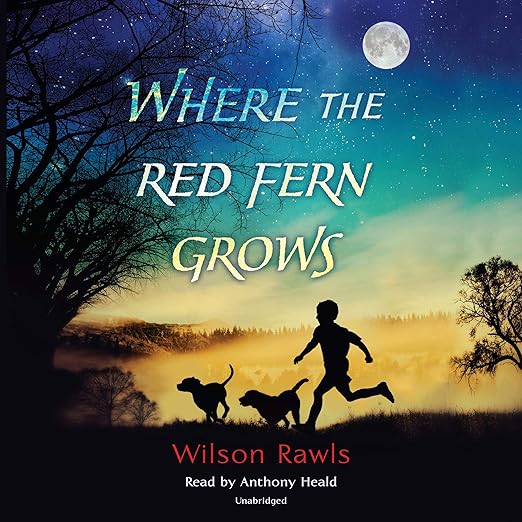
Anthony Heald has just under seven hours to spend on Billy, Old Dan, and Little Ann, and this audiobook listing hands over almost nothing about how that time gets used. What it hands over instead is a jacket: award citations, a print sales figure, and pull quotes from six outlets stacked underneath the plot summary. So the honest place to start is with what the page actually establishes, which amounts to a single credited reader, a Listening Library release dated October 24, 2003, and a novel that whole generations of children were handed in a classroom.
Five Voices Arrive Through One Throat
Wilson Rawls builds the whole thing on a simple economy. A boy wants two hound pups, the money does not exist, so the boy earns it, and the description is specific that the saving comes before the dogs do. Everything after depends on how completely you buy that opening arithmetic of wanting and working, and for most listeners the answer is completely, because the wanting is rendered with far more patience than the hunting ever receives. The pups arrive already loved, and Rawls spends the front half of the novel on a want rather than an event, which is precisely why the back half is able to do what it does.
Billy and the hounds become the finest hunting team in the valley, and the copy is happy to say that stories of their achievements spread across the region. In one clause it does not linger on, it also says that tragedy awaits these determined hunters, now friends. One of the five written responses frames the book as a man revisiting his memories as a child, which is a useful structural warning before you press play: the voice doing the remembering is older than the boy being remembered.
Listening Library put this edition out in October 2003 with Heald as the only name on the performance credit, and that single line matters more than it looks. A retrospective narrator, a boy speaking Ozark hill country English, a mother, a father, and a grandfather all arrive through one throat across nearly seven hours. No cast is listed, no second reader shares the load, and whether that suits you is the one production question the page raises and then declines to answer. A single line of production detail would settle it in ten seconds, and no such line exists.
Fifteen Silent Votes Explain the Gap
Twenty votes hold up the 4.8 badge, and all five of the grades you can actually see are 5.0. That gap deserves noticing rather than explaining away: the opinions with text attached are unanimous, the aggregate is not, and the fifteen silent votes are where the difference has to live. The page gives you no way to go further than that, so the badge works best as a rough temperature reading and the five responses work better as evidence.
Five people wrote something, and all five wrote about paper. One was assigned the novel in sixth grade and still calls it a favorite decades later. One bought it for a son who resented being made to read a primitive book, then walked past his room a few days later and found him reading instead of gaming. One first met it in fifth grade, reread it as a young adult, and at forty-four is still not ready for a third pass. A fourth calls it the book that started a son reading, then bought it again for a grandson who reads already. Every one of them is describing a paperback.
Heald's name is therefore the only performance information anywhere on the page, and it is doing a great deal of unaccompanied work. The review column is a record of a book that adults hand to children because it was handed to them, which is a genuine signal, just not a signal about a recording. If you want to know how this narration sounds before committing seven hours, neither the publisher copy nor the people who loved the book will tell you.
The Time Line Is Credited to a Film
Nothing on the page prepares a buyer for the last hour. The blurb quotes NPR calling it a must-read for kids 9 to 14 and School Library Journal calling it an exciting tale of love and adventure, then quotes The Huffington Post admitting it cannot finish a one-sentence description without getting a little misty. All three are accurate at once. The book has a reputation for wrecking people, and the copy files that under very touching, which is the most misleading phrase on the listing.
Parents should also know what the hunting means in practice. Old Dan's brawn and Little Ann's brains are pointed at raccoons in Ozark hill country after dark, and the synopsis promises tragedy for hunters who have become friends. The written responses describe the outcome in their own vocabulary: gutted, ugly cried for five days straight, heart shattering. Filed under children's audiobooks with an Animals and Nature tag, the listing reads considerably gentler than the book those five people remember. No part of the tag structure signals that to an adult scanning quickly.
Common Sense Media, Kirkus Reviews, the Arizona Daily Star, and Time all turn up in the description, and not one of those citations was written about a recording. The Time line is explicitly credited to the film adaptation. The rest praise a novel the copy says has passed seven million copies in print, a number that belongs to a format nobody is selling you here. Strip the trophies out and the audio page is three lines long.
The Dogs Are Still Running at the End
Adults who read this at ten and have carefully avoided it since are the clearest audience, and the reviewers make that case far better than the publisher does. Families with children in the nine-to-fourteen band the blurb targets should treat it as a shared listen rather than a handoff, because the questions it raises about animals and death land better with somebody in the room. Teachers will find the runtime fits comfortably inside a term.
Anyone hoping for a modern children's animal story where everybody survives should look elsewhere, and anyone who needs a sample before trusting one narrator with a dialect novel should accept that this page offers no help whatsoever. Everything else about the listing is straightforward. One reader, one file, a story that has outlasted the classrooms that assigned it, and a description spending more energy on awards than on the recording it is meant to sell. Seven hours goes quickly while the dogs are still running.
- Voice: Anthony Heald is credited alone for the entire runtime, and that credit is the only production fact the page offers.
- Big ideas: a boy and two hounds, money earned before skill is earned, grief that arrives without a warning label.
- Atmosphere: plainspoken and warm until it stops being warm.
- Worth it?: worth it for the story people keep handing down, provided you accept an unsampled single-voice reading.