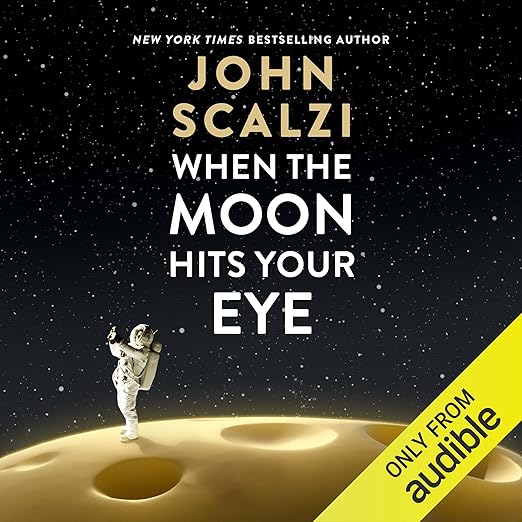
- Performance: Wil Wheaton is the sole credit on a novel with eight kinds of protagonist and no second reader to hand any of them to.
- What it covers: the impossible treated as an ordinary fact, faith and science under strain, an ensemble portrait of a species
- Feel: Playful with a grieving undertow
- Our call: Buy it for the joke and the range, avoid it if you need a protagonist or a plot that builds toward something.
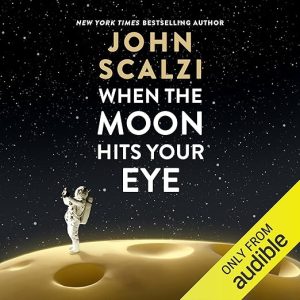
Absurdity is easy to set up and very hard to sustain, which is the whole problem this audiobook takes on. The moon has turned into cheese. John Scalzi states it in two sentences, offers no mechanism, and spends the next ten hours on the only question that seems to interest him: what a species actually does when the impossible becomes a fact it has to live beside.
Is When the Moon Hits Your Eye Worth Your Time?
Structure is both the risk and the design. Over a single lunar cycle the novel hands its microphone to astronauts and billionaires, comedians and bank executives, professors and presidents, teenagers and patients at the end of their lives. Each gets a turn, then goes. Some treat the moon as an opportunity, some as a crisis of faith in God or in science or in everything, and some just try to keep the lights on.
Listening advice arrives from an unexpected direction. A. Rutter's July 2025 five-star tells you to pay attention to the names of people, places and businesses, because that is where the subtle chuckles are hidden, and the same response flags Day Twenty-One as the point where the prose turns philosophical. On paper you can stop and reread a sign. Spoken, a buried pun goes past at talking speed and either lands or vanishes.
Numbers on this listing do not work. The rating counter shows two ratings while five people have written full responses, grading it three, four, four, five and five. Two whole-star votes can only average four, four and a half, or five, so the 4.1 on display cannot have come from them. Whatever produced that figure, it is not the pool you can actually read, which comes to 4.2.
Rick M. Cook's March 2026 five-star makes the comparison that matters, arguing that comedy inside science fiction is close to impossible and that Douglas Adams stands as the proof it can be done at all. Adding Scalzi to that shelf is a large claim. It is also the right frame for a buying decision, because this is one joke sustained at novel length, and the only question is whether the joke holds.
Breadth is what you get in exchange for plot. Handing a global event to eight kinds of person and letting each respond in character produces a survey of a species rather than a story about individuals, and when it works the effect accumulates: a president and a dying patient answer the same question in incompatible registers. Comedy about institutions under strain is what the premise generates, and institutions are exactly what a cheese moon breaks.
Wil Wheaton reads it, and the assignment is register control rather than character work. A chapter ends, a new location opens with a new cast and a new problem, and nothing marks the change except the voice making it. No interstitials, no second reader, no shared cast to spread the load across a full lunar cycle of separate episodes. Sample two consecutive chapter openings and listen for how far apart they sound.
Before You Commit to When the Moon Hits Your Eye
Auton's January 2026 three-star is the honest counterweight, and it comes from somebody who lists Kaiju Preservation Society, Starter Villain, Android's Dream, the Dispatcher and Lock In among their favorites. The complaint is not the premise. It is that most chapters function as one-off vignettes with little character development, and that the implausibility spreads well past the moon itself.
Tonal range needs weighing too. The description promises panic, planning, wonder, prayer, laughter and grief inside one book, which is a great deal of gear-changing for a comic novel to survive. Some listeners will decide the grief chapters earn the silliness; others will feel the handbrake go on. Neither reaction is wrong, and a sample drawn from the front cannot tell you which one you are.
Mechanism never arrives, and the copy is honest about that in its own way. A moon made of cheese, a species obliged to cope, and no third sentence of explanation offered anywhere. If you are the sort of listener who needs a rule for how a world works before you can enjoy watching it break, this is a long stretch to spend waiting for a rule that was never coming.
Genre shelving oversells the science. This sits under science fiction, and that label will pull in people expecting speculation with rigor behind it, when the actual mode is closer to a fable furnished with modern objects. Nothing is wrong with the mode. But a buyer arriving from hard SF, finding a cheese moon treated as a comic given rather than an engineering problem, has been mis-sold by the shelf rather than by the author.
Should You Listen to When the Moon Hits Your Eye?
Comic science fiction is a narrow taste and this lands squarely inside it. If the author's recent standalone comedies worked for you, the odds here are good. If you enjoy ensemble structure, where nobody is the protagonist and the pleasure comes from the pattern rather than from any single arc, that is precisely the shape of the thing you would be buying.
Richard Irwin's October 2025 four-star describes the path most doubters take: hesitation at the description, a memory of being equally hesitant about the previous book and loving it anyway, then a purchase and no regret. What settled it, according to that response, is that Scalzi plays the premise straight instead of winking at it. If your resistance is to the pitch rather than to the author, weigh that.
Look elsewhere if you want plot momentum, a protagonist to follow, or science that behaves itself. Anybody who needs character development will find the ensemble design working directly against them, since a chapter runs exactly long enough to like somebody and then lose them. Play the sample twice, once from the opening and once from further along, because a book built out of separate rooms cannot be judged from the first room.
Does the audiobook hold together when a new cast arrives every chapter?
That is the real structural question. One reader has to reset location, cast and tone at every chapter break, with no interstitial music and no second voice to hand off to, across a full cycle of separate episodes. Whether it works depends on how far apart two consecutive openings sound, which the sample will answer quickly.
Which chapters did readers single out as the strongest?
The February 6, 2026 four-star names two: one set in Vegas, and one about a writer of, in that response's own phrasing, a het fantasy world. The same account credits the book with putting every chapter in a different place with different problems, and grants that making each of them interesting must have been difficult work.
Should you know the author's other books before starting this audiobook?
No. Nothing carries over and the premise explains itself in two sentences. Familiarity helps in one respect only: the comic register sits close to the recent standalone comedies, so anybody who bounced off those will likely bounce off this. A newcomer loses a point of comparison and nothing else.
Does the story ever explain how the moon turned to cheese?
No, and the description never pretends otherwise. The transformation is stated as a fact and everything proceeds from there, which means the subject is the reaction rather than the cause. Anybody who needs a mechanism before they can invest in a premise should know going in that none is ever supplied.