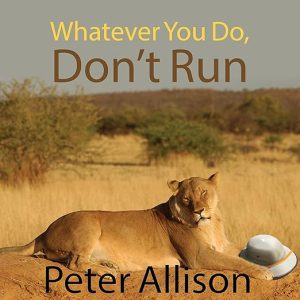
Whatever You Do, Don't Run by Peter Allison presents a specific puzzle for the reviewer: how do you write about a book whose humor depends almost entirely on delivery, timing, and the careful understatement of situations that could have been fatal? The answer, it turns out, is that you do not need to worry. Allison is a natural storyteller, and Antony Ferguson's narration honors the timing with exactly the wry restraint the material requires. This audiobook, based on Allison's collection of true stories from his years guiding safaris in Botswana, is consistently funny in the way that genuine near-death experience processed by a person with excellent comedic instincts tends to be funny.
The Review
Each chapter in Whatever You Do, Don't Run is a self-contained incident, which makes the audiobook's structure pleasingly flexible. You could listen in order, in which case the cumulative effect of Allison's escalating encounters builds a picture of a man who has been charged by lions twice, driven a Land Rover full of tourists into a lagoon full of hippos, and adopted what the synopsis describes as the most vicious animal in Africa as a pet. Or you could dip in and out, since each chapter works on its own terms. Both approaches work, and the episodic structure means the audiobook is easy to re-enter after interruptions.
What makes the book more than a string of funny animal stories is Allison's genuine affection for Botswana and for the wildlife he has spent his career navigating around. Reviewers have noted that the book lets them enjoy the author's adventures with wildlife without getting upset, which is a real achievement in a genre that often tips into either cheap sentiment or exploitative peril. Allison clearly loves these animals, which is why the encounters feel like mishaps rather than confrontations, and why the tourists who create the most dangerous situations are described with exasperation rather than contempt.
Why Listen to Whatever You Do, Don't Run
Antony Ferguson is a thoughtful narrator for this material. The specific register Allison's prose requires, the cultivated casualness of someone describing an elephant charge as though it were a minor scheduling inconvenience, is easy to miss in narration that is too enthusiastic or too dry. Ferguson finds the middle. His pacing gives each punchline room to land without telegraphing it, and his delivery of the tourist-behavior chapters has exactly the right amount of barely contained disbelief. At six hours and forty-five minutes, this is a comfortable listen that does not outstay its welcome.
The Caveats
The subtitle describes it as a hilarious collection of true tales, and that is accurate, but the word hilarious sets expectations that the book's actual register does not quite match. The humor is dry, observational, and built on understatement rather than on jokes with clear punchlines. Listeners looking for broad comedy or highly dramatic survival-story tension will find the tone more subdued than they might expect. The book's pleasures are quieter: Allison's precision with language, his genuine expertise, and the sense that every story is told by someone who has already made peace with the fact that it could have ended very differently.
The chapter structure means there is no overarching narrative arc building toward a climax. This is a feature if you want something easy to consume in short sessions; it is a limitation if you prefer audiobooks with sustained narrative momentum. Reviewers who noted it is an easy book to pick up and put down were observing this structure appreciatively, but listeners who need forward drive to stay engaged may find the collection episodic in a way that works against sustained listening.
What Allison has that many travel writers lack is earned authority. His accounts of charging lions and hippo-filled lagoons are not the experiences of a journalist who flew in for a week. They are the accumulated incidents of a career spent in a specific place with specific knowledge of that place's animals and terrain. That expertise shows in the precise details he chooses to include and the professional assessments that underlie even his funniest observations. The title itself is one such piece of advice: when confronted with a large predator, the instinct to run is both understandable and potentially fatal, and Allison knows this from experience rather than from a field guide. The comedy in the book is consistently rooted in this knowledge gap between the guide and the tourists, and it works because Allison never positions himself as superior to the tourists for not knowing what he knows. He was once in the position of not knowing. His patience with their ignorance, even when that ignorance puts him in genuine danger, is one of the book's quietly admirable qualities, and Antony Ferguson's narration carries that generosity throughout.
Who Should Pick Up Whatever You Do, Don't Run
Wildlife enthusiasts who want their safari stories told with genuine expertise and dry comedy will find Allison one of the better practitioners of this particular niche. Listeners who enjoy travel writing with a comedic sensibility, particularly around the specific absurdities of wildlife tourism, will find this exactly pitched to that appetite. Anyone who has ever been on safari and wondered what the guide was actually thinking will get considerable satisfaction from this account.
Skip if you want dramatic survival narrative with high tension and emotional stakes. Allison defuses his own stories with humor rather than amplifying them for effect, which means the audiobook consistently chooses wit over drama. Listeners who wanted something closer to the sustained peril of a wilderness-survival memoir will find the register here too relaxed. But for what it is, a skilled guide's affectionate and funny account of a career spent in close proximity to animals that could kill him, Whatever You Do, Don't Run delivers precisely what it promises.
Frequently Asked Questions
How does Antony Ferguson's narration suit the comedic tone of the audiobook?
Ferguson uses an unhurried, wry delivery that honors Allison's understatement. The humor in these stories depends on timing and a casual attitude toward situations that were actually dangerous, and Ferguson reads them with exactly the right degree of dry restraint. He does not push the comedy or play up the peril, which lets both land more naturally.
Can I listen to individual chapters of this audiobook without following the full sequence?
Yes. Each chapter is a self-contained story about a specific incident, and the book has no overarching plot that requires sequential listening. You can dip in and out, or listen in full. Multiple reviewers mentioned it as an easy book to pick up and put down, which reflects the episodic structure.