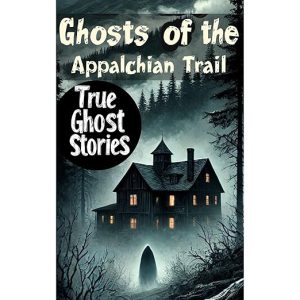
Fifteen stories across eight hours and ten minutes works out at roughly half an hour of ghost per sitting, which is close to the ideal shape for an audiobook of this kind. The Appalachian Trail runs through fog, hollows and abandoned cabins, and it has accumulated the folklore that terrain like that always accumulates: whispers in the trees, figures standing between trunks, people who walked in and never walked out. Ethan Blackwood has collected the results and rebuilt them.
Our Take on Ghosts of the Appalachian Trail
Appalachia is the reason this collection has material to work with. Mountain communities kept oral tradition alive longer than most of the country did, the terrain isolates, and the weather performs half the atmospheric labor before anybody opens their mouth. The stories range across haunted cabins, disappearances that were never explained, and encounters with spirits described as unwilling to rest, which is the standard taxonomy of regional ghost lore, competently divided up.
Thirty-two minutes per story is the arithmetic, and it tells you what kind of book this is. That is long enough for an actual narrative with a setup, a witness and a reversal, and far too long for a campfire anecdote. Blackwood calls the approach immersive and narrative-driven, which in practice means each account has been rebuilt as a story rather than reported as testimony. The reconstruction is the product being sold.
Truth is the claim the author's note insists on, and it deserves flagging before anybody buys. The note states directly that these are not folklore or campfire tales but real encounters, experienced by people who walked these trails, some handed down through generations and others coming from modern witnesses. Anyone who needs that distinction to hold will have to take it on trust, because no sourcing accompanies any of the fifteen accounts.
Synthetic speech reads all fifteen of these stories. Virtual Voice appears where a performer's name would normally sit, and that credit means the audio was generated rather than recorded. On this material the cost is heavier than it would be on a manual or a business title. Ghost stories are a performance genre. They existed as spoken forms for centuries before anyone wrote one down, and every effect they produce depends on how the telling is timed.
Silence is the specific mechanism. A ghost story works by withholding: the sentence that stops a beat too long, the description arriving slower than a listener wants it. A person telling one adjusts to the room. A speech engine applies the same interval to a whispered line and to a paragraph about weather, because the punctuation is identical and nothing else is available to it. Test the sample on a passage that builds toward a reveal.
Anthologies survive that problem better than novels do, which is the honest argument for buying this anyway. Every story restarts, so a level delivery gets fifteen fresh chances instead of one long arc to sustain. The material is also inherently structured: a place, a witness, an event, an aftermath. That structure carries a listener through a reading that a novel of the same length, in the same voice, would not manage for an hour.
What to Watch For in Ghosts of the Appalachian Trail
Checkmarks and emoji survive in the description, in a formatted block asking what is inside and answering with three ticked bullets, followed by a line telling you to get your copy today. Another line instructs you to read these terrifying tales and decide for yourself. All of it was written for a page you look at rather than a file you play, and it has been transferred across without a single word being changed.
Nobody has written anything about this release. Four ratings sit on the page, averaging 4.2, with no text attached to any of them, which is about the thinnest evidence base an eight-hour purchase can have. Four votes on a title available since March 2025 also suggests the collection has barely circulated at all, so the displayed average is less unreliable than simply meaningless.
Travel and tourism is where the catalog files this, with a regional tag for North America, and that is not what the book is. Nothing here functions as a guide. No trail sections are described for planning purposes, no logistics appear, and no practical information about walking the route is offered anywhere. A shopper browsing a travel shelf finds a horror anthology, while a horror reader looking in the right place never sees it.
Who Should Listen to Ghosts of the Appalachian Trail
Campfire-story listeners are the audience, and the format hands them one real advantage: you can play this in the dark, in a tent, with the actual trees standing outside. Regional folklore works better consumed in or near its own region, and the collection is specific enough about place for that effect to survive. Anyone who has walked any section of the trail will recognize the kind of terrain being described.
Skeptics who want sourcing should stay away, because the author's note forecloses the argument rather than engaging with it, asking only for an open mind in return. Anyone sensitive to synthetic narration should treat the sample as decisive rather than indicative, since this entire genre depends on delivery and this delivery is automated. Neither objection is unreasonable, and both are cheap to settle in advance.
Hikers planning a section are the group who will get most from it, for a reason the marketing never mentions: the stories are organized around places, and knowing the legend attached to a particular shelter or hollow changes how it feels to arrive there. Fifteen accounts, half an hour apiece, no performer and no sourcing. Judge it on the sample rather than the description, because the description was written for a different format entirely.
Common Questions
How long is each story in the Ghosts of the Appalachian Trail audiobook?
Roughly half an hour. Fifteen accounts divided across the running time gives about thirty-two minutes apiece, which is long enough for a proper narrative with a setup, a witness and a reversal, and considerably longer than a campfire anecdote needs. The author describes the approach as immersive and narrative-driven.
Are the stories presented as true?
Yes, explicitly. The author's note states that these are not folklore or campfire tales but real encounters experienced by people who walked these trails, some handed down through generations and others taken from modern witnesses. No sourcing accompanies any of the fifteen, so the claim rests entirely on the author's word.
Does synthetic narration hurt a ghost story more than other genres?
More than most, yes. Horror depends on timing above almost everything else, and a speech engine cannot lengthen the pause before a reveal or drop its volume for a whisper. The credit here reads Virtual Voice, which is a text-to-speech system rather than a person. Sample a passage that builds toward something.
Why is this audiobook filed under travel rather than horror?
A catalog error, most likely, driven by the Appalachian Trail in the title and a regional tag for North America. Nothing in the collection works as a guide: no route information, no logistics, no practical planning material of any kind. If you found it while shopping for a trail book, you found a ghost anthology instead.