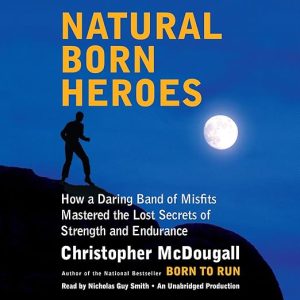
I picked up Natural Born Heroes expecting it to be Born to Run's sequel, a book about running, reframed around a different athletic philosophy. What I got instead was something considerably stranger: a WWII espionage narrative about a penniless artist, a young shepherd, and a playboy poet kidnapping a German general off the island of Crete, intercut with chapters on parkour, ancestral nutrition, fascia research, and the training practices of British special forces. It should not hold together. The fact that it mostly does is a function of McDougall's ability to make almost anything feel urgent.
Nicholas Guy Smith is the right narrator for this material. He handles the historical narrative with the pace and urgency of a thriller, then downshifts effectively for the more reflective fitness-philosophy chapters. At nearly fourteen hours, the book is long, and Smith's range keeps the different registers of the material from bleeding into each other.
Is Natural Born Heroes Worth Your Time?
The WWII backbone of the book is legitimately extraordinary. Patrick Leigh Fermor, the playboy poet, is one of history's more improbable action heroes, a literary wanderer who ended up leading one of the war's most audacious operations from inside a Nazi-occupied island. The kidnapping of General Kreipe in 1944, carried out with a handful of Cretan resistance fighters and a level of improvisation that should have gotten everyone killed, is a story that earns its telling.
McDougall uses this story as a lens for examining what the ancient Greeks called heroism, not a quality of character but a set of physical and mental skills: endurance, natural movement, efficient nutrition, the ability to navigate unfamiliar terrain under pressure. His argument is that these skills were not exceptional in the ancient world; they were ordinary. And that the modern gym-and-diet-plan industrial complex has replaced them with something simultaneously more complicated and less effective.
The most compelling sections of the audiobook are the ones where the two threads converge, where McDougall connects the Cretan resistance fighters' ability to move silently over mountain terrain at night to the natural movement research being done by contemporary practitioners. The through-line between ancient heroic practice and modern athletic philosophy is the book's genuine intellectual contribution, and when it is working, it is exciting in the way that only good nonfiction can be.
One reviewer described it as just as if Quentin Tarantino wrote a fitness book, and that is not an inaccurate summary of the tonal ambition. McDougall wants the historical narrative to be thrilling, the science to be credible, and the personal journey of retracing the resistance fighters' steps to be transformative. He achieves at least two of those three goals consistently.
Before You Commit to Natural Born Heroes
The book's structural weakness is its refusal to stay focused. Several reviewers noted that the chapters skip between the Cretan resistance story, modern fitness experts, nutritional philosophy, and McDougall's own training experiments in ways that interrupt the momentum of the historical narrative. If you are primarily there for the WWII story, and many listeners will be, the fitness-philosophy interludes can feel like a detour rather than a discovery.
The nutritional sections have also dated unevenly. McDougall's enthusiasm for low-carb, high-fat approaches reflects the dietary conversation of the early 2010s rather than current nutritional science. The information has not been superseded in every respect, but it should be taken as a starting point for research rather than a settled conclusion.
Should You Listen to Natural Born Heroes?
History enthusiasts with an interest in WWII resistance movements will find the Cretan narrative genuinely compelling, particularly if they have any prior interest in Patrick Leigh Fermor's remarkable life. Readers of Born to Run who want more McDougall will find his voice and his method recognizable, though the subject matter is considerably further from a running track this time.
If your patience for intercut narratives is limited, if you want either the WWII story or the fitness philosophy fully, not braided together, this may be a frustrating listen. The book requires you to trust McDougall that both threads are going somewhere together. Most listeners who make that commitment report the investment was worth it.
Common Questions
Do you need to have read Born to Run to get something from Natural Born Heroes?
No prior McDougall background is required. Natural Born Heroes stands entirely on its own. Born to Run is about barefoot running culture; Natural Born Heroes covers WWII history and ancestral movement philosophy. They share an author and a sensibility but not a subject.
How accurate is the WWII historical narrative about the kidnapping of General Kreipe?
The core events are well-documented history. Patrick Leigh Fermor's memoir and multiple historical accounts verify the kidnapping operation. McDougall's rendering is narrative nonfiction rather than dry history, so he reconstructs dialogue and atmosphere, but the events themselves have a firm historical basis.
Does Nicholas Guy Smith's narration work for both the historical thriller sections and the fitness-philosophy sections?
Yes. Smith adjusts his register between the action-forward historical narrative and the more reflective athletic philosophy chapters effectively. The fourteen-hour runtime benefits from his range, the book needs a narrator who can sustain momentum across very different types of content, and he manages it.