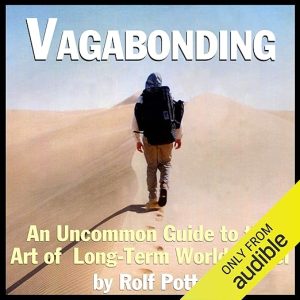
Vagabonding opens with a premise that is simultaneously obvious and radical: the obstacle between most people and extended travel is not money but the unexamined assumption that work and home represent the only legitimate organization of adult life. The audiobook, which Rolf Potts narrates himself in just over four hours, does not spend long on this premise before moving into practical territory, but that framing remains operative throughout. It is why this book has stayed in active circulation for more than two decades, passed between travelers the way useful things get passed.
Potts narrates his own material with the slight deliberateness of someone thinking through sentences as he delivers them rather than performing a finished text, which is precisely the register this content requires. The book's authority derives entirely from personal experience rather than institutional credential, and hearing Potts deliver his own advice reinforces that authority in a way that hired narration cannot replicate. When he talks about adjusting to life on the road or handling travel adversity, he is talking about things he has done repeatedly, and that accumulated experience is audible.
Where This One Lands
Potts is careful to define his terms early. Vagabonding, as he uses the word, means taking extended time off from normal life to travel on one's own terms; he specifies a range of six weeks to four months to two years, which is broad enough to include a sabbatical year and specific enough to exclude weekend trips. This is not a book about luxury travel or packaged tourism, nor is it a survivalist guide to traveling with nothing. It occupies the specific space of long-term, low-budget, independent travel, and it is designed for people who are considering that kind of trip for the first time.
One reviewer describes it as "a roadmap to living life more fully through the lens of extended travel," and that is an accurate summary of the book's ambition. But Potts does not rely on inspirational rhetoric to make his case; he relies on practical information. The chapters on financing travel time, determining destination, and working or volunteering overseas are detailed and applicable. A reviewer who notes that Potts "deals with all potential issues of long-term travel" and "lists tremendous resources" is describing the actual architecture of the book: it moves systematically through the genuine logistical obstacles that prevent people from attempting extended travel, addressing each with specific strategies rather than generalized encouragement.
The section on reassimilation is the one that surprises most listeners who come to the book for departure planning. Potts takes the return journey as seriously as the outbound one, which reflects his understanding that vagabonding is not an escape from life but a different mode of living it. The practical advice on maintaining financial flexibility, not over-planning re-entry, and managing the disorientation of return is underrepresented in the broader travel writing genre and is among the most useful material in the audiobook.
The self-narration is a significant asset. Potts reads with the deliberateness of someone who is thinking through the sentences as he delivers them, which is the register of personal advice rather than performance. This suits Vagabonding precisely because the book's authority derives entirely from personal experience. A hired narrator would deliver the same words, but the voice carrying them would be someone who had not crossed a land border with a backpack and a thin travel budget. The difference is not theatrical; it is epistemic. The voice that has done the thing and the voice that has read about the thing are different in a way that audio makes audible.
At four hours and nine minutes, this is a short audiobook relative to its scope. Potts writes with compression; he does not pad chapters with anecdotes past the point of usefulness. The material it covers in four hours would take a more discursive writer twice as long. Some listeners who want more granular destination advice may find the book too general, but Potts is explicit that Vagabonding is a philosophy of travel rather than a destination guide, and the brevity is consistent with that intention.
Before You Commit to Vagabonding
The sections on working and volunteering overseas are worth close attention for listeners who are uncertain whether long-term travel is financially feasible for them. Potts is realistic about the income options available to travelers and does not oversell the possibilities, but he maps the territory clearly enough to allow listeners to assess their own situations against it.
The philosophical framing that runs throughout the book, the argument that time is the real currency of travel and that the primary barrier to buying it is not money but the assumptions people make about what counts as a legitimate use of adult life, is the part that stays with listeners long after the practical chapters. Tim Ferriss, who recommended Vagabonding in The 4-Hour Workweek, was responding to precisely this reframing. The book belongs on the same shelf as Paul Theroux's The Great Railway Bazaar in the travel canon, but it serves a different reader: not the reader who wants to be told what travel feels like, but the reader who wants to know how to actually do it.
Recommended For
This audiobook is for people who are genuinely considering extended travel and want a pragmatic framework for thinking about it rather than an inspirational push. A reviewer correctly identifies it as designed for those who have never traveled in the long-term independent sense, and that is its primary audience. Experienced long-term travelers will recognize most of the practical content, though the philosophical framing may still be useful as a way of articulating what they already know instinctively. Those looking for destination-specific guidance or travel writing in the literary tradition will need to look elsewhere; Vagabonding is a different kind of book for a different kind of reader.
Before You Listen
Does Rolf Potts narrating his own audiobook add to the experience?
Yes, meaningfully. The book's authority rests on lived experience, and hearing Potts deliver his own advice in his own voice reinforces that authority in a way that hired narration cannot replicate. The reading style is deliberate rather than theatrical, which suits the conversational tone of the text.
Is the Vagabonding audiobook still relevant given how much travel logistics have changed since 2002?
The philosophical framework and the section on mindset are as applicable as ever. The specific resources Potts references have evolved, but the book's core argument about how to fund travel time, how to adjust to life on the road, and how to handle the return home operates at a level of abstraction that does not depend on any specific app or platform.
How does this audiobook compare to travel memoirs like the ones Tim Ferriss recommends in The 4-Hour Workweek?
Ferriss actually recommends Vagabonding in his book, and the two titles address adjacent territory: both argue that extended time outside conventional work structures is achievable with deliberate preparation. But Potts is less focused on productivity optimization and more focused on the experience of travel itself as a value, which makes Vagabonding a somewhat quieter and more philosophically serious companion to Ferriss's more entrepreneurial frame.